On May 14, 2026, Edward Busby became the 600th person executed in Texas in the last 50 years. A three-judge panel of the United States Court of Appeals for the Fifth Circuit had temporarily stayed his execution, but the U.S. Supreme Court lifted the stay, allowing the execution to proceed. Mr. Busby is a person whom all experts agree has intellectual disability, and he should therefore have been legally ineligible for execution.
Mr. Busby’s case is illustrative of several patterns that show how the death penalty is used in Texas and nationally:
| Trend/Fact | Edward Busby | Texas | Nationally |
|---|---|---|---|
| Intellectual Disability | State and defense experts agree he has intellectual disability | Three of the five people executed in 2025 had evidence of intellectual disability, brain damage, or low IQ. | 25 of the 47 people executed in 2025 (53%) had evidence of intellectual disability, brain damage, or low IQ. |
| Time on Death Row | 21 years on death row | People executed in 2025 spent an average of just under 16 years on death row. | People executed in 2025 spent an average of 27 years on death row. |
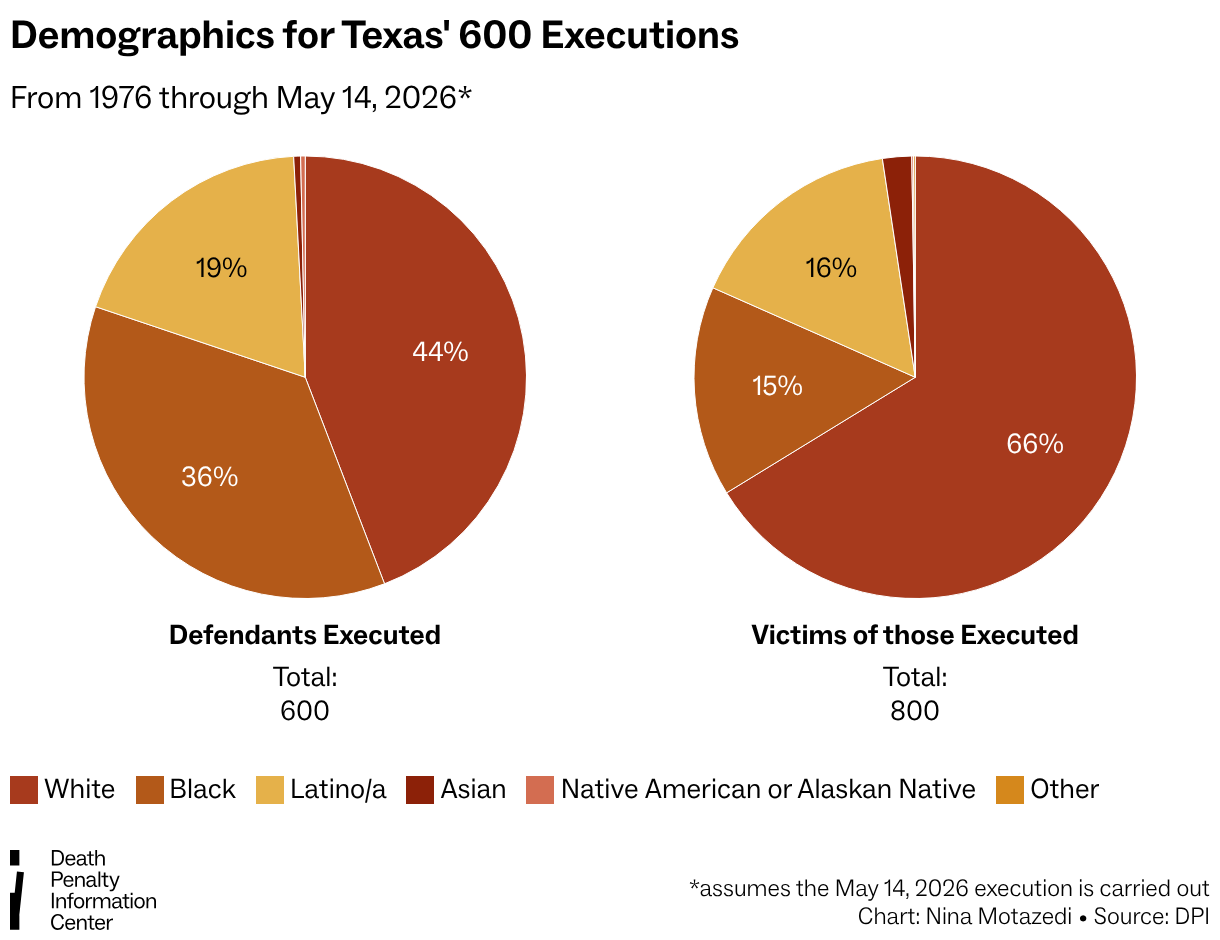
| Race | A Black man convicted of killing a white woman | 215 of the 599 people executed in Texas (35.8%) were Black. 55.8% were people of color. 69.7% of people executed in Texas were convicted of killing at least one white victim. | 34% of people executed in the U.S. were Black. 44% were people of color. 78% of the victims were white. |
| Geographically Isolated Use | Sentenced to death in Tarrant County, which is responsible for 48 of Texas’ 599 executions (8%) | 136 people who were sentenced in Harris County have been executed, the most of any county in the nation. Four counties (Harris, Dallas, Bexar, and Tarrant) are responsible for half (298) of all executions in Texas. | Texas has executed more than four times as many people as any other state and is responsible for 36% of all executions. Florida has executed 131 people and Oklahoma has executed 130 people. Harris County alone has executed more people than any state outside Texas. |
Declining Use of the Death Penalty
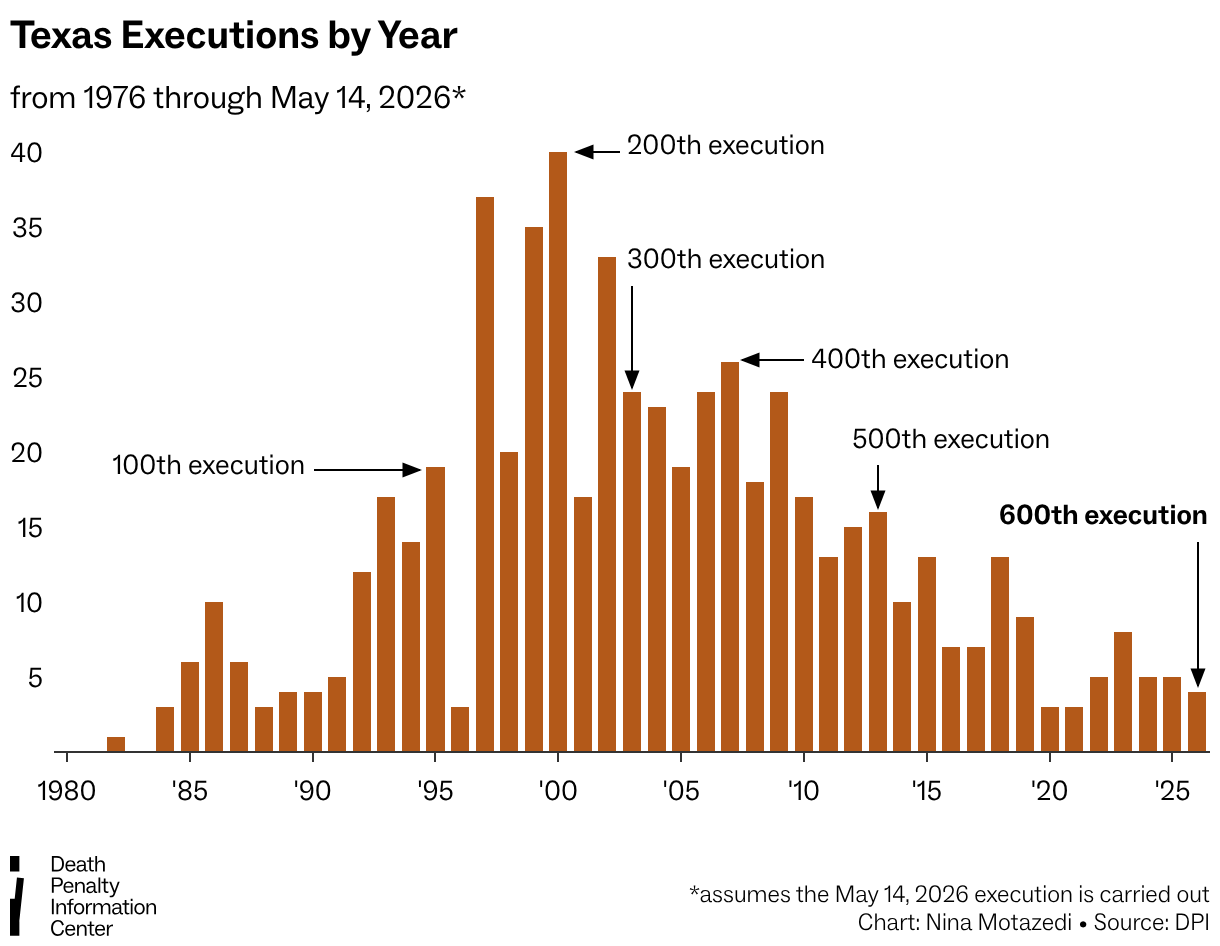
This milestone in Texas’ use of the death penalty highlights the state’s changing approach to capital punishment. Although Texas remains the national leader in the total number of executions in the modern era, its pace has slowed dramatically in recent years. Texas’ first execution in the modern era took place on December 7, 1982. In the early years, Texas carried out its first 100 executions in just under 13 years (12/7/82 – 10/4/95). The next 100 executions occurred in just over 4 years (12/6/95 – 1/12/2000). That period also marked the heaviest use of the death penalty across the U.S. In 2000, Texas carried out 40 executions, the most ever carried out by a single state in a single year. It reached 300 executions on March 20, 2003, executing 100 prisoners in just over three years. Execution number 400 took place on August 22, 2007, four years and five months later. Thereafter, the pace of executions began to slow, and Kimberly McCarthy became the 500th person executed in Texas on June 26, 2013, almost six years after the 400th execution.
It has been nearly 13 years since that 500th execution, evidence of the remarkable change in how and when Texas uses the death penalty. The drop in numbers of new death sentences has mirrored the decline in executions, reflecting changes in the law and a growing discomfort with the death penalty. Where Texas juries once imposed 48 death sentences in a single year (1999), in the past decade juries have chosen life sentences far more often. Just 38 people have been sentenced to death since 2016.
Texas is also no longer the epicenter of the American death penalty. Just once since 2020 has Texas performed more executions than any other state. In 2025, Florida became the extreme outlier with 19 executions. Texas’ five executions represented just 10.6% of the national total for the year.
Geographic Isolation
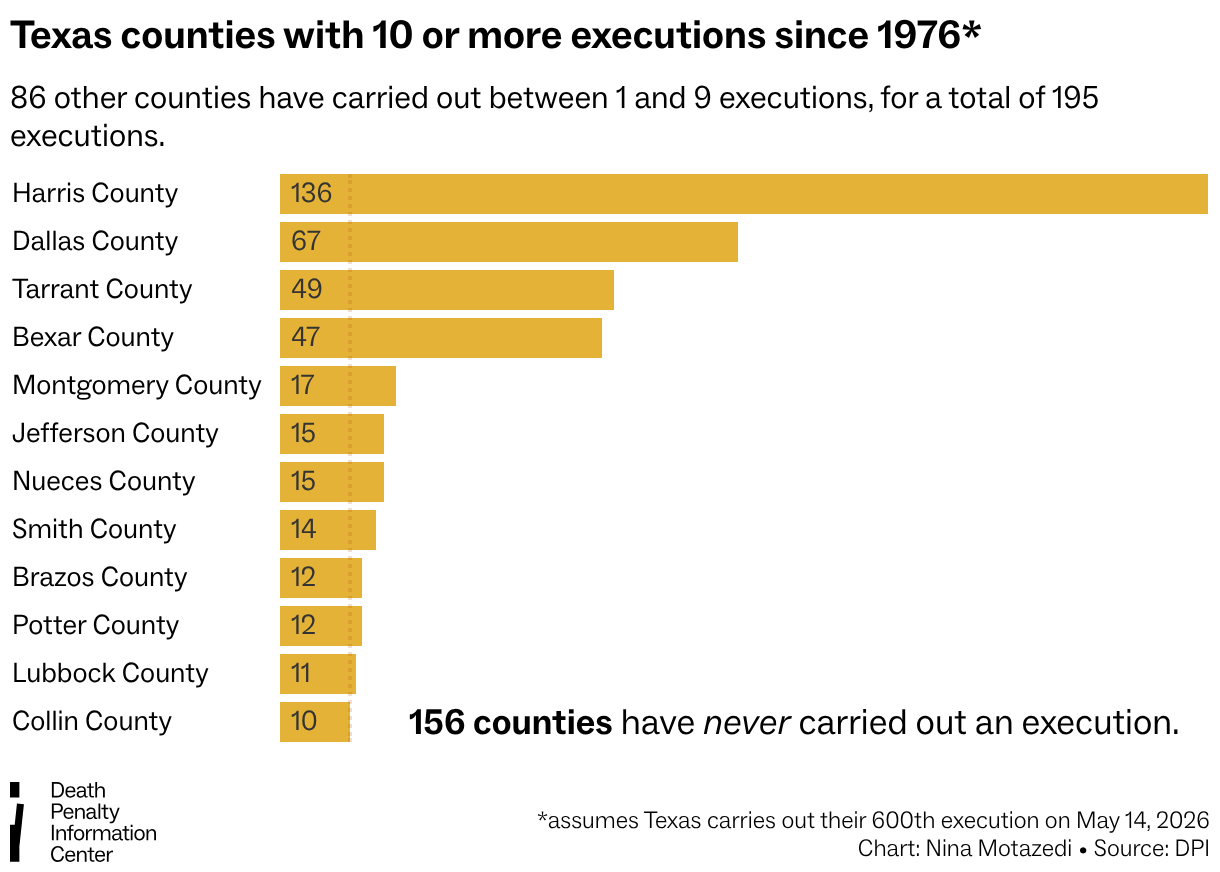
Use of the death penalty has always been geographically isolated in Texas, a trend that is becoming more evident as use declines. More than half of the state’s 254 counties have never imposed a death sentence. Three counties (Harris, Tarrant, and Dallas) account for more than half of the people currently on death row. A recent report by the Texas Defender Service found that Tarrant County, which represents just 7% of the state’s population, has accounted for nearly a quarter of all death penalty trials in Texas since 2020. The racial disparities in Tarrant County are striking. Since 2012, Tarrant County prosecutors have sought the death penalty against 13 people. Twelve of those defendants were people of color. Mr. Busby, who is Black, was sentenced to death in Tarrant County in 2005.
Vulnerable Groups
Many of the 600 people executed in Texas belonged to vulnerable groups that later secured constitutional protections. Texas led the country in the executions of juveniles prior to the U.S. Supreme Court’s 2005 decision in Roper v. Simmons, which barred the death penalty for defendants who committed crimes before age 18. Thirteen of the 22 juvenile defendants executed before Roper (59%) were executed in Texas.
Of the 44 documented cases of people with intellectual disability executed prior to the Supreme Court’s decision in Atkins v. Virginia (2002), nine (20%) were in Texas. The U.S. Supreme Court struck down the death penalty for people with intellectual disability in that decision but gave states the discretion to set their own procedures for determining who had intellectual disability. Texas adopted a set of unique and unscientific criteria known as the “Briseño factors” (named after the Texas court decision that announced them) to determine whether a capital defendant had deficits in adaptive functioning that would make them ineligible for the death penalty. The U.S. Supreme Court unanimously struck down that standard in 2017 in Moore v. Texas and required states to use criteria “informed by the medical community’s diagnostic framework.” As of 2021, at least 25 people have been resentenced due to their intellectual disability, but defendants like Mr. Busby still face procedural and legal hurdles to obtaining relief, even when multiple experts agree that they should be exempt from execution.
A 2021 study by Joseph Margulies, John Blume, and Sheri Johnson found that Texas also executed at least 95 people under a sentencing scheme that unconstitutionally prevented juries from considering mitigating evidence outside the limited context of three statutorily defined questions. According to the authors, those 95 prisoners presented claims that were “indistinguishable from claims that have gotten relief in the state or federal courts.” Their only fault was timing – courts had not acknowledged the flaws in the sentencing scheme at the time of their executions.
Economic and Human Costs
Estimates of the cost of Texas’ death penalty vary significantly. A 1992 study by the Dallas Morning News estimated that Texas spent $2.3 million per case. In 2025, El Paso County dropped its attempt to obtain a death sentence for Patrick Crusius, who pleaded guilty to killing 23 people at an El Paso Walmart in 2019. Without even going to trial, the case had cost taxpayers nearly $6 million. Also in 2025, the Houston Chronicle reported the defense costs alone in one Harris County death penalty case had reached $1.8 million. Prosecutors did not respond to public records requests for their spending on the trial.
Using the 1992 estimate of $2.3 million per case, which is conservative in light of more recent cost data, Texas has spent approximately $1.38 billion on 600 executions. That figure does not include the costs associated with the more than 500 people who were sentenced to death in Texas but died on death row, had their conviction or sentence overturned, were exonerated, or remain on death row today. It also cannot calculate the high cost of the many death penalty trials that did not end in a death sentence.
In addition to the monetary costs of the death penalty are the human costs that cannot be so easily tabulated. Each of the 600 people executed faced a jury of 12 members from their community. The approximately 7,200 Texans who served on those juries were subjected to extensive evidence of violent crimes and heartbreaking grief, an experience many jurors described as uniquely traumatizing. Jurors also bear the weight of determining whether another human being should live or die. A 2025 New York Times report described the “vicarious trauma” experienced by up to 50% of jurors in violent criminal cases, which can manifest in symptoms like sleeplessness and anxiety. The psychological toll of executions on corrections officers is well-documented, including reports of Post-Traumatic Stress Disorder, depression, and even suicide among the prison officials tasked with executing prisoners.
Conclusion
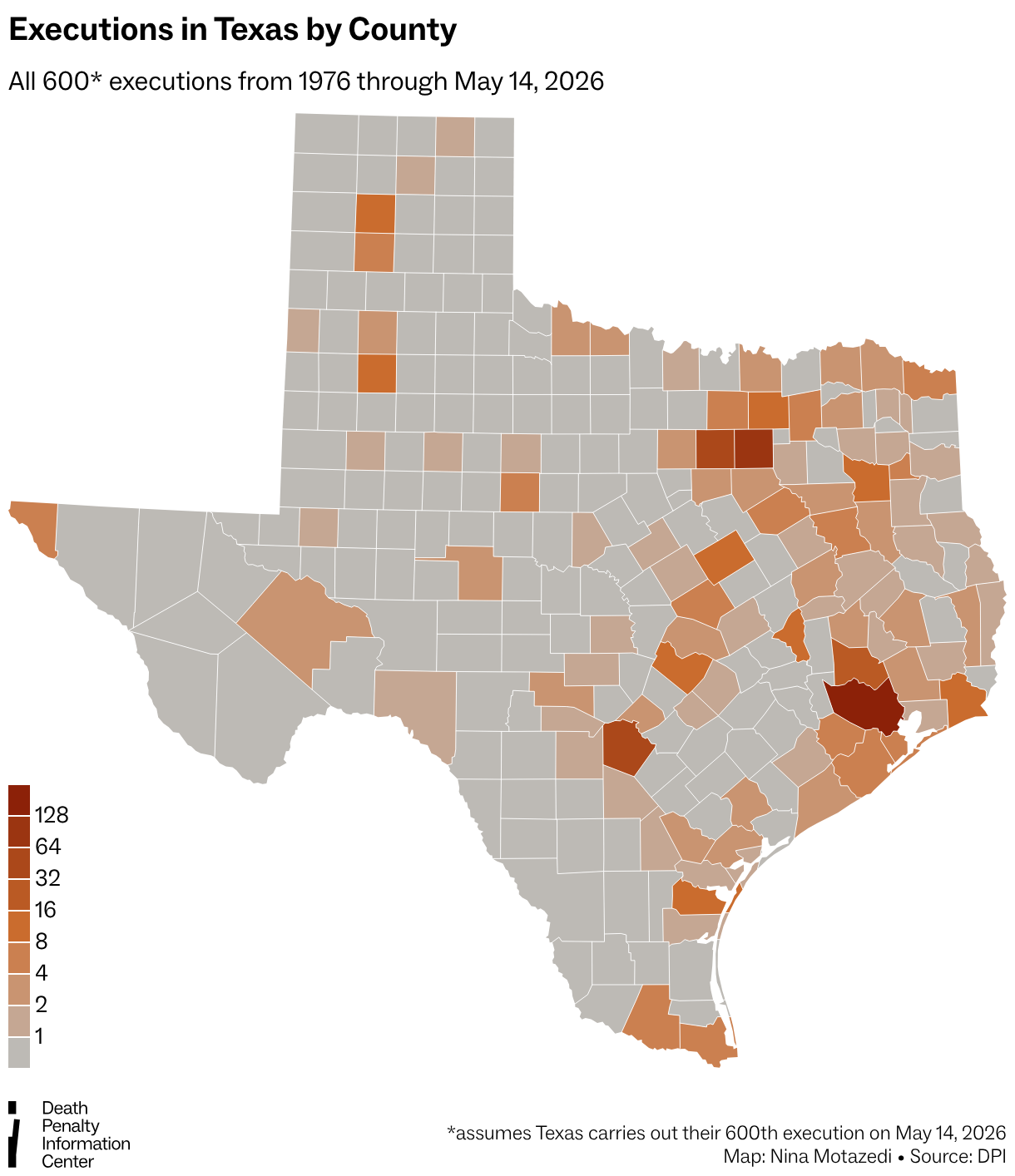
For decades, Texas stood apart from the rest of the country with its heavy use of the death penalty. As it reaches the milestone of 600 executions, Texas now appears to be falling in line with broader national trends. Like use of the death penalty nationally, which is heavily concentrated in a minority of states, Texas’ death penalty is isolated in a handful of counties. Like the U.S. death penalty, which has declined in both popularity and use over the last 25 years, Texas’ death sentences and executions have slowed to a fraction of their former numbers. Like the U.S. death penalty, Texas’ death penalty can be characterized by racial bias, arbitrariness, and high costs.
- Holsinger, A. (2026, May 18). A Man With Intellectual Disability Was the 600th Person Executed in Texas. Death Penalty Information Center. Retrieved October 22, 2026, from https://deathpenaltyinfo.org/news/will-a-person-with-intellectual-disability-become-texas-600th-execution-in-the-modern-era
- Holsinger, Anne. “A Man With Intellectual Disability Was the 600th Person Executed in Texas.” Death Penalty Information Center. Last modified May 18, 2026. Accessed October 22, 2026. https://deathpenaltyinfo.org/news/will-a-person-with-intellectual-disability-become-texas-600th-execution-in-the-modern-era.
- Holsinger, Anne. “A Man With Intellectual Disability Was the 600th Person Executed in Texas.” Death Penalty Information Center, 18 May 2026, https://deathpenaltyinfo.org/news/will-a-person-with-intellectual-disability-become-texas-600th-execution-in-the-modern-era. Accessed 22 Oct. 2026.
Nicole Hensley, County spent $1.8M in man’s death penalty trial defense, Houston Chronicle, May 31, 2025; Robert Moore, How the El Paso Walmart shooting prosecution cost $6 million, even without a trial, El Paso Matters, May 14, 2025; An Extreme Outlier: Race and the Death Penalty in Tarrant County, Texas’s Third-Largest County, Texas Defender Service, May 2026; Death Penalty at the County Level, Texas Coalition to Abolish the Death Penalty