History

Calvin Goddard analyzing ballistics evidence.
Smithsonian Institution Archives, Accession 90 – 105, Science Service Records, Image No. SIA2007-0458
The formal use of firearm identification in U.S. courts dates to the late 19th century, with one of the earliest documented cases occurring in 1879, when a bullet was matched to a specific weapon. By the early 1900s, forensic examiners began recognizing that firearms leave unique markings on bullets and that cartridge cases could be used for identification purposes. Calvin Goddard, considered a pioneer in forensic ballistics, helped establish the Bureau of Forensic Ballistics in New York City in 1925.
The formalization of ballistics analysis accelerated when the FBI established its crime laboratory in 1932, which included a dedicated firearms identification unit. During this period, courts increasingly accepted ballistic evidence under the Frye standard (established in 1923), which required general acceptance within the relevant scientific community. The field became more formalized with the creation of the Association of Firearm and Tool Mark Examiners (AFTE) in 1969, which brought standardization to the field.
From the 1970s through the 1990s, forensic ballistics saw evolving techniques. Comparison microscopes became standard equipment for tool mark examiners, and the AFTE developed formal theory and criteria for identification. Courts generally accepted firearms and tool mark evidence with limited scientific scrutiny, and the first computerized ballistic imaging systems were introduced in the 1990s. The Daubert standard established in 1993 resulted in increased scrutiny of ballistics evidence and raised the bar by requiring scientific reliability, not just general acceptance. The 2009 National Academy of Sciences report Strengthening Forensic Science in the United States questioned the scientific foundation of firearm analysis, and the President’s Council of Advisors on Science and Technology (PCAST) report in 2016 further criticized the empirical basis of forensic ballistics.
Several notable cases have shaped the evolution of ballistics evidence, including People v. Fisher (1926), which represented early acceptance of firearms evidence in New York. More recent cases like United States v. Monteiro (2006) and United States v. Tibbs (2019) have raised concerns about whether specific firearms can actually be individually identified and connected by the markings left on bullets.
The 2023 Maryland case (non-capital), Kobina Ebo Abruquah v. State of Maryland, represents a significant challenge to traditional ballistics testimony. The Maryland Court of Appeals ruled that a firearms examiner in this case overstepped scientific boundaries by testifying with “practical certainty” that recovered shell casings matched the defendant’s firearm. The court found that such a categorical conclusion lacked sufficient scientific foundation and potentially misled the jury about the reliability of the evidence. The ruling established new standards for Maryland courts, requiring examiners to acknowledge the limitations of their methodology and prohibiting testimony that claimed to match a firearm “to the exclusion of all other firearms in the world.” This landmark decision aligns with the growing judicial skepticism of pattern-matching disciplines.
Standard of Care
Firearm and tool-mark analysts specialize in the examination of firearms, ammunition, and related evidence that establish connections between weapons and crimes. The starting point for examiners is to document physical characteristics of a recovered firearm: make, model, caliber, serial number, and any modifications. Examiners then conduct test firings in controlled environments (typically within a water tank) to generate reference samples of bullets and cartridge cases. These known samples are then compared with the evidence recovered from a crime scene using a comparison microscope that allows for simultaneous examination of both bullets and cases.

Cartridge casings under a comparison microscope.
The foundation of firearms identification is uniqueness — each firearm leaves distinctive markings on fired ammunition. Rifling, a critical feature in firearms barrels, consists of spiral lands and grooves machined into the interior of the barrel. Lands are the raised portions that protrude into the barrel, while the grooves are the recessed sections between lands. As a bullet travels through a barrel, the lands and grooves allow the projectile to spin, improving accuracy and stability. The lands and grooves leave unique striation patterns on a bullet’s surface. Examiners can measure the number of lands and grooves, their width, and the direction of twist (right-hand or left-hand rifling).
Right-hand rifling causes the bullet to rotate clockwise as viewed from the gun user’s perspective, while left-hand rifling produces counterclockwise rotation. This distinction is apparent when examining fired bullets and serves as a quick elimination tool when comparing evidence. Manufacturers use various rifling production methods, including cut, button, broach, and hammer, all of which leave characteristic toolmarks that “individualize” the weapon’s markings.
Beyond comparative bullet analysis, firearms examiners study impression marks left on cartridge cases. The firing pin strike, breech face impressions, extractor and ejector marks, and magazine lip scratches all provide comparison points. Class characteristics narrow the field of potential source weapons by make and model, while these individual characteristics can possibly link to a specific firearm.
Modern firearm analysis techniques incorporate digital technology. Automated identification systems like NIBIN (National Integrated Ballistic Information Network) allow for comparison of evidence against an extensive database of previous cases. 3D imaging techniques capture surface features at a microscopic level while chemical analysis processes help identify gunshot residue components and uncover destroyed serial numbers.
Examiners ultimately study striation patterns on bullets and impression marks on cartridge cases to determine if they were fired from a particular weapon, categorizing their conclusions as identification, elimination, or inconclusive.
Concerns with Ballistics and Tool Mark Analysis

Photo by Eliezer Muller on Unsplash
There is concern with ballistics and tool mark evidence among the forensic science community. The foundational concern is the subjective nature of comparison methods. Where DNA analysis relies on statistical underpinnings, traditional firearm and tool mark examination relies heavily on the examiner’s visual assessment and experience, often considered “pattern-matching” rather than a quantifiable science.
Examiners often claim matches with near certainty, but research studies have revealed varying error rates depending largely on examiner experience, quality of the evidence, and test conditions. The 2009 National Academy of Sciences (NAS) report and 2016 President’s Council of Advisors on Science and Technology (PCAST) report both highlighted this issue, calling for more rigorous validation studies to determine rates of false positives and false negatives in realistic lab conditions.
Historical cases revealed instances where examiners failed to photograph comparison points, document elimination tests, or maintain proper chain of custody, making independent verification impossible. Additionally, defense attorneys often lacked access to qualified experts who could review the prosecution’sevidence, creating an imbalance in technical expertise that disadvantaged defendants.
Some courts have limited the strength of conclusions examiners can present to juries. Instead of claiming “identification to the exclusion of all other tools,” examiners may be restricted to statements like “the evidence is consistent with being produced by the suspect firearm.”
Case Studies
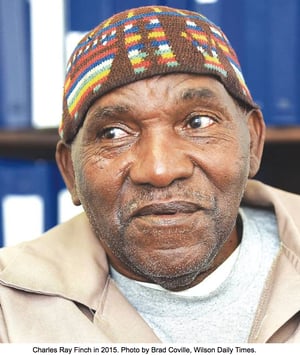
Charles Ray Finch
In February 1976, Richard Holloman was fatally shot during an attempted robbery at his convenience store outside Wilson, North Carolina. The sole eyewitness, Lester Jones, initially provided just a vague description of three Black male assailants, one wearing a stocking over his head, another with a black cap, and the third with a wool hat. Despite this limited information, police quickly focused on Charles Ray Finch as a suspect based on a previous (and dismissed) robbery charge and a witness claim that Mr. Finch had been seen at the store hours before the robbery.
Mr. Finch was arrested the same night when police found him in a blue Cadillac, which did not match the witness’s description of a black Pontiac. Mr. Jones identified Mr. Finch as the shooter in several lineups, but there were serious flaws in the composition of the lineups. As the case progressed, Mr. Jones’ testimony became increasingly detailed and aligned with Mr. Finch’s appearance. During the trial, in June 1976, Mr. Jones claimed the shooter used a shotgun, and prosecutors reinforced this with testimony about a shotgun shell found in Mr. Finch’s Cadillac.
The ballistic evidence proved central to both Mr. Finch’s conviction and eventual exoneration. Dr. Henry Haberyan’s autopsy erroneously stated in three separate places that Mr. Holloman had died from “shotgun wounds,” a critical mistake where the term “shotgun” was used instead of “gunshot.” At trial, Dr. Haberyan avoided specifying the weapon while testifying, but prosecutors emphasized the shotgun theory in their closing arguments. A Wilson County Medical Examiner’s review dated February 17, 1976, correctly stated that Mr. Holloman was killed by gunshot wounds from a pistol, not a shotgun. When confronted with this error in 2002, Dr. Haberyan acknowledged his mistake and stated definitively: “The wounds suffered by Mr. Holloman were not caused by a shotgun.”
The presentation of this evidence to the jury was also problematic. A deputy sheriff cut open a shotgun shell found in Mr. Finch’s car during testimony so jurors could examine the pellets, while the prosecutor suggested they were “just like or very similar to the one that was removed from the body of Mr. Holloman.” However, an undisclosed North Carolina State Bureau of Investigations ballistics report found insufficient similarities between pellets from that type of shell and the bullet fragments recovered from Mr. Holloman’s body. This report was withheld from the defense.
For 43 years, Mr. Finch fought to overturn his conviction. In 2001, the Wrongful Convictions Clinic at Duke University School of Law began representing him and uncovered the previously suppressed evidence through a 1996 state law that required prosecutors to turn over all investigative records. Counsel for Mr. Finch filed a motion in 2013 challenging Mr. Jones’ identification, the tainted lineup procedure, and the exculpatory evidence that was withheld, but Wilson County Superior Court Judge Wayland Sermons, Jr. denied relief in 2014. In his decision, Judge Sermons dismissed the medical examiner’s report and claimed that jurors were “in as good a position to consider the similarity or the difference in the pellets as anyone.”
When faced with the evidence that Mr. Holloman was killed by a pistol, rather than a shotgun, prosecutors shifted their theory and argued that Mr. Finch was still guilty because he was present, regardless of the weapon used. This contradicted the theory presented at trial and the jury instructions from trial, which specifically required the jury to find that Mr. Finch “had a sawed off shotgun and that he shot that gun” to convict him. The U.S. Court of Appeals for the Fourth Circuit found this evidence compelling, noting that Mr. Jones’ credibility was severely undermined by his incorrect testimony about the murder weapon and that there was no physical evidence that implicated Mr. Finch.
In May 2019, U.S. District Court Judge Terrence Boyle vacated Mr. Finch’s conviction and ordered his release. After nearly 43 years of wrongful imprisonment, 81-year-old Mr. Finch left prison in a wheelchair. He subsequently received a $2 million settlement from Wilson County in May 2021, a pardon of innocence from then-Governor Roy Cooper in June 2021, and his estate later received a $7.5 million settlement from the North Carolina State Bureau of Investigation and an additional $750,000 in state compensation. Mr. Finch passed away in January 2022, less than three years after his release.
Sources
Kobina Ebo Abruquah v. State of Maryland, No. 10, September Term, 2022. Opinion by Fader, C.J. ; Ken Otterbourg, Charles Finch, National Registry of Exonerations, June 24, 2019; Report to the President Forensic Science in Criminal Court: Ensuring Scientific Validity of Feature-Comparison Methods, Executive Office of the President, President’s Council of Advisors on Science and Technology, September 2016; Brian J. Heard, Handbook of Firearms and Ballistics: Examining and Interpreting Forensic Evidence, July 11, 2008; Sally A. Schehl, Firearms and Toolmarks in the FBI Laboratory, Part 1, FBI Laboratory Division, April 2000; Paul C. Giannelli, Firearms and Toolmark Evidence, Faculty Publication, 1985; Firearms Analysis, Georgia Bureau of Investigation Division of Forensic Science.