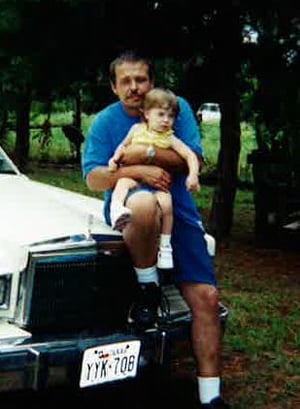
Robert Roberson with daughter Nikki. Courtesy of the Roberson family.
Shaken Baby Syndrome (SBS) emerged as a medical diagnosis in the early 1970s, following research by pediatric neurosurgeon Norman Guthkelch, who suggested that certain brain injuries in infants could only be the result of being violently shaken. The theory gained prominence through research by Dr. Guthkelch and Dr. John Caffey, who published influential papers connecting a “triad” of symptoms — subdural hemorrhage, retinal hemorrhage, and brain swelling — to abusive shaking. By the 1980s, SBS had become an accepted diagnosis in the medical field and was increasingly used in criminal prosecutions, with caregivers facing serious charges like murder, manslaughter, and child abuse based primarily on this triad of symptoms.

Prosecutors relied heavily on the presence of the symptoms as definitive proof of abuse, even in the absence of external injuries or witnesses. Courts largely accepted medical expert testimony regarding SBS as conclusive, leading to convictions, substantial prison sentences, and even some death sentences.
By the late 1990s and into the early 2000s, however, scientific challenges to SBS began to emerge and gain momentum. Biomechanical studies questioned whether manual shaking alone could generate enough force to cause the triad of injuries, while other medical researchers identified alternative explanations for the same symptoms, including accidental falls, birth trauma, certain medical conditions, and genetic disorders. These findings led the medical community to change the diagnosis once considered SBS to Abusive Head Trauma (AHT), which reflects a more inclusive understanding of the potential causes of the symptoms.
The legal community was slow to respond to the change in the scientific community’s understanding. Some courts now allow limited post-conviction challenges in recognition of the changes in scientific understanding. Though AHT remains widely accepted in pediatric medicine, many courts now require more comprehensive evidence beyond the presence of the triad of symptoms alone, and many jurisdictions have seen acquittals, dismissals, and successful appeals in cases that once ended in convictions during peak use of the SBS diagnosis.
The foundation of an SBS diagnosis is the presence of a triad of symptoms: subdural hemorrhage — bleeding between the brain’s surface and lining — retinal hemorrhage — rupture of blood vessels in the eyes — and brain swelling caused by the alleged shaking. The medical community attributed each element to specific trauma mechanisms: bridging veins that carry blood from the brain to the dural sinuses were thought to rupture traumatically, causing subdural hemorrhages; blood vessels in the retina were thought to burst from trauma, resulting in retinal hemorrhages; and widespread damages to neural connections between brain cells was considered evidence of traumatic disruption.

Blausen.com staff (2014). “Medical gallery of Blausen Medical 2014″. WikiJournal of Medicine 1 (2). DOI:10.15347/wjm/2014.010. ISSN 2002 – 4436.
Given the bilateral and extensive nature of brain injuries associated with SBS, medical experts believed these patterns required forces comparable to those experienced in severe car crashes or falls from significant heights. Because of this, when caretakers provided histories lacking such catastrophic events, physicians deemed these accounts inconsistent with the medical findings and concluded that abuse was the only plausible explanation for the injuries. For children exhibiting these characteristic findings without external trauma markings, the medical hypothesis further specified that violent shaking must have been the abuse mechanism, as it could supposedly generate the necessary forces to cause injury without leaving external bruising or other visible signs of trauma.
An extension of the SBS hypothesis also held that medical findings alone could establish both the timing of the injuries and thus the identity of the perpetrator. Medical experts theorized that widespread traumatic damage to neural connections throughout the brain would produce immediate and catastrophic functional impairment, similar to those found in concussion injuries. This immediate-effect theory rejected the idea of a “lucid interval,” a period during which the child might appear relatively normal after sustaining the critical injury. The presumed instantaneous onset of symptoms created a temporal link between the injury and the appearance of neurological distress.
Prosecutors largely accepted this medical proposition, as it created a straightforward investigative framework: since symptoms would manifest immediately after the traumatic event, the person caring for the child whenever symptoms first appeared must be the perpetrator of the abuse. This medical timing theory effectively transformed the clinical SBS diagnosis into a forensic tool for establishing culpability.
Despite SBS’s growing acceptance in the 1980s, some medical professionals raised early concerns. In 1987, Dr. Ann-Christine Duhaime, a neurosurgeon, along with several biomechanical engineers, attempted to validate the SBS hypothesis by measuring the force on a child’s skull while shaking and comparing it to known injury thresholds. This early experiment showed that the force generated when shaking a baby was far below the established head injury criteria, and a small fraction (1/50) of the force was generated from impact. The study found that “shaken baby syndrome, at least in its most severe acute form, is not usually caused by shaking alone.” Dr. Duhaime would go on to suggest that the triad of injuries associated with SBS were likely the result of shaking followed by impact.
2001 research by Dr. Jennian Geddes and her colleagues studied the brains of infants who reportedly died from abuse. They found that the brain pathology of these infants was hypoxic or ischemic, indicating a lack of oxygen, rather than a traumatic event. While some of the infants showed injury to neural connections in the brain, most did not. This contradicted the founding principles of SBS.
The same year, Professor Werner Goldsmith, a biomechanical engineer, expressed concerns with SBS hypothesis to the National Institute of Health (NIH). Professor Goldsmith’s presentation emphasized that pediatric head injuries predominantly occur accidentally, though some stem from abuse or natural causes without mechanical trauma. Research from Dr. John Plunkett, a forensic pathologist, centered on fatal short falls and included a videotaped fall of a toddler who presented with the triad symptoms and died after a short lucid period. The video demonstrated that the triad could occur as the result of a short fall and that lucid intervals could occur.
In 2002, the NIH held a conference to address concerns with the SBS hypothesis. While the attendees supported the SBS theory, many acknowledged the lack of grounded scientific evidence supporting the theory. Through the early 2000s, biomechanical studies continued to show the force required to cause the triad of symptoms did not result by shaking an infant, and that doing so would also expect the presence of neck injury. By 2006, proponents of the SBS hypothesis broadly acknowledged numerous conditions other than abuse that could mimic its presentation. These included various accidental injuries, medical conditions, and illnesses spanning from birth-related trauma to pediatric strokes.
In an Arizona post-conviction relief case in February 2012, Dr. Guthkelch, who was among the first to propose the SBS hypothesis, submitted a declaration criticizing the term “Shaken Baby Syndrome” as unsuitable. He admitted there had been no conclusive evidence at the time of his original proposal that shaking alone caused the diagnostic triad. Dr. Guthkelch further acknowledged that various conditions, including natural causes, accidents, and abuse, could potentially produce the same triad of symptoms.
The conventional SBS hypothesis proposed that children would lose consciousness immediately after suffering a head injury, presumed to involve torn veins and axons. This led to the conclusion that the person present during the child’s collapse was the perpetrator. However, this reasoning contradicts the well-established pattern of delayed deterioration following minor head trauma, where extended periods of normal or near-normal functioning often precede eventual collapse. Studies show that there can be a period of more than 24 hours of delayed deterioration between trauma and the appearance of symptoms.
Many medical experts today cite the fact that the SBS hypothesis relies on an oversimplified three-part model that does not address the complexity of the infant brain. Infant subdural hemorrhages are typically too small to result from ruptured bridging veins as originally thought, likely originating instead from small blood vessels in the protective layers surrounding the brain that don’t match the model’s hypothesis. Retinal hemorrhages, associated with traumatic vein rupture according to SBS hypothesis, occur in various natural conditions and share causes with adult cases — including oxygen deprivation and blood clots. Brain swelling, incorrectly attributed to widespread nerve tissue damage, has been recognized as resulting from oxygen deprivation regardless of cause. This evidence was disregarded to preserve the original model of SBS.
Case Studies
Jeffrey Havard
Jeffrey Havard was convicted and sentenced to death in 2002 in Mississippi for sexual abuse and murder in the death of six-month-old Chloe Benn, the daughter or his girlfriend. Mr. Havard was accused of shaking Chloe and sexually abusing her before her death, but the medical expert who testified at his trial later recanted, raising serious doubts about the state’s theory of Chloe’s cause of death.
During Mr. Havard’s trial, which lasted just two days, the state presented testimony from state pathologist Steven Hayne, who told the jury that Mr. Havard had shaken Chloe hard enough to cause injuries that would eventually lead to her death. Mr. Hayne testified that Chloe presented the “telltale symptoms” of SBS. The defense presented only one witness, who provided just three pages worth of testimony, and failed to challenge the forensic testimony in the case. Defense counsel also failed to question the prosecution’s theory. Mr. Havard alleges that on the night in question, Rebecca Britt, his girlfriend and Chloe’s mother, went out to get food, leaving Chloe with him. After Chloe spit up food on her clothing, Mr. Havard gave her a bath, and as he lifted her from the tub, she slipped from his hands. She hit her head on the toilet as she fell. Mr. Havard admitted to the authorities that he lied to Ms. Britt about dropping Chloe initially, claiming he did not know what caused her injuries.
Since the 2002 trial, Mr. Hayne has recanted his diagnosis that Chloe died from Shaken Baby Syndrome. He had testified under oath that he regularly performed 1,500 or more autopsies each year, nearly five times the maximum number recommended by the National Association of Medical Examiners. Mr. Hayne had never been certified in forensic pathology by the American Board of Pathology and failed the certification exam in 1980. Three other reputable experts who reviewed Mr. Hayne’s autopsy report found no evidence of abuse of the infant. In 2008, Mr. Hayne was barred from doing autopsies for Mississippi prosecutors and the U.S. Court of Appeals for the Sixth Circuit called his work “discredited.”
During an evidentiary hearing in August 2017, Mr. Hayne told the court that SBS is no longer a widely accepted diagnosis in the scientific community and that his assessment of Chloe Britt came to incorrect conclusions. On September 14th, 2018, Adam County Circuit Judge Forest Johnson ruled that Mr. Hayne’s recantation was “not sufficient to undermine this court’s confidence in the conviction,” but that “there is a cautious disturbance in confidence of the sentence of death, even if slight.” Ultimately, Judge Johnson did not dispute the scientific community’s declining acceptance of the diagnosis but found that even if Mr. Havard’s jury heard this testimony, they likely would have convicted him anyway. Judge Johnson pointed to an interview in which Mr. Havard admitted to lightly shaking Chloe after she first fell and was unresponsive, but the experts that testified at the evidentiary hearing all agreed that this shaking would not have been substantial enough to cause injury.
In December 2018, Judge Johnson formally resentenced Mr. Havard to life in prison without the possibility of parole, taking him off Mississippi’s death row.
Robert Roberson
Robert Roberson with daughter Nikki. Courtesy of the Roberson family.
Robert Roberson was convicted and sentenced to death in Texas for the 2002 death of his two-year-old daughter, Nikki Curtis. At the time of her death, she was sick with a high fever and undiagnosed pneumonia and had been prescribed medications inappropriate for her age (Phenergan and Codeine) before suffering a short fall from bed. Mr. Roberson immediately brought Nikki to the emergency room when he found her unresponsive and was unable to explain his chronically ill daughter’s symptoms. At the hospital, staff were unaware that Mr. Roberson has autism and misconstrued his flat mannerisms as lack of concern for his daughter. Using one physician’s hypothesis that Nikki’s death was the result of Shaken Baby Syndrome (SBS), police arrested Mr. Roberson, even prior to an autopsy being performed.
At trial, Mr. Roberson’s attorney ignored his claims of innocence, instead conceding the prosecution’s argument that it was a “classic” SBS case but noted that Mr. Roberson lacked the intent to kill his daughter. Doctors testified that Nikki had died of SBS.
The jury never learned that Nikki had pneumonia at the time of her death and that she had been on medication no longer recommended for children because it can suppress breathing. CAT scans also showed a single impact injury to Nikki’s head, consistent with impact from a fall. She had no injuries to her neck, which would be expected had she been subjected to violent shaking. Mr. Roberson was convicted and sentenced to death in 2003.
In 2016, the Texas Court of Criminal Appeals stayed a scheduled execution date for Mr. Roberson, and the trial court conducted an eight-day evidentiary hearing. In February 2022, Judge Deborah Evans recommended the TCCA deny Mr. Roberson’s claims, stating that the court “had found insufficient facts to support granting relief.” Judge Evans said that the defense failed to present any newly discovered evidence that was not already available at the time of trial that establishes Mr. Roberson’s innocence, nor any new evidence that would lead a reasonable juror to a different decision.
In June 2024, Anderson County District Attorney Allyson Mitchell filed a motion to set an execution date for Mr. Roberson, while a motion requesting a new hearing remained pending. The motion for a new hearing explained that since June 2016, Mr. Roberson’s attorneys developed new evidence of his actual innocence. At the same time, Mr. Roberson asked the TCCA to reconsider its previous ruling. The suggestion argued that another case, Ex parte Roark, pending before the TCCA, showed that the state conceded the false nature of nearly identical evidence from expert testimony on SBS. Both Mr. Roberson and Mr. Roark were convicted and sentenced more than two decades ago using the SBS theory and testimony from the same child abuse expert. The court ultimately set an October 17, 2024, execution date for Mr. Roberson.
In July 2024, counsel for Mr. Roberson filed an additional writ of habeas corpus with three new expert opinions precisely explaining the circumstances of Nikki’s death. After examining new evidence, unavailable during the previous application for habeas relief in 2016, these three experts unanimously concluded Nikki’s death was caused by severe viral and bacterial pneumonia that progressed to sepsis and then septic shock and was not the result of SBS.
In September 2024, the TCCA dismissed Mr. Roberson’s request for habeas relief without reviewing the merits of any of his claims, citing a failure to meet procedural requirements, despite the inclusion of new, previously unavailable medical and scientific evidence. The TCCA denied an emergency motion for a stay of execution and the U.S. Supreme Court denied a writ of certiorari to determine whether TCCA’s unexplained use of a procedural rule violates federal due process when a death row prisoner has an actual innocence claim previously unavailable. Mr. Roberson was scheduled to be executed October 17, 2024, but his execution was stayed because of a subpoena issued by the legislature for Mr. Roberson to testify after his scheduled execution.
On February 19, 2025, Mr. Roberson again asked the TCCA for relief, presenting substantial new evidence that supported his actual innocence claim. Counsel again pointed to TCCA’s decision in Ex parte Roark, where the Court overturned a murder conviction based on the SBS testimony from the same expert who testified against Mr. Roberson. Evidence-based science has dismantled each of the SBS premises that were presented as medical facts at Mr. Roberson’s trial, a development officially recognized by the TCCA in the Roark case. This filing also included a new affidavit for Dr. Michael Laposata, a pathologist with more than four decades of expertise in coagulation and bleeding disorders. Dr. Laposata, who reviewed Nikki’s medical records, autopsy, and other available information determined that based on those records, Nikki suffered from Disseminated Intravascular Coagulation (DIC), a blood clotting disorder that is commonly caused by serious illnesses, such as pneumonia. He also explained that the bleeding in Nikki’s brain that the medical examiner attributed to “multiple impact” sites was, in actuality, because of DIC. Dr. Laposata also reviewed the reports of the three other medical experts and found their conclusions to be consistent with his own. The filings also include a joint statement of 10 pathologists who conclude that the autopsy performed on Nikki was not reliable.
In July 2025, an Anderson County judge set another execution date for Mr. Roberson, October 16, 2025. Just a week before his scheduled execution, the TCCA stepped in a granted a stay of execution based on the February 2025 motion. With the TCCA’s grant of relief, Mr. Roberson may get an evidentiary hearing to determine whether scientific changes since his initial conviction warrant a new trial.
Sources
Hayley Bedard, Robert Roberson Once Again Asks Texas Court of Criminal Appeals to Consider New Evidence Supporting His Actual Innocence and Grant Him Relief, Death Penalty Information Center, February 26, 2025; Innocence: The Death Penalty in 2024, Death Penalty Information Center, December 19, 2024; Texas Court of Criminal Appeals Dismisses New Evidence of Innocence and Denies Robert Roberson Habeas Relief, Death Penalty Information Center, September 12, 2024; Anderson County, Texas District Attorney Requests Execution for Robert Roberson, Despite a Conviction Obtained with Debunked Forensic Science, Death Penalty Information Center, June 20, 2024; Scientists, Physicians, Retired Federal Judges, and Innocence Groups File Amicus Briefs in Support of Robert Roberson, Texas Man Convicted and Sentenced to Death in “Shaken Baby Syndrome” Case, Death Penalty Information Center, June 15, 2023; Forensics Experts and Shaken-Baby Exonerees File Briefs Supporting Texas Death-Row Prisoner Robert Roberson’s Innocence Claim, Death Penalty Information Center, April 18, 2022; Questionable Ruling Grants Jeffrey Havard New Sentencing but Not New Trial in Controversial “Shaken Baby” Case, Death Penalty Information Center, September 24, 2018; Radley Balko, The murder evidence evaporated, but Jeffrey Havard still sits in a Mississippi prison, The Washington Post, September 19, 2018; Keith A. Findley, Patrick D. Barnes, David A. Moran, and Waney Squier, Shaken Baby Syndrome, Abusive Head Trauma, and Actual Innocence: Getting it Right, Houston Journal of Health and Law Policy, April 30, 2012; Ivan Blumenthal, Shaken baby syndrome, Postgraduate Medical Journal, 2002.