Examining Georgia’s History of Racial Violence and Capital Punishment
by Taylor Bonner
- Historical Foundations: Racist Roots
- Landmark Legislation
- Juror Bias
- Human Impact
- By the Numbers
- Georgia’s Capital Punishment Procedures Under ABA Scrutiny
Historical Foundations: Racist Roots Top
To understand the modern use of the death penalty in Georgia, it is necessary to begin with its historical foundations. Capital punishment in the United States has long been applied unevenly across racial groups, and Georgia’s history reflects this broader pattern.
The Equal Justice Initiative identifies Georgia as one of twelve states with the highest number of documented lynchings in the United States. These acts of racial terror are not separate from formal systems of punishment; lynching and legal executions were used simultaneously and were often mutually reinforcing. This fact provides important context for understanding how the death penalty has been and is currently used in the state.
Between the years 1877 – 1950, at least 599 people were lynched in Georgia.1And between the years 1890 and 1900 there was an average of more than one mob execution per month in Georgia.2Mob executions in Georgia nearly exclusively targeted Black people, who comprised 95% of victims. Almost none of the mob participants faced any legal consequences. According to newspaper accounts from the late 19th century through the mid 20th century, the two most common justifications for mob executions were for the alleged murder of a white person and the alleged rape of a white woman.
Sam Hose (a.k.a. Sam Holt) is one of many Black people who was lynched by a mob in Georgia. On April 23, 1899 in Coweta County, while he was sitting in jail for being accused of killing a white man, a lynch mob broke into Mr. Hose’s cell, transported him off-site, “mutilated his body with knife cuts”, then “doused him in oil and set him on fire” in front of nearly 2,000 spectators. After the execution, it is reported that spectators collected “pieces of [Mr. Hose’s] bone and bits of flesh” as souvenirs.
Race-based data is closely connected to modern day capital sentencing patterns; several studies document how the race of victims affects whether and how often Black capital defendants are sentenced to death. Research from 2024 discovered that in 92%3 of all Georgia death eligible cases without a white female victim, a death sentence was never even sought.

On August 16, 1924, the Georgia General Assembly passed a law that ended death by hanging for all people convicted of a capital crime and replaced the method of execution with electrocution. The first electrocution occurred on September 13, 1924 at Georgia State Prison in Milledgeville, Georgia with the execution of Howard Hinton — a Black man in his early 20s, who was executed for the alleged assault of a white woman in Dekalb County.
Landmark Legislation Top
Furman v. Georgia is one of the most monumental cases in American legal history and invalidated every state death penalty statute across the nation. The 1972 decision also spared the lives of 629 individuals who had been sentenced to death.
The decision consolidated three cases, Furman v. Georgia, Jackson v. Georgia, and Branch v. Texas. The lead petitioner, William Henry Furman, at just 24-years old, was sentenced to death for the murder of William Mickie. A host of mitigating factors told Mr. Furman’s story: he was a Black man who was poor, had a mental illness, a physical disability, an intellectual disability, a sixth-grade education, epilepsy-induced psychosis, and suffered from alcoholism. His death sentence was imposed by a jury comprised of 11 white people and 1 Black person during a time when Black people were routinely excluded from jury service. Mr. Furman was denied his Sixth Amendment right to be tried by a jury drawn “from a representative cross section of the community.”
Ultimately, Mr. Furman, Mr. Jackson, and Mr. Branch — all Black men — urged the United States Supreme Court to consider whether their death sentences constituted cruel and unusual punishment in violation of the Eighth and Fourteenth Amendments. Successfully litigated by the NAACP Legal Defense Fund (LDF), the Furman decision held by a 5 to 4 vote that the administration of the death penalty was so arbitrary that it was unconstitutional “as applied.” Justice William O. Douglas in his concurring opinion for the majority stated:
“It would seem to be incontestable that the death penalty inflicted on one defendant is ‘unusual’ if it discriminates against him by reason of his race, religion, wealth, social position, or class, or if it is imposed under a procedure that gives room for the play of such prejudices.”
Gregg v. Georgia
Just four years after Furman, the Court’s decision in Gregg v. Georgia (1976) signaled the beginning of the modern era of capital punishment. Defendant Troy Leon Gregg was sentenced to death under a new death penalty statute for robbing and murdering two men in Gwinnett County, Georgia. During the penalty phase, the jury was instructed that it could consider either life imprisonment or a death sentence on each count by considering mitigating and aggravating factors.4 The jury could not consider an imposition of death sentence unless it found “beyond a reasonable doubt” one of three relevant statutory aggravating circumstances. The Supreme Court was asked to decide whether the process Georgia used to impose a death sentence violated the Eighth and Fourteenth Amendments. In a 7 – 2 decision, the Court held that it did not. It held that a death sentence is not invariably disproportionate where “a life has been taken deliberately by the offender,” characterizing capital punishment as “an extreme sanction, suitable to the most extreme of crimes.” Justice Potter Stewart wrote a concurrence declaring:
“But we are concerned here only with the imposition of capital punishment for the crime of murder, and, when a life has been taken deliberately by the offender, we cannot say that the punishment is invariably disproportionate to the crime. It is an extreme sanction, suitable to the most extreme of crimes. We hold that the death penalty is not a form of punishment that may never be imposed, regardless of the circumstances of the offense, regardless of the character of the offender, and regardless of the procedure followed in reaching the decision to impose it.”
Thirty-four years after Gregg, in an October 2010 interview on National Public Radio, then newly-retired Supreme Court Justice John Paul Stevens, who voted with the plurality to reinstate the death penalty in Gregg, admitted he particularly regretted his vote:
“I thought at the time … that if the universe of defendants eligible for the death penalty is sufficiently narrow so that you can be confident that the defendant really merits that severe punishment, that the death penalty was appropriate…over the years, the Court constantly expanded the cases eligible for the death penalty, so that the underlying premise for my vote has disappeared, in a sense.”

Justice Stevens also made note of the complexities in death penalty statues.
“I really think that the death penalty today is vastly different from the death penalty that we thought we were authorizing.”

McCleskey v Kemp (1987): “The Dred Scott of our Time”

The McCleskey case made a convincing argument about the racial bias in the death penalty by presenting a groundbreaking empirical study from University of Iowa law professor David C. Baldus and his colleagues Charles Pulaski and George Woodworth, showing that race influences who is sentenced to die in Georgia.
The defendant, Warren McCleskey, a Black man, was sentenced to death in Fulton County for the killing of a white police officer. Mr. McCleskey and the NAACP Legal Defense Fund challenged his sentence on the grounds that it was racially biased and violated his Eighth and Fourteenth Amendment rights. He presented several data points from the Baldus study that analyzed 230 different factors that can be part of a state’s decision to seek death.

In a 5 – 4 decision, the United States Supreme Court ruled against Mr. McCleskey. The Baldus study, it held, “fail[ed] to contribute anything of value” to McCleskey’s claim, “[the] statistics do not demonstrate a prima facie case in support of the contention that the death penalty was imposed upon him because of his race, because of the race of the victim, or because of any Eighth Amendment concern,” and “[the data is] insufficient to demonstrate discriminatory intent or unconstitutional discrimination in the Fourteenth Amendment context, [and] insufficient to show irrationality, arbitrariness and capriciousness under any kind of Eighth Amendment analysis.” In its opinion, the Court acknowledged the statistics as proof of discriminatory intent in cases challenging juror selection or Batson cases, but said that “…the nature of the capital sentencing decision, and the relationship of the statistics to that decision, are fundamentally different from the corresponding elements in the venire selection or Title VII cases.” Justice Lewis F. Powell, who wrote the majority opinion, later confessed to his biographer that he regretted his McCleskey vote. When asked whether he would change his vote in any case he responded with the following:
“Yes, McCleskey v. Kemp.”
“Do you mean you would now accept the argument from statistics?”
“No, I would vote the other way in any capital case.”
“In any capital case?”
“Yes.”
“Even in Furman v. Georgia?”
“Yes. I have come to think that capital punishment should be abolished.”
Mr. McCleskey was executed on September 25th, 1991. The American Civil Liberties Union (ACLU) notes the McCleskey decision “…has been roundly condemned as a ‘low point’ in the quest for equality, comparable to Dred Scott v. Sanford (1857) — which held that people of African ancestry were not entitled to the protections of the Constitution — and Plessy v. Ferguson (1896) — which upheld racial segregation of public facilities.”
During a DPI podcast with Professor and Co-director of the Center for Criminal Justice, Alexis Hoag-Fordjour of Brooklyn Law School, Professor Hoag-Fordjour reflected on the legacy of the McCleskey decision at its 35th anniversary.
“And again, it’s Black defendants charged, convicted with murdering white victims, [who are] those that throughout that entire process are the least likely to have obtained post-conviction relief, the least likely to [obtain] clemency, you know, maybe from a governor at that sort of 11th hour stage of decision making and are ultimately actually executed. So if anything, the evidence that David Baldus brought on behalf of Mr. McCleskey has just become even stronger in the subsequent 35 years.”

After struggling with the issue of capital punishment for more than 20 years, Justice Harry Blackmun — who dissented in McCleskey v. Kemp and Furman v. Georgia but joined the majority in Gregg v. Georgia—ultimately concluded that “the death penalty experiment has failed.” According to a 1994 New York Times article, Justice Blackmun later acknowledged that race contributes to the inherent arbitrariness of the death penalty, a position that contrasted with the holding in McCleskey. Justice Blackmun expressed his final view on capital punishment:
“It seems that the decision whether a human being should live or die is so inherently subjective — rife with all of life’s understanding, experiences, prejudices, and passions — that it inevitably defies the rationality and consistency required by the Constitution. [It is time] to admit the futility of the effort to harmonize these two irreconcilable constitutional commands. This means accepting the fact that the death penalty cannot be administered in accord with our Constitution.”

Juror Bias Top
Juror bias is a persistent and damaging flaw in America’s death penalty system. For centuries, capital defendants of color have been — and remain — vulnerable to convictions and death sentences imposed by juries that do not represent a fair cross section of their communities. Too often these juries are not racially diverse because of the deliberate misconduct of prosecutors.
Keith Leroy Tharpe
In April 2019, Keith Leroy Tharpe appealed to the Supreme Court to consider the appeal of his death sentence based on evidence of racial bias. Mr. Tharpe, a Black man, received his death sentence in 1990. While preparing his appeal, Mr. Tharpe’s lawyers interviewed jurors from his case, and one white juror made the following statement in his affidavit:
“I have observed there are two types of Black people: 1. Black folks and 2. N*****s.
For example, some of them who hang around our little store act up and carry on. I tell them, ‘n****r, you better straighten up or get out of here fast.’ I felt Tharpe who wasn’t in the ‘good’ [B]lack folks category in my book, should get the electric chair for what he did…
After studying the Bible, I have wondered if [B]lack people even have souls. Integration started in Genesis. I think they are wrong. For example, look at O.J. Simpson. That white woman wouldn’t have been killed if she hadn’t married that [B]lack man.”
Mr. Tharpe’s lawyers argued that the troubling racial bias demonstrated by this juror should result in a new trial. And the ACLU comments that prosecutor Joseph Briley, and the attorney general “…should have responded to the juror’s affidavit by announcing they would not tolerate racial bias in capital sentencing and agree that Tharpe should get a new trial.” But instead the prosecutor and attorney general obtained a new statement from the juror and argued that the racial bias of the juror should be irrelevant to Mr. Tharpe’s death sentence because the law should not permit investigation into racial bias by jurors after the verdict. This response is particularly notable given Joseph Briley’s documented history of allegations involving racially biased prosecutorial practices in other cases.
Although the U.S. Supreme Court denied certiorari for Mr. Tharpe, Justice Sonya Sotomayor dissented from this decision, noting the role that race played in his sentencing:
“These racist sentiments, expressed by a juror entrusted with a vote over Tharpe’s fate, suggest an appalling risk that racial bias swayed Tharpe’s sentencing. The danger of race determining any criminal punishment is intolerable and endangers public confidence in the law.”

Mr. Tharpe died on death row in January 2020 at the age of 61.
Johnny Lee Gates


Jury notes from Mr. Gates’ trial
Johnny Lee Gates spent 43 years incarcerated, including 26 years on death row, for a crime he has always maintained he did not commit. His attorneys say detectives coerced his confession, exploited his intellectual disability, and prosecutors withheld key evidence from the defense. These deliberate actions undermined the legitimacy of his conviction, and in 1991, Mr. Gates was sentenced to death by an all-white jury in Muscogee County, Georgia — situated in a judicial area once known as the “buckle of the death belt.” This area pursued capital punishment more aggressively than any other jurisdiction in Georgia, and has a demonstrated history of regularly empaneling all-white juries and illegally excluding Black jurors. According to the Georgia Innocence Project, Muscogee County prosecuting attorney Douglas Pullen excluded 27 out of 27 qualified Black jurors in five death penalty cases against Black defendants in the late 1970s. In his appeal process, Mr. Gates’ lawyers discovered jury selection notes from the prosecutors which showed that they had tracked the race of jurors, excluded most Black jurors, and repeatedly wrote derogatory comments about Black people and Black prospective jurors, whom they described as “slow,” “old +ignorant,” “cocky,” “con artist,” “hostile,” and “fat.” White jurors were marked only with the letter “W,” while Black jurors had an additional notation of “N.” A Georgia Tech mathematics professor provided expert testimony that the probability that Black jurors had been removed for race-neutral reasons was infinitesimally small at 0.000000000000000000000000000004%. Moreover, prosecutors rated jurors on a scale of 1 to 5, with 5 being the most favored — every Black juror was ranked a “1.” The only white juror ranked a “1” had said he was opposed to the death penalty.
Mr. Gates’ death sentence was vacated in 2003 not because of the illegal racial discrimination by prosecutors, but on evidence of his intellectual disability. The Georgia Supreme Court then vacated Mr. Gates’ conviction based on exculpatory DNA evidence.
Mr. Gates walked free on May 15, 2020.
Given these patterns and narratives of systemic exclusion, research on jury deliberations provides context for examining prosecutorial jury selection practices and the prevalence of majority-white or all-white juries in capital cases. A study of 340 capital trials, including Georgia trials, found that when white jurors outnumber Black jurors on a trial jury, there is a greater likelihood that a Black defendant will be sentenced to death. This was particularly true in cases with white victims.
Research shows that, among white people, support for the death penalty is highly correlated with anti-Black racial prejudice. Having at least one Black man on a jury reduces the likelihood of a death sentence in cases with Black defendants and white victims by almost 30%.
Human Impact Top
Lena Baker

On August 14, 1945, Lena Baker, a Black woman, was sentenced to death for the murder of her white male employer, though records indicate she acted in self-defense. Her trial lasted only four hours, and the jury was composed entirely of white men. In August 2005, the Georgia Board of Pardons and Paroles issued a formal pardon for Ms. Baker — the first and only woman executed in Georgia in the electric chair. The document was signed by all five board members, and a resolution was issued acknowledging Ms. Baker’s life and the harm caused by her wrongful conviction. The pardon stated that the board’s 1945 decision to deny Ms. Baker clemency “was a grievous error, as this case called out for mercy.”
Timothy Foster
On the 13th anniversary of Batson v. Kentucky (1986) —the landmark case that held that excluding potential jurors based on their race was unconstitutional under the Equal Protection Clause of the Fourteenth Amendment —Timothy Foster’s conviction and death sentence were overturned by the U.S. Supreme Court after overwhelming evidence showed that Black prospective jurors had been illegally excluded at his Georgia trial. “Evidence that a prosecutor’s reasons for striking a black prospective juror apply equally to an otherwise similar nonblack prospective juror who is allowed to serve tends to suggest purposeful discrimination.” After a 35-year legal battle, Mr. Foster, a Black man, was resentenced to life in prison without the possibility of parole.

Sample of notes reflecting that the prosecution marked the name of each Black prospective juror in green highlighter on four different copies of the jury list; circled the word “BLACK” next to the “Race” question on the juror questionnaires of five Black prospective jurors; identified three black prospective jurors as “B#1,” “B#2,” and “B#3”; and ranked the Black prospective jurors against each other in case “it comes down to having to pick one of the [B]lack jurors.” Prosecutors claimed they struck each of the Black jurors for race-neutral reasons and did not use the highlighted list in their final decision.
Troy Davis: “A catastrophic failure of the justice system.”
Troy Anthony Davis, a Black man, was sentenced to death in 1991 for the murder of a white off-duty police officer in Savannah, Georgia. The case against him consisted entirely of eyewitness testimony. A 2025 report from the America Civil Liberties Union (ACLU) finds eyewitness misidentifications have contributed to more than one-fifth of wrongful death penalty convictions, accounting for 42 innocent people wrongfully convicted and sentenced to death. The ACLU also highlights the role of race in wrongful death penalty convictions, noting that eyewitness misidentification is more likely to occur in cases involving cross-racial identification. Research has consistently identified cross racial identification as one of the oldest and most reliable findings in eyewitness misidentification studies, demonstrating that white people are much more likely to misidentify Black individuals than to mistakenly identify members of their own race. This increased risk of cross-racial misidentification has contributed to wrongful convictions in capital cases, further illustrating the racial disparities embedded within the administration of the death penalty.
Mr. Davis relentlessly maintained his innocence amid evidence of racial bias and a deeply flawed investigation.
No physical evidence connected Mr. Davis to the crime. And 7 of the 9 witnesses who testified for the prosecution at Mr. Davis’ trial recanted and claimed that they were coerced to lie by the police. One of the witnesses testified that he had seen the killing and that another man, Sylvester Cole, was the actual shooter; another witness heard Mr. Cole confess to the crime but was barred from testifying about what they heard; another testified that she had heard Mr. Cole confess three times to the killing and was using Mr. Davis as his scapegoat. According to the Atlanta Journal Constitution, one juror expressed, that she feels “empathetically” “…that Mr. Davis cannot be executed under these circumstances.”
In 2011, The New York Times published an opinion article describing Mr. Davis’ case as “a grievous wrong.”

Barry Scheck, co-founder and special counsel at the Innocence Project at the Benjamin N. Cardozo School of Law, notes that “[I]n Georgia, the recanting witnesses don’t get to testify because the state’s courts have created an extraordinary Catch-22 rule — the ‘purest fabrication’ doctrine – that arbitrarily denies evidentiary hearings even when extremely persuasive recantation affidavits have been submitted.”
Mr. Davis’ case garnered worldwide attention; with pleas for clemency from renowned people across sociopolitical lines such as: former President Jimmy Carter, Archbishop Desmond Tutu, Pope Benedict XVI, the European Union, the European Parliament, the Secretary General of the Council of Europe, former FBI Director William Sessions, 51 former and current members of U.S. Congress, former Texas governor Mark White, former U.S. Senator Carol Moseley Braun and Civil Rights Activist and former U.S. Representative John Lewis. Additionally, more than 630,000 letters were delivered to the Georgia Board of Pardons and Paroles pleading for a stay of execution, including a letter signed by 110 murder victim family members – delivered by the son of a murdered police officer in Atlanta.
After 4 execution dates, police misconduct, several failed appeals, serious doubts of his guilt, and 22 years on death row, Mr. Davis was executed by the state of Georgia on September 21, 2011. He left this final message to his advocates and supporters.
“…this Movement to end the death penalty, to seek true justice, to expose a system that fails to protect the Innocent must be accelerated. There are so many more Troy Davis’. This fight to end the death penalty is not won or lost through me but through our strength to move forward and save every innocent person in captivity around the globe. We need to dismantle this Unjust system city by city, state by state and country by country. I can’t wait to Stand with you, no matter if that is in physical or spiritual form, I will one day be announcing, I AM TROY DAVIS, and I AM FREE! Never Stop Fighting for Justice and We will Win !”

The day after Mr. Davis’ execution, thousands gathered in New York City for a “Day of Outrage” to “denounce the perceived failures of the justice system.” Lee Wengraf, a writer and activist commented on the protest:
“The struggle for Troy Davis has not just struck a chord, it has taken the lid off of the outrage that people feel about the depths of racism that surrounds the death penalty, the prison system, all the criminal justice, police brutality. And I think it’s that kind of energy and outrage that has kept Troy Davis, first of all, that kept him alive as long as it did and brought us so close to potentially winning this, that Troy Davis was someone that the whole world was watching over these past few days, and because of the way that people raised their voices and shouted out and said this must not stand, this is a legal lynching.”
Since the year Troy Davis entered death row, DPI has identified nearly 100 defendants of color who have been released from death row across the United States based on innocence claims.
By the Numbers Top
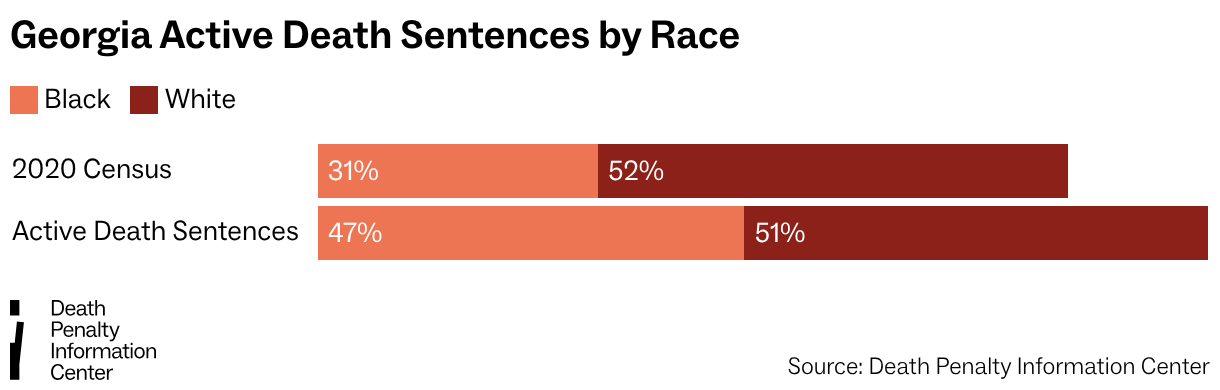
Homicides with white victims are 7.49x more likely to result in the defendant being sentenced to death than homicides with Black victims. 5
In Georgia, among defendants sentenced to death in the modern era, nearly 64% of Black defendants were sentenced in cases involving at least one White victim, while only 3% of White defendants were sentenced in cases involving at least one Black victim.
Georgia’s Capital Punishment Procedures Under ABA Scrutiny Top
In January 2006 the American Bar Association Death Penalty Moratorium Implementation Project released Evaluating Fairness and Accuracy in State Death Penalty Systems: The Georgia Death Penalty Assessment Report which identified how Georgia’s capital punishment system fell short in fairness and accuracy. The Assessment Team identified 7 major problems in Georgia’s capital punishment system including racial disparities in sentencing:
Both the race of the defendant and the race of the victim predict who is sentenced to death in the State of Georgia, with white suspects and those who kill white victims more likely to be sentenced to death than black suspects and those who kill black victims. ‘The data show that among all homicides with known suspects, those suspected of killing whites are 4.56 times as likely to be sentenced to death as those who are suspected of killing blacks.’ Based on this data, race clearly matters in capital sentencing in Georgia.
The Assessment Team established that “…the State cannot ensure that fairness and accuracy are the hallmark of every case in which the death penalty is sought or imposed.” And therefore, all but one team member suggests that the State impose a moratorium on both capital prosecutions and executions until the State can address the problems identified in their report.
Georgia issued a brief moratorium on executions during the Covid-19 pandemic in March 2020, agreeing not to pursue certain execution warrants until “a vaccination against Covid is readily available to all members of the public.” Then after more than 4 years without an execution, the state executed Willie James Pye, a Black man, on March 20, 2024 at age 59. Mr. Pye previously had his death sentence reversed due to his attorney’s ineffective representation and racial bias.
Regarding racial disparities, the Assessment Team made specific recommendations that urged Georgia to implement:
- Jurisdictions should fully investigate and evaluate the impact of racial discrimination in their criminal justice systems and develop strategies that strive to eliminate it.
- Jurisdictions should collect and review all valid studies already undertaken to determine the impact of racial discrimination on the administration of the death penalty and should identify and carry out any additional studies that would help determine discriminatory impacts on capital cases. In conducting new studies, states should collect data by race for any aspect of the death penalty in which race could be a factor.
- Jurisdictions should adopt legislation explicitly stating that no person shall be put to death in accordance with a sentence sought or imposed as a result of the race of the defendant or the race of the victim. To enforce such a law, jurisdictions should permit defendants and inmates to establish prima facie cases of discrimination based upon proof that their cases are part of established racially discriminatory patterns. If such a prima facie case is established, the State should have the burden of rebutting it by substantial evidence.
- Jurisdictions should develop and implement educational programs applicable to all parts of the criminal justice system to stress that race should not be a factor in any aspect of death penalty administration. To ensure that such programs are effective, jurisdictions also should impose meaningful sanctions against any State actor found to have acted on the basis of race in a capital case.
- Jurisdictions should require jury instructions that it is improper to consider any racial factors in their decision making and that they should report any evidence of racial discrimination in jury deliberations.
- Defense counsel should be trained to identify and develop racial discrimination claims in capital cases. Jurisdictions also should ensure that defense counsel are trained to identify biased jurors during voir dire.
Even though some have the option to implement the recommendations in the state, they are not required, leaving a significant gap in fairness and accuracy. Since the report’s release, there has been no meaningful implementation of the Assessment Team’s recommendations. The only reform is the passage of HB123 in 2025, that strengthens protections for death penalty defendants with intellectual disability.
Vanessa Griddine-Jones, Executive Director of the Georgians for Alternatives to the Death Penalty provides perspective on the impact of race on Georgia’s capital punishment:
“Georgia’s death penalty carries a long, undeniable history of racial disparity: a white victim’s death is more likely to result in a death sentence than a Black victim’s. That disparity has been exposed, documented, and still allowed to stand. A punishment this final cannot be trusted to a system where race weighs on the outcome at all.”

Scott Phillips, Justin F. Marceau, Sam Kamin, and Nicole King, Sacred Victims: Fifty Years of Data on Victim Race and Sex as Predictors of Execution, 114 J. CRIM. L. & CRIMINOLOGY 249 (2024).
American Civil Liberties Union. “Fatal Flaws: Revealing the Racial and Religious Gerrymandering of the Capital Jury.” ACLU, (24 June 2025).
Cruel and Unusual Punishment: The Death Penalty Cases: Furman v. Georgia, Jackson v. Georgia, Branch v. Texas, 408 U.S. 238 (1972), 63 J. Crim. L. Criminology & Police Sci. 484 (1972)