
Overview
The federal death penalty applies in all 50 states and U.S. territories but is used relatively rarely. President Biden commuted the federal death sentences of 37 men on December 23, 2024, leaving just 3 prisoners on the federal death row. Sixteen federal executions have been carried out in the modern era, all by lethal injection, with 13 occurring in a six-month period between July 2020 and January 2021.
The federal death penalty was held unconstitutional following the Supreme Court’s opinion of Furman v. Georgia in 1972. Unlike the quick restoration of the death penalty in most states, the federal death penalty was not reinstated until 1988, and then only for a very narrow class of offenses. The Federal Death Penalty Act of 1994 greatly expanded the number of eligible offenses to about 60.
The use of the federal death penalty in jurisdictions that have themselves opted not to have capital punishment — such as Washington, D.C., Puerto Rico, and many states — has raised particular concerns about federal overreach into state matters.

News & Developments
News
Aug 18, 2026
Article of Interest: Law Review Article Examines How the Federal Death Penalty Reflects National Death Penalty Trends

In her February 2026 article published by the Georgia State University Law Review, University of the District of Columbia Law Professor Ngozi Ndulue argues that recent trends have shifted the federal death penalty “from being a laggard to being a leader in national death penalty trends.” Written before the most recent changes to federal death penalty policy by the Trump administration were implemented, her article highlights how federal death penalty cases, though numerically few, mirror…
Read MoreNews
Jun 08, 2026
U.S. Department of Justice Will Not Seek Death Penalty in Trial of Vance Boelter, Accused of Killing Minnesota State Lawmaker
A spokesperson for the U.S. Department of Justice (DOJ) announced that the federal government will not seek a death sentence for Vance Boelter, the man accused of killing Minnesota State Representative Melissa Hortman and her husband, Mark Hortman. Mr. Boelter is charged with their murders and stalking, but DOJ said that stalking likely would not meet the definition of a “crime of violence,” which would be necessary to secure a federal death sentence. Mr. Boelter also faces state charges, but…
Read MoreNews
May 05, 2026
New Analysis: In Seeking Firing Squad, Electrocution, and Nitrogen Gas Executions, DOJ Misrepresents American History and Law
On April 24, the U.S. Department of Justice (DOJ) released a report proposing an expansion of the federal death penalty, including adding firing squad, electrocution, and lethal gas as execution methods. The DOJ characterizes the Biden Administration’s moratorium on executions as “an unprecedented break from the [DOJ]’s longstanding approach to the death penalty,” while casting this new effort as a return to form. The DOJ further claims that the three alternative methods of execution have a…
Read More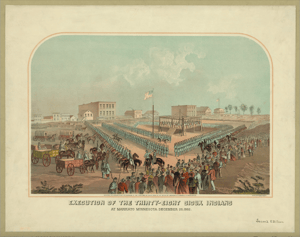
News
Apr 27, 2026
Department of Justice Releases Memo Calling for Expansion of Federal Death Penalty and New Methods
On April 24, 2026, the Department of Justice’s Office of Legal Policy released a detailed report, Restoring and Strengthening the Federal Death Penalty, calling on the Federal Bureau of Prisons (BOP) to reinstate use of a single-drug (pentobarbital) execution protocol, and urging Congress to enact sweeping legislative changes that would expand the reach and speed of the federal death penalty. Alongside the release of the report, DOJ announced that it has directed BOP to immediately reinstate…
Read MoreNews
Feb 12, 2026
Federal Judge Rebukes DOJ and Blocks Transfer of Former Federally Death-Sentenced Prisoners to Supermax Prison
In an order dated February 11, 2026, U.S. District Court Judge Timothy J. Kelly issued a preliminary injunction temporarily blocking the federal government from transferring many former federally death-sentenced prisoners to the notorious Administrative Maximum Facility in Florence, Colorado, known as “ADX.” Judge Kelly found it “likely” that the government violated the prisoners’ Fifth Amendment due process rights when it deprived them of a “meaningful opportunity to challenge” their transfer…
Read More