Entries by Death Penalty Information Center
News
Aug 19, 2015
NEW VOICES: Execution Secrecy “Has No Place in a Democracy”
A recent op-ed by former Texas Governor Mark White (pictured) and former Florida Supreme Court Chief Justice Gerald Kogan criticized a recently passed North Carolina law that imposes secrecy on the source of lethal injection drugs and removes execution procedures from public review and comment. The authors said the new law will only prolong litigation, rather than ending North Carolina’s hold on executions, as intended. The op-ed also maintained that the new policy violates democratic…
Read More
News
Aug 18, 2015
STUDIES: Racial Bias in Jury Selection
A new study of trials in Caddo Parish, Louisiana, revealed that potential jurors who were black were much more likely to be struck from juries than non-blacks. The results were consistent with findings from Alabama, North Carolina, and other parts of Louisiana, highlighting an issue that will be reviewed by the U.S. Supreme Court this fall. In Caddo Parish, an area known for its many death sentences, prosecutors used peremptory strikes against 46% of black jurors, but only 15% of other jurors…
Read More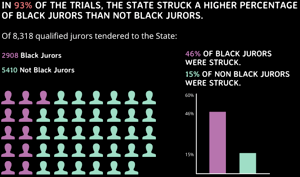
News
Aug 17, 2015
DPIC Series, “50 Facts About the Death Penalty,” Now Complete
DPIC’s complete set of 50 facts about the death penalty is now available. The 50 facts provide an excellent introduction to a variety of death penalty topics, including costs, deterrence, race, innocence, and more. Each fact is presented in graphical form, with links to further information available on our 50 Facts page. The series is also available on Facebook and Twitter, and we encourage readers to share and retweet items they found particularly interesting or surprising. (Posted by DPIC…
Read More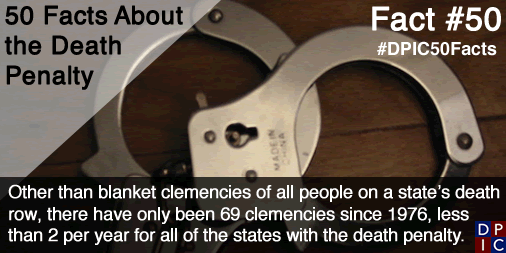
News
Aug 14, 2015
EDITORIALS: North Carolina Newspapers Critique Execution Secrecy Law
On August 6, North Carolina Governor Pat McCrory signed a law that removed the requirement that a physician be present at executions and shrouded in secrecy many elements of the lethal injection process, including the specific drugs to be used and the suppliers of those drugs. By eliminating the physician-participation requirement, the law attempted to remove a legal hurdle that has halted executions in North Carolina since 2006. Two major state newspapers sharply criticized the new law…
Read More
News
Aug 13, 2015
Connecticut Supreme Court Finds Death Penalty Violates State Constitution
The Connecticut Supreme Court ruled on August 13 that the death penalty violates the state constitution. In the 4 – 3 decision in State v. Santiago, the Court said that, because of the prospective repeal of the death penalty in 2012 and “the state’s near total moratorium on carrying out executions over the past fifty-five years, capital punishment has become incompatible with contemporary standards of decency in Connecticut.” As a result, the Court said, it “now violates the state constitutional…
Read More
News
Aug 13, 2015
“Bloodsworth: An Innocent Man” Premieres
A new film, “Bloodsworth: An Innocent Man,” premieres on August 13. The movie, described as a “documentary memoir,” tells the story of Kirk Bloodsworth, an innocent man sentenced to death in Maryland who became the first death row prisoner in the United States to be exonerated by DNA evidence. Bloodsworth was convicted and sent to death row in 1985 for the sexual assault and murder of a 9‑year-old girl. He won a new trial as a result of prosecutorial misconduct, but was convicted again and this…
Read More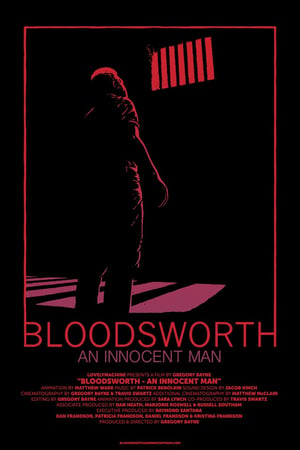
News
Aug 12, 2015
Death Sentences Drop in Three High-Use Counties As Prosecutors Change
Changes in who is District Attorney have caused a dramatic decline in death sentences in 3 counties that historically have produced a disproportionate number of death sentences in the United States, according to a story from The Marshall Project. Harris County (Houston), Texas, Oklahoma County, Oklahoma, and Philadelphia County, Pennsylvania were all among the 2% of counties that accounted for 56% of inmates on death row as of 2013, but the resignations or retirements of their long-time…
Read More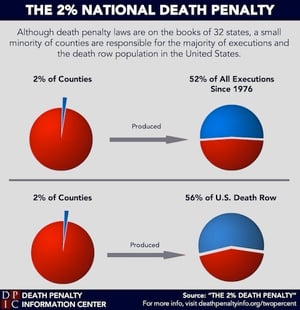
News
Aug 11, 2015
False and Contaminated Confessions Prevalent in Death Row Exonerations
A report by University of Virginia Law Professor Brandon L. Garrett describes the effects of false confessions in cases in which DNA evidence later led to an exoneration. Garrett reports that half of the 20 death row inmates who were exonerated by DNA testing had falsely confessed to the crime. He uses the recent exonerations of intellectually disabled defendants Leon Brown and Henry McCollum in North Carolina to illustrate the problem: “The police claimed that Brown and McCollum had each…
Read More
News
Aug 10, 2015
Mentally Ill James Holmes Sentenced to Life in Prison in Aurora, CO Theater Shooting
On August 7, a jury in Aurora, Colorado, sentenced James Holmes to life in prison without the possibility of parole for the 2012 movie theater shooting that killed 12 people and injured dozens more. The jury said they could not reach a unanimous decision on Holmes’ sentence, an outcome that results in a sentence of life without parole. After the trial, one juror said that the prosecution had not persuaded three of the jurors to impose a death sentence. The deliberations, she said, were very…
Read More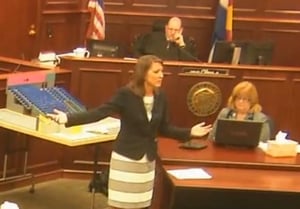
News
Aug 07, 2015
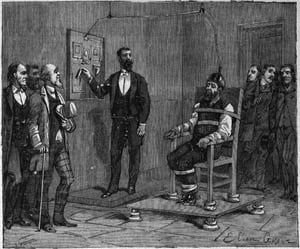
125 Years Ago, First Execution Using Electric Chair Was Botched
On August 6, 1890, New York executed William Kemmler. It was the first time ever a state used the electric chair to carry out an execution. Proponents of electrocution — including Thomas Edison — touted the new method as quick, effective, painless, and humane: the same arguments later used by legislators to support lethal injection and execution by nitrogen gas. In May 1890, the U.S. Supreme Court rejected Kemmler’s challenge that the electric chair was cruel and unusual punishment.
Read More