Publications & Testimony
Testimony and Statements on the Death Penalty
FROM DPIC
For testimony by former Executive Director Robert Dunham and former Executive Director Richard C. Dieter, please visit our page DPIC Testimony.
FROM RELIGIOUS LEADERS AND ORGANIZATIONS
- News Brief: Pope Francis Calls for Prayer to Abolish the Death Penalty (September 1, 2022)
- Jewish Congregation Renews Request for Department of Justice to Drop Death Penalty in Tree of Life Synagogue Killings (June 24, 2021)
- Orthodox Church Patriarch Calls Death Penalty Incompatible with Christian Beliefs (October 20, 2020)
- Presbyterian Church (U.S.A.) — Statement on the Federal Death Penalty (August 5, 2019)
- Louisiana Christian Faith Leaders Call for State to Abolish Death Penalty (April 25, 2019)
- Pittsburgh Rabbi’s Wife Opposes Death Penalty for Tree of Life Synagogue Killings (March 18, 2019)
- Orthodox Jewish Organization Calls for an End to Capital Punishment in the U.S. | Death Penalty Information Center (February 17, 2016)
- Baptist Theologian Says Death Penalty Does Not Fit With Christian Theology (March 8, 2016)
- Civil and Human Rights: Death Penalty — Church & Society, The United Methodist Church
- Religious Views: Over 150 Catholic Theologians Call for Repeal of the Death Penalty (September 27, 2011)
- Power Over Life and Death — The Power to Save a Life (January 15, 2005)
- Responsibility, Rehabilitation, and Restoration: A Catholic Perspective on Crime and Criminal Justice (November 2000)
- The Challenge of Holiness: A Sermon on the Death Penalty (January 10, 2000)
- General Assembly of the Texas Conference of Churches — Resolution Opposing the Death Penalty (February 24, 1998)
- Statement by Catholic Bishops of Texas on Capital Punishment (October 20, 1997)
- Catholic Church Expresses Strong Opposition to Capital Punishment in Catechism (September 9, 1997)
- Catholic Bishops of Iowa Issue Statement on Death Penalty (February 4, 1998)
- To End the Death Penalty: A Report of the National Jewish/Catholic Consultation
- Transcript of Dr. Pat Robertson’s Speech on the Role of Religion and the Death Penalty at The College of William and Mary
- Collection of Official Catholic Statements on the Death Penalty (1980)
FROM THE INTERNATIONAL COMMUNITY
- UN experts call for universal abolition of the death penalty | OHCHR (October 9, 2023)
- Zambia Becomes 25th Sub-Saharan African Nation to Abolish Death Penalty (December 23, 2022)
- Belgium Wants a World Without the Death Penalty (October 20, 2022)
- As France Prepares to Assume Presidency of European Union, Emmanuel Macron Announces Initiative for Worldwide Abolition of Death Penalty (October 11, 2021)
- U.N. Secretary-General, European Union Ambassador Call for Abolition of “Barbaric” Death Penalty (October 11, 2017)
- European Union Calls for Abolition of Capital Punishment as World Coalition Hosts International Death Penalty Conference (June 27, 2017)
- U.N. Investigator Talks About the Future of Solitary and the Death Penalty (November 7, 2016)
- World Congress Against the Death Penalty Renews Call for Global Moratorium, Pope Sends Message of Support (June 27, 2016)
- Declaration by the Presidency on behalf of the European Union on the 400th execution in Texas from the Council of the European Union (August 21, 2007)
- Resolution Supporting Worldwide Moratorium on Executions from the United Nations Commission on Human Rights (April 1999)
- Mary Robinson, U.N. High Commissioner for Human Rights — Message to the Press Conference organized by the Death Penalty Information Center for the release of the report, “International Perspectives on the Death Penalty” (October 12, 1999)
- Status of the International Covenants on Human Rights from the United Nations Commission on Human Rights (April 1998)
FROM ADVOCACY GROUPS
- Advocacy Group Tells Supreme Court that Negative Stereotypes Distort Perception that Latinos in Death-Penalty Cases Pose Future Danger to Society (April 15, 2022)
- Disability Rights Groups, Legal Experts, and Conservative Advocates Urge Supreme Court to Strike Down Georgia’s Uniquely Harsh Proof Requirements in Death-Penalty Intellectual Disabilities Cases (January 11, 2022)
- NAACP Reaffirms Its Support of Abolishing the Death Penalty (2022)
- More Than 80 Civil Rights and Advocacy Organizations Urge President Biden to End Federal Executions | Death Penalty Information Center (February 9, 2021)
- More Than 250 Conservative Leaders Join Call to End Death Penalty (October 29, 2019)
- National Alliance on Mental Illness: The Death Penalty
- Florida League of Women Voters Calls for Halt to Executions (May 28, 2007)
- Victims Organizations Issue Joint Statement for National Victims’ Rights Week (April 19, 2007)
FROM JUDGES, LEGISLATORS, AND OTHER ORGANIZATIONS
- Republican-led Oklahoma committee considers pause on executions amid death case scrutiny (October 5, 2023)
- Former Pro-Death Penalty District Attorney Explains Why He Now Supports Abolition, and Fears Political Promises to Expand the Use of the Death Penalty (August 20, 2023)
- Pressley, Durbin Reintroduce Bill to End the Federal Death Penalty (July 13, 2023)
- The Lancet Editorial: Physician Involvement in Executions Violates Medical Ethics | Death Penalty Information Center (May 20, 2023)
- APA calls for extending ineligibility for the death penalty to adolescent offenders younger than age 21 (August 4, 2022)
- Why some Republicans are turning against the death penalty | Ron Ferguson | Ohio House of Representatives (March 8, 2022)
- Eight years on Texas’ highest criminal court turned Elsa Alcala into a death penalty skeptic. How will the court change without her? (January 26, 2019)
- AMA to Supreme Court: Doctor participation in executions unethical (August 22, 2018)
- Former Governor Bill Richardson: Death Penalty Is Bad for Business, Out of Step With World’s Views (June 16, 2017)
- Capital Punishment and Nurses’ Participation in Capital Punishment (2016)
- Former Ohio Attorney General Jim Petro Says Death Penalty Unfixable, “Not Worth It Any More” (September 12, 2016)
- Resolution Supporting Repeal of the Death Penalty, National Hispanic Caucus of State Legislators (August 11, 2016)
- Retired Police Captain Says Repealing Death Penalty Is “Smart on Crime” (November 24, 2014)
- Resolution Supporting Abolition of the Death Penalty, Natl. Assoc. of Black Psychologists (2012)
- The Road to Justice and Peace by New Jersey State Senator Raymond Lesniak (February 1, 2009)
- Statement On The Federal Death Penalty System by Senator Feingold (June 7, 2001)
- Statement on the Need for a Federal Moratorium on the Death Penalty Senator Feingold (October 29, 2000)
- Death Penalty: The Torah and Today (August 23, 2000)
- Press Release for Senator Russ Feingold’s Introduction of Senate’s First Death Penalty Moratorium Bill (April 20, 2000)
- Amnesty International Southern Regional Conference: Orlando, Florida Remarks by Former Florida Chief Justice Gerald Kogan (October 23, 1999)
- American Bar Association Resolution on the Death Penalty (February 3, 1997)
FROM MURDER VICTIMS’ FAMILY MEMBERS
Items: 111 — 120
Mar 31, 2026
Texas Prisoner Asks Courts to Intervene in Scheduled Execution as New Confession Raises Serious Doubt Over Original Conviction
James Broadnax, a Texas death-sentenced prisoner, is scheduled to be executed on April 30, 2026. He was convicted in 2009 by a Dallas County jury for the murders of two music producers, Stephen Swan and Matthew Butler, who were shot and killed outside their recording studio in 2008. On March 19, 2026, a little more than a month before his scheduled execution, attorneys for Mr. Broadnax filed a new appeal and a sworn affidavit from his codefendant and cousin Demarius Cummings, in which Mr.
Read More
Mar 30, 2026
New “Facts About the Death Penalty” from the Death Penalty Information Center
For 35 years, the Death Penalty Information Center (DPI) has carefully tracked and analyzed how the death penalty is used in the United States. DPI is the only national organization that monitors new death sentences, executions, public opinion, legislation, and newsworthy events, providing critical context to facilitate meaningful public debate and inform sound policy decisions about the death penalty. DPI’s most popular educational resource, “Facts About the Death Penalty,” presents critical…
Read More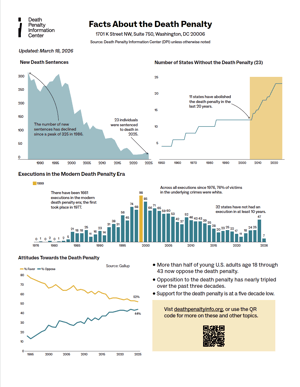
Mar 27, 2026
Focus on Iran: Three Men are Executed Amid War, Marking First Executions of December 2025/January 2026 Protestors
Iran hanged three men — Saleh Mohammadi, Saeed Davodi, and Mehdi Ghasemi — in the city of Qom on March 19, 2026, the day before the nation’s new year. According to the judiciary-affiliated Mizan News Agency, the three men, who were accused of participating in the killings of two policemen during protests, were hanged “in the presence of a group of people.” This marked the first execution of protestors following the recent wave of nationwide protests, which began on December 28, 2025, initially in…
Read MoreMar 25, 2026
Three U.S. Supreme Court Justices Decry “Inexplicable” Texas Refusal to Test DNA in Rodney Reed Case
Texas prosecutors sent Rodney Reed to death row for the 1996 murder of Stacey Stites, whom they argued was strangled with her own leather belt. Yet for over a decade, state officials have fought Mr. Reed’s requests to test that belt for the killer’s DNA. In 2023, the United States Supreme Court ruled that Mr. Reed’s lawsuit seeking the test was timely, and last year it struck down Texas’ attempts to block DNA testing in two other capital cases. However, on March 23, the Court refused to hear…
Read More
Mar 24, 2026
Amici Supporting Texas Prisoner Charles Flores Urge U.S. Supreme Court to Hear His Innocence Claims, Including Those Based on Discredited ‘Investigative Hypnosis’ Evidence
On March 12, 2026, a diverse group of voices filed amicus curiae briefs in support of Charles Flores (pictured), a Texas death-sentenced prisoner, urging the U.S. Supreme Court to review his case. Mr. Flores has spent more than 25 years on death row for a murder he maintains he did not commit. His conviction relied on the testimony of a neighbor who identified him — for the first time, at trial — only after being hypnotized by police. The briefs were filed by a coalition including the entertainers…
Read More
Mar 23, 2026
What to Know: Mentally Ill Prisoners and the Death Penalty
DPI’s “What to Know” series examines capital punishment from multiple angles, one topic at a time. Each installment provides essential facts and data on specific aspects of the death penalty. Why it matters: While the U.S. Supreme Court has barred the execution of individuals with intellectual disabilities, no such categorical ban exists for those with severe mental illness (SMI). Consequently, people suffering from active psychosis, delusions, or severe neurobiological impairments remain…
Read MoreMar 20, 2026
12:01 The Death Penalty in Context: Elizabeth Vartkessian on Mitigation and “The Deserving”
In the March 2026 episode of 12:01: The Death Penalty in Context, DPI Managing Director Anne Holsinger speaks with Elizabeth Vartkessian (pictured), the executive director of Advancing Real Change (ARC), a national non-profit that works to provide mitigation investigation services and training that ensure the full life histories of individuals facing extreme sentences are presented to judges and juries. Ms. Vartkessian is a mitigation specialist who has spent decades investigating the lives and…
Read More
Mar 18, 2026
Ohio Court “Formally Vindicates” Death Row Exoneree 41 Years After Conviction, Opening the Door for Potentially 1 Million Dollars in Wrongful Conviction Compensation
On March 5, 2026, Hamilton County Common Pleas Judge Christopher McDowell “formally vindicated” death-sentenced exoneree Derrick Jamison, allowing him to seek monetary compensation from the state for his wrongful incarceration 21 years after prosecutors dropped charges. Mr. Jamison, who was scheduled for execution six times while imprisoned, filed a lawsuit seeking a formal declaration of wrongful imprisonment in 2024. With this formal declaration, he can now file a civil claim for monetary…
Read More
Mar 17, 2026
U.S. Supreme Court Declines to Hear State’s Appeal in Michael Sockwell’s Case, Clearing Path for New Trial
On March 2, 2026, the U.S. Supreme Court declined to review Alabama’s appeal of a ruling by the U.S. Court of Appeals for the Eleventh Circuit that reversed and remanded Michael Sockwell’s case on the grounds that the trial prosecutor violated his constitutional rights by intentionally removing Black jurors. The Court’s denial of review clears a path for Mr. Sockwell to receive a new trial, some 36 years after a judge first sentenced him to death. A November 2025 federal court ruling ordered…
Read More
Mar 16, 2026
The New York Times Editorial Board Condemns Secrecy, Arbitrariness of U.S. Death Penalty
The New York Times editorial board published an article on March 13, 2026, condemning use of the death penalty in the country as secretive, arbitrary, and unjust. Relying heavily on research and data maintained by the Death Penalty Information Center, the board describes the events of 2025, with its sharp increase in executions, as a “dark new period” in the nation’s history. The board attributes much of the surge to Florida, which alone carried out 19 executions in 2025 alongside broader…
Read More