Publications & Testimony
Testimony and Statements on the Death Penalty
FROM DPIC
For testimony by former Executive Director Robert Dunham and former Executive Director Richard C. Dieter, please visit our page DPIC Testimony.
FROM RELIGIOUS LEADERS AND ORGANIZATIONS
- News Brief: Pope Francis Calls for Prayer to Abolish the Death Penalty (September 1, 2022)
- Jewish Congregation Renews Request for Department of Justice to Drop Death Penalty in Tree of Life Synagogue Killings (June 24, 2021)
- Orthodox Church Patriarch Calls Death Penalty Incompatible with Christian Beliefs (October 20, 2020)
- Presbyterian Church (U.S.A.) — Statement on the Federal Death Penalty (August 5, 2019)
- Louisiana Christian Faith Leaders Call for State to Abolish Death Penalty (April 25, 2019)
- Pittsburgh Rabbi’s Wife Opposes Death Penalty for Tree of Life Synagogue Killings (March 18, 2019)
- Orthodox Jewish Organization Calls for an End to Capital Punishment in the U.S. | Death Penalty Information Center (February 17, 2016)
- Baptist Theologian Says Death Penalty Does Not Fit With Christian Theology (March 8, 2016)
- Civil and Human Rights: Death Penalty — Church & Society, The United Methodist Church
- Religious Views: Over 150 Catholic Theologians Call for Repeal of the Death Penalty (September 27, 2011)
- Power Over Life and Death — The Power to Save a Life (January 15, 2005)
- Responsibility, Rehabilitation, and Restoration: A Catholic Perspective on Crime and Criminal Justice (November 2000)
- The Challenge of Holiness: A Sermon on the Death Penalty (January 10, 2000)
- General Assembly of the Texas Conference of Churches — Resolution Opposing the Death Penalty (February 24, 1998)
- Statement by Catholic Bishops of Texas on Capital Punishment (October 20, 1997)
- Catholic Church Expresses Strong Opposition to Capital Punishment in Catechism (September 9, 1997)
- Catholic Bishops of Iowa Issue Statement on Death Penalty (February 4, 1998)
- To End the Death Penalty: A Report of the National Jewish/Catholic Consultation
- Transcript of Dr. Pat Robertson’s Speech on the Role of Religion and the Death Penalty at The College of William and Mary
- Collection of Official Catholic Statements on the Death Penalty (1980)
FROM THE INTERNATIONAL COMMUNITY
- UN experts call for universal abolition of the death penalty | OHCHR (October 9, 2023)
- Zambia Becomes 25th Sub-Saharan African Nation to Abolish Death Penalty (December 23, 2022)
- Belgium Wants a World Without the Death Penalty (October 20, 2022)
- As France Prepares to Assume Presidency of European Union, Emmanuel Macron Announces Initiative for Worldwide Abolition of Death Penalty (October 11, 2021)
- U.N. Secretary-General, European Union Ambassador Call for Abolition of “Barbaric” Death Penalty (October 11, 2017)
- European Union Calls for Abolition of Capital Punishment as World Coalition Hosts International Death Penalty Conference (June 27, 2017)
- U.N. Investigator Talks About the Future of Solitary and the Death Penalty (November 7, 2016)
- World Congress Against the Death Penalty Renews Call for Global Moratorium, Pope Sends Message of Support (June 27, 2016)
- Declaration by the Presidency on behalf of the European Union on the 400th execution in Texas from the Council of the European Union (August 21, 2007)
- Resolution Supporting Worldwide Moratorium on Executions from the United Nations Commission on Human Rights (April 1999)
- Mary Robinson, U.N. High Commissioner for Human Rights — Message to the Press Conference organized by the Death Penalty Information Center for the release of the report, “International Perspectives on the Death Penalty” (October 12, 1999)
- Status of the International Covenants on Human Rights from the United Nations Commission on Human Rights (April 1998)
FROM ADVOCACY GROUPS
- Advocacy Group Tells Supreme Court that Negative Stereotypes Distort Perception that Latinos in Death-Penalty Cases Pose Future Danger to Society (April 15, 2022)
- Disability Rights Groups, Legal Experts, and Conservative Advocates Urge Supreme Court to Strike Down Georgia’s Uniquely Harsh Proof Requirements in Death-Penalty Intellectual Disabilities Cases (January 11, 2022)
- NAACP Reaffirms Its Support of Abolishing the Death Penalty (2022)
- More Than 80 Civil Rights and Advocacy Organizations Urge President Biden to End Federal Executions | Death Penalty Information Center (February 9, 2021)
- More Than 250 Conservative Leaders Join Call to End Death Penalty (October 29, 2019)
- National Alliance on Mental Illness: The Death Penalty
- Florida League of Women Voters Calls for Halt to Executions (May 28, 2007)
- Victims Organizations Issue Joint Statement for National Victims’ Rights Week (April 19, 2007)
FROM JUDGES, LEGISLATORS, AND OTHER ORGANIZATIONS
- Republican-led Oklahoma committee considers pause on executions amid death case scrutiny (October 5, 2023)
- Former Pro-Death Penalty District Attorney Explains Why He Now Supports Abolition, and Fears Political Promises to Expand the Use of the Death Penalty (August 20, 2023)
- Pressley, Durbin Reintroduce Bill to End the Federal Death Penalty (July 13, 2023)
- The Lancet Editorial: Physician Involvement in Executions Violates Medical Ethics | Death Penalty Information Center (May 20, 2023)
- APA calls for extending ineligibility for the death penalty to adolescent offenders younger than age 21 (August 4, 2022)
- Why some Republicans are turning against the death penalty | Ron Ferguson | Ohio House of Representatives (March 8, 2022)
- Eight years on Texas’ highest criminal court turned Elsa Alcala into a death penalty skeptic. How will the court change without her? (January 26, 2019)
- AMA to Supreme Court: Doctor participation in executions unethical (August 22, 2018)
- Former Governor Bill Richardson: Death Penalty Is Bad for Business, Out of Step With World’s Views (June 16, 2017)
- Capital Punishment and Nurses’ Participation in Capital Punishment (2016)
- Former Ohio Attorney General Jim Petro Says Death Penalty Unfixable, “Not Worth It Any More” (September 12, 2016)
- Resolution Supporting Repeal of the Death Penalty, National Hispanic Caucus of State Legislators (August 11, 2016)
- Retired Police Captain Says Repealing Death Penalty Is “Smart on Crime” (November 24, 2014)
- Resolution Supporting Abolition of the Death Penalty, Natl. Assoc. of Black Psychologists (2012)
- The Road to Justice and Peace by New Jersey State Senator Raymond Lesniak (February 1, 2009)
- Statement On The Federal Death Penalty System by Senator Feingold (June 7, 2001)
- Statement on the Need for a Federal Moratorium on the Death Penalty Senator Feingold (October 29, 2000)
- Death Penalty: The Torah and Today (August 23, 2000)
- Press Release for Senator Russ Feingold’s Introduction of Senate’s First Death Penalty Moratorium Bill (April 20, 2000)
- Amnesty International Southern Regional Conference: Orlando, Florida Remarks by Former Florida Chief Justice Gerald Kogan (October 23, 1999)
- American Bar Association Resolution on the Death Penalty (February 3, 1997)
FROM MURDER VICTIMS’ FAMILY MEMBERS
Items: 2631 — 2640
Nov 03, 2016
Editorial Boards, Oklahoma Conference of Churches Oppose Death Penalty Ballot Measure
The editorial boards of Oklahoma’s two major newspapers and the leadership of the Oklahoma Conference of Churches are all urging voters to vote no on State Question 776, which would enshrine the death penalty in the Oklahoma constitution and remove from state courts the power to declare the death penalty cruel and unusual punishment. The Oklahoman called SQ 776 “unnecesary,” saying it, “should be rejected by Oklahoma voters on Nov. 8.” The Tulsa World also encouraged a no vote on 776, saying…
Read More
Nov 02, 2016
Former Ohio Death Row Prisoner Seeks Full Exoneration in Light of Misconduct Accusations Against State Crime Lab Analyst
Former Ohio death row prisoner Kevin Keith (pictured) has filed a motion seeking a new trial to clear his name after evidence has emerged of systemic bias and erratic behavior by the Ohio Bureau of Criminal Investigation (BCI) scientist whose testimony helped put him on death row. Keith and James Parsons, who also was convicted of murder and was sentenced to a term of 15 years to life in prison, have challenged the work of BCI analyst G. Michele Yezzo, who testified at dozens of trials over her…
Read More
Nov 01, 2016
BOOKS: “Courting Death: The Supreme Court and Capital Punishment”
Courting Death: The Supreme Court and Capital Punishment by Harvard Law Professor Carol S. Steiker and University of Texas Law Professor Jordan M. Steiker examines the U.S. Supreme Court’s “extensive — and ultimately failed — effort to reform and rationalize the practice of capital punishment in the United States through top-down, constitutional regulation.” The authors argue that significant constitutional flaws persist in the death penalty system despite the Court’s attempts to regulate it, and…
Read More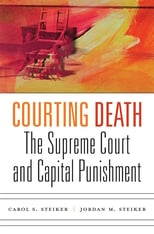
Oct 31, 2016
OUTLIER COUNTIES: San Bernardino, California Shares Problematic Patterns of Neighboring Counties
San Bernardino County, California is one of five Southern California counties that have produced more death sentences since 2010 than 99.5% of all U.S. counties. Along with its neighbors, Kern County, Riverside County, Orange County, and Los Angeles County, San Bernardino forms a “new Death Belt,” a region with high numbers of death sentences marked by overzealous prosecutors and poor representation for defendants facing a death sentence. In January 2013, San Bernardino had 37 prisoners on…
Read More
Oct 28, 2016
Florida Supreme Court Vacates Capital Conviction on Innocence Claim
With newly discovered confessions and DNA evidence pointing to the prosecution’s chief witness as the actual killer, the Florida Supreme Court, on October 27, vacated the capital conviction of death-row prisoner Clemente Aguirre. Aguirre was convicted of killing his two neighbors — an elderly woman and her adult daughter — but he has always maintained his innocence and claimed that he discovered the women after they were deceased. After he was convicted, Aguirre’s post-conviction attorneys…
Read More
Oct 27, 2016
President Commutes All Death Sentences in Kenya
Kenya has commuted the death sentences of all 2,747 prisoners on the nation’s death row. On October 24, President Uhuru Kenyatta signed orders sparing the lives of 2,655 men and 92 women who had been sentenced to death, commuting their sentences to terms of life in prison. While Kenya still authorizes the death penalty, it has not carried out an execution in nearly 30 years. In August 2009, former President Mwai Kibaki commuted the death sentences of the more than 4,000 prisoners who were then…
Read More
Oct 26, 2016
Gallup Poll: Support for Death Penalty at Lowest Level Since 1972
Support for the death penalty in the United States is at its lowest level since November 1972, according to a Gallup poll released October 25. Gallup reported that 60% of respondents said they support capital punishment — off one percentage point from last year — while opposition remained at 37%, matching its highest level since the U.S. Supreme Court struck down the death penalty in 1972. Support has dropped 9 points since 2007 and 20 points since its peak in 1994. The results reflect the same…
Read More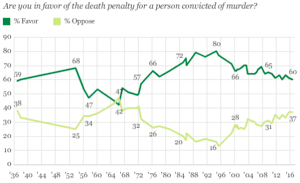
Oct 25, 2016
Supported by New DNA Evidence, Man Sentenced to Death in Virginia in 1970 Files Innocence Claim
Sherman Brown (pictured), a man who was sentenced to death in Virginia in 1970 for the murder of a 4‑year-old boy, has filed a writ of actual innocence with the Virginia Supreme Court saying that DNA testing on recently discovered evidence clears him of the crime. Brown’s petition states: “Recent DNA testing demonstrates by clear and convincing evidence what I have maintained for over 45 years: that I am innocent of this crime. The evidence against me at trial was deeply flawed.” Brown was…
Read More
Oct 24, 2016
STUDIES: Death Penalty Adversely Affects Families of Victims and Defendants
The death penalty adversely affects both families of murder victims and families of the accused, according to two recent journal articles. In his Psychology Today blog, Talking About Trauma, psychologist Dr. Robert T. Muller (pictured) reports that psychological studies have have found that the death penalty produces negative effects on families and friends of murder victims (referred to as “co-victims”). One University of Minnesota study found that just 2.5% of co-victims reported achieving…
Read More
Oct 21, 2016
Florida Supreme Court Rules Intellectual Disability Decision Applies Retroactively
The Florida Supreme Court has ruled that death-row prisoners who had unsuccessfully argued that they are ineligible for the death penalty because of intellectual disability must be provided a second chance to prove their claims. On October 20, the Court decided in Walls v. State that Florida must retroactively apply the U.S. Supreme Court’s 2014 decision in Hall v. Florida, which declared Florida’s procedures for determining intellectual disability to be unconstitutional. Prisoners whose…
Read More