Publications & Testimony
Testimony and Statements on the Death Penalty
FROM DPIC
For testimony by former Executive Director Robert Dunham and former Executive Director Richard C. Dieter, please visit our page DPIC Testimony.
FROM RELIGIOUS LEADERS AND ORGANIZATIONS
- News Brief: Pope Francis Calls for Prayer to Abolish the Death Penalty (September 1, 2022)
- Jewish Congregation Renews Request for Department of Justice to Drop Death Penalty in Tree of Life Synagogue Killings (June 24, 2021)
- Orthodox Church Patriarch Calls Death Penalty Incompatible with Christian Beliefs (October 20, 2020)
- Presbyterian Church (U.S.A.) — Statement on the Federal Death Penalty (August 5, 2019)
- Louisiana Christian Faith Leaders Call for State to Abolish Death Penalty (April 25, 2019)
- Pittsburgh Rabbi’s Wife Opposes Death Penalty for Tree of Life Synagogue Killings (March 18, 2019)
- Orthodox Jewish Organization Calls for an End to Capital Punishment in the U.S. | Death Penalty Information Center (February 17, 2016)
- Baptist Theologian Says Death Penalty Does Not Fit With Christian Theology (March 8, 2016)
- Civil and Human Rights: Death Penalty — Church & Society, The United Methodist Church
- Religious Views: Over 150 Catholic Theologians Call for Repeal of the Death Penalty (September 27, 2011)
- Power Over Life and Death — The Power to Save a Life (January 15, 2005)
- Responsibility, Rehabilitation, and Restoration: A Catholic Perspective on Crime and Criminal Justice (November 2000)
- The Challenge of Holiness: A Sermon on the Death Penalty (January 10, 2000)
- General Assembly of the Texas Conference of Churches — Resolution Opposing the Death Penalty (February 24, 1998)
- Statement by Catholic Bishops of Texas on Capital Punishment (October 20, 1997)
- Catholic Church Expresses Strong Opposition to Capital Punishment in Catechism (September 9, 1997)
- Catholic Bishops of Iowa Issue Statement on Death Penalty (February 4, 1998)
- To End the Death Penalty: A Report of the National Jewish/Catholic Consultation
- Transcript of Dr. Pat Robertson’s Speech on the Role of Religion and the Death Penalty at The College of William and Mary
- Collection of Official Catholic Statements on the Death Penalty (1980)
FROM THE INTERNATIONAL COMMUNITY
- UN experts call for universal abolition of the death penalty | OHCHR (October 9, 2023)
- Zambia Becomes 25th Sub-Saharan African Nation to Abolish Death Penalty (December 23, 2022)
- Belgium Wants a World Without the Death Penalty (October 20, 2022)
- As France Prepares to Assume Presidency of European Union, Emmanuel Macron Announces Initiative for Worldwide Abolition of Death Penalty (October 11, 2021)
- U.N. Secretary-General, European Union Ambassador Call for Abolition of “Barbaric” Death Penalty (October 11, 2017)
- European Union Calls for Abolition of Capital Punishment as World Coalition Hosts International Death Penalty Conference (June 27, 2017)
- U.N. Investigator Talks About the Future of Solitary and the Death Penalty (November 7, 2016)
- World Congress Against the Death Penalty Renews Call for Global Moratorium, Pope Sends Message of Support (June 27, 2016)
- Declaration by the Presidency on behalf of the European Union on the 400th execution in Texas from the Council of the European Union (August 21, 2007)
- Resolution Supporting Worldwide Moratorium on Executions from the United Nations Commission on Human Rights (April 1999)
- Mary Robinson, U.N. High Commissioner for Human Rights — Message to the Press Conference organized by the Death Penalty Information Center for the release of the report, “International Perspectives on the Death Penalty” (October 12, 1999)
- Status of the International Covenants on Human Rights from the United Nations Commission on Human Rights (April 1998)
FROM ADVOCACY GROUPS
- Advocacy Group Tells Supreme Court that Negative Stereotypes Distort Perception that Latinos in Death-Penalty Cases Pose Future Danger to Society (April 15, 2022)
- Disability Rights Groups, Legal Experts, and Conservative Advocates Urge Supreme Court to Strike Down Georgia’s Uniquely Harsh Proof Requirements in Death-Penalty Intellectual Disabilities Cases (January 11, 2022)
- NAACP Reaffirms Its Support of Abolishing the Death Penalty (2022)
- More Than 80 Civil Rights and Advocacy Organizations Urge President Biden to End Federal Executions | Death Penalty Information Center (February 9, 2021)
- More Than 250 Conservative Leaders Join Call to End Death Penalty (October 29, 2019)
- National Alliance on Mental Illness: The Death Penalty
- Florida League of Women Voters Calls for Halt to Executions (May 28, 2007)
- Victims Organizations Issue Joint Statement for National Victims’ Rights Week (April 19, 2007)
FROM JUDGES, LEGISLATORS, AND OTHER ORGANIZATIONS
- Republican-led Oklahoma committee considers pause on executions amid death case scrutiny (October 5, 2023)
- Former Pro-Death Penalty District Attorney Explains Why He Now Supports Abolition, and Fears Political Promises to Expand the Use of the Death Penalty (August 20, 2023)
- Pressley, Durbin Reintroduce Bill to End the Federal Death Penalty (July 13, 2023)
- The Lancet Editorial: Physician Involvement in Executions Violates Medical Ethics | Death Penalty Information Center (May 20, 2023)
- APA calls for extending ineligibility for the death penalty to adolescent offenders younger than age 21 (August 4, 2022)
- Why some Republicans are turning against the death penalty | Ron Ferguson | Ohio House of Representatives (March 8, 2022)
- Eight years on Texas’ highest criminal court turned Elsa Alcala into a death penalty skeptic. How will the court change without her? (January 26, 2019)
- AMA to Supreme Court: Doctor participation in executions unethical (August 22, 2018)
- Former Governor Bill Richardson: Death Penalty Is Bad for Business, Out of Step With World’s Views (June 16, 2017)
- Capital Punishment and Nurses’ Participation in Capital Punishment (2016)
- Former Ohio Attorney General Jim Petro Says Death Penalty Unfixable, “Not Worth It Any More” (September 12, 2016)
- Resolution Supporting Repeal of the Death Penalty, National Hispanic Caucus of State Legislators (August 11, 2016)
- Retired Police Captain Says Repealing Death Penalty Is “Smart on Crime” (November 24, 2014)
- Resolution Supporting Abolition of the Death Penalty, Natl. Assoc. of Black Psychologists (2012)
- The Road to Justice and Peace by New Jersey State Senator Raymond Lesniak (February 1, 2009)
- Statement On The Federal Death Penalty System by Senator Feingold (June 7, 2001)
- Statement on the Need for a Federal Moratorium on the Death Penalty Senator Feingold (October 29, 2000)
- Death Penalty: The Torah and Today (August 23, 2000)
- Press Release for Senator Russ Feingold’s Introduction of Senate’s First Death Penalty Moratorium Bill (April 20, 2000)
- Amnesty International Southern Regional Conference: Orlando, Florida Remarks by Former Florida Chief Justice Gerald Kogan (October 23, 1999)
- American Bar Association Resolution on the Death Penalty (February 3, 1997)
FROM MURDER VICTIMS’ FAMILY MEMBERS
Items: 2781 — 2790
Apr 11, 2016
Virginia Governor Rejects Mandatory Use of Electric Chair, Proposes Lethal Injection Secrecy
Virginia Governor Terry McAuliffe rejected a bill that would have employed the electric chair as the state’s method of execution if lethal injection drugs are unavailable. Instead, he offered amendments that would permit the Commonwealth’s Department of Corrections to enter into confidential contracts to obtain execution drugs from compounding pharmacies, whose identities would be concealed from the public. His proposal is similar to legislation he backed last year that failed because of…
Read More
Apr 08, 2016
Orange County Prosecutors Drop Death Penalty in Misconduct-Plagued Case, May Avoid Surrendering DNA Evidence
Kenneth Clair (pictured), whose California death sentence was overturned last year, says he is innocent and that the Orange County District Attorney’s office is withholding DNA evidence that would prove it. His prosecutors have declared that they will not seek the death penalty against Clair in a new sentencing hearing, and in so doing may avoid pretrial discovery proceedings in which they could have been required to turn over the potentially exclupatory DNA evidence to the defense. Clair was…
Read More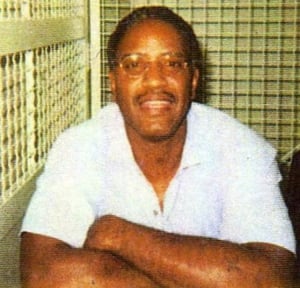
Apr 07, 2016
Texas Court Finds Marcus Druery Mentally Incompetent, Spares Him From Execution
A Texas court has found that a severely mentally ill death-row inmate, Marcus Druery (pictured), is incompetent to be executed. Druery’s attorneys presented more than 150 pages of reports from mental health professionals arguing that, as a result of major mental illness, Druery does not understand why he is being punished, making it unconstitutional to execute him. His “paranoid and grandiose delusions…deprive him of a rational understanding of the connection between his crime and punishment,”…
Read More
Apr 06, 2016
Amnesty International Reports Concentrated Spikes in Executions Amidst Continuing Trend Towards Global Death Penalty Abolition
Amnesty International reported that worldwide executions spiked by 54% to at least 1,634 — a 25-year high — in 2015, even as the number of countries abolishing the death penalty reached record levels. In its annual report on global developments in capital punishment, released on April 6, Amnesty said that the bulk of recorded executions were concentrated in just three outlier countries — Iran, Pakistan, and Saudi Arabia. These countries accounted for 89% of all recorded executions. Amnesty did not…
Read More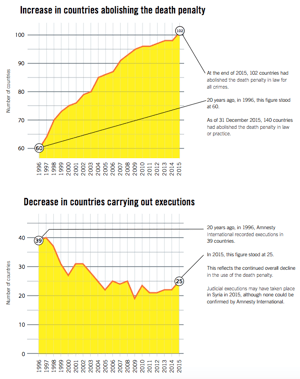
Apr 05, 2016
Victim’s Cousin in Oklahoma Death Penalty Case Speaks of “Awful” Guilt Upon Learning Defendants Were Actually Innocent
After Debbie Carter was raped and murdered in Ada, Oklahoma in 1982, police and prosecutors told her cousin, Christy Sheppard (pictured) that Ron Williamson and Dennis Fritz were guilty of the crime. In 1988, Williamson was convicted and sentenced to death; Fritz received a life sentence. Eleven years later, the pair were exonerated when DNA testing excluded them as perpetrators and pointed to another man who had once been a suspect. Sheppard, now a criminal justice counselor and victim…
Read More
Apr 04, 2016
Arbitrariness Remains Pervasive 40 Years After Court Decision Upholding Capital Punishment
Forty years after the U.S. Supreme Court upheld newly enacted death penalty statutes in Gregg v. Georgia and two other cases, Professor Evan J. Mandery of the John Jay College of Criminal Justice says arbitrariness continues to plague the administration of capital punishment across the United States. In a piece for The Marshall Project, Professor Mandery revisits the death penalty in light of the constitutional defects that led the Supreme Court to overturn existing capital punishment statutes…
Read More
Apr 01, 2016
Recent Executions May Have Denied Key Evidence to Defendants in Pending Innocence Cases
According to a report by Raw Story, two recent executions may have irreparably impaired efforts by several prisoners to prove their innocence, preventing them from presenting testimony from potential alternate suspects. Rodney Lincoln was convicted of the 1982 murder of JoAnn Tate and assaulting her two young daughters and was sentenced to two life terms. The primary evidence against him was the testimony of Melissa Davis, Tate’s eight-year-old daughter who survived the attack. Years later…
Read More
Mar 31, 2016
Board Denies Clemency for Death Row Inmate Whose Co-Defendant Received Life Sentence
The Georgia Board of Pardons and Paroles announced on March 31 that it had denied clemency to Joshua Bishop. Bishop had asked that his death sentence be reduced to life without parole because his co-defendant, who was nearly twice Bishop’s age at the time of the crime, and had a history of violent crime while Bishop did not, was given a plea deal resulting in a life sentence. Bishop is scheduled to be executed in Georgia on March 31. Seven of the twelve jurors who voted to sentence Bishop to…
Read More
Mar 30, 2016
Volunteer Death Penalty Review Commission to Examine Oklahoma’s Death Penalty
A group of prominent Oklahomans have announced the creation of a 12-member Oklahoma Death Penalty Review Commission to conduct a comprehensive review of the state’s death penalty. The all-volunteer commission will be led by three co-chairs, former Governor Brad Henry (pictured), retired Court of Criminal Appeals Judge Reta Strubhar, and former U.S. Magistrate Judge Andy Lester. The commission intends “to conduct extensive research on [Oklahoma’s] entire death penalty process, beginning with an…
Read More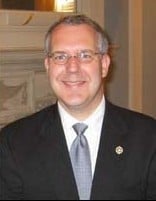
Mar 29, 2016
Finding Prosecutorial Misconduct, Alabama Courts Grant Relief from Two Capital Convictions
In one week, courts in unrelated cases have granted relief to two Alabama death row inmates because of prosecutorial misconduct. On March 11, Alabama Circuit Judge Robert Smith dismissed capital charges against ex-state trooper George Martin and barred his retrial because of the prosecution’s “willful misconduct.” Martin had been convicted for allegedly murdering his wife in a car fire. In 2000, jurors recommended that Martin be sentenced to life, but the trial judge overrode their…
Read More