Publications & Testimony
Testimony and Statements on the Death Penalty
FROM DPIC
For testimony by former Executive Director Robert Dunham and former Executive Director Richard C. Dieter, please visit our page DPIC Testimony.
FROM RELIGIOUS LEADERS AND ORGANIZATIONS
- News Brief: Pope Francis Calls for Prayer to Abolish the Death Penalty (September 1, 2022)
- Jewish Congregation Renews Request for Department of Justice to Drop Death Penalty in Tree of Life Synagogue Killings (June 24, 2021)
- Orthodox Church Patriarch Calls Death Penalty Incompatible with Christian Beliefs (October 20, 2020)
- Presbyterian Church (U.S.A.) — Statement on the Federal Death Penalty (August 5, 2019)
- Louisiana Christian Faith Leaders Call for State to Abolish Death Penalty (April 25, 2019)
- Pittsburgh Rabbi’s Wife Opposes Death Penalty for Tree of Life Synagogue Killings (March 18, 2019)
- Orthodox Jewish Organization Calls for an End to Capital Punishment in the U.S. | Death Penalty Information Center (February 17, 2016)
- Baptist Theologian Says Death Penalty Does Not Fit With Christian Theology (March 8, 2016)
- Civil and Human Rights: Death Penalty — Church & Society, The United Methodist Church
- Religious Views: Over 150 Catholic Theologians Call for Repeal of the Death Penalty (September 27, 2011)
- Power Over Life and Death — The Power to Save a Life (January 15, 2005)
- Responsibility, Rehabilitation, and Restoration: A Catholic Perspective on Crime and Criminal Justice (November 2000)
- The Challenge of Holiness: A Sermon on the Death Penalty (January 10, 2000)
- General Assembly of the Texas Conference of Churches — Resolution Opposing the Death Penalty (February 24, 1998)
- Statement by Catholic Bishops of Texas on Capital Punishment (October 20, 1997)
- Catholic Church Expresses Strong Opposition to Capital Punishment in Catechism (September 9, 1997)
- Catholic Bishops of Iowa Issue Statement on Death Penalty (February 4, 1998)
- To End the Death Penalty: A Report of the National Jewish/Catholic Consultation
- Transcript of Dr. Pat Robertson’s Speech on the Role of Religion and the Death Penalty at The College of William and Mary
- Collection of Official Catholic Statements on the Death Penalty (1980)
FROM THE INTERNATIONAL COMMUNITY
- UN experts call for universal abolition of the death penalty | OHCHR (October 9, 2023)
- Zambia Becomes 25th Sub-Saharan African Nation to Abolish Death Penalty (December 23, 2022)
- Belgium Wants a World Without the Death Penalty (October 20, 2022)
- As France Prepares to Assume Presidency of European Union, Emmanuel Macron Announces Initiative for Worldwide Abolition of Death Penalty (October 11, 2021)
- U.N. Secretary-General, European Union Ambassador Call for Abolition of “Barbaric” Death Penalty (October 11, 2017)
- European Union Calls for Abolition of Capital Punishment as World Coalition Hosts International Death Penalty Conference (June 27, 2017)
- U.N. Investigator Talks About the Future of Solitary and the Death Penalty (November 7, 2016)
- World Congress Against the Death Penalty Renews Call for Global Moratorium, Pope Sends Message of Support (June 27, 2016)
- Declaration by the Presidency on behalf of the European Union on the 400th execution in Texas from the Council of the European Union (August 21, 2007)
- Resolution Supporting Worldwide Moratorium on Executions from the United Nations Commission on Human Rights (April 1999)
- Mary Robinson, U.N. High Commissioner for Human Rights — Message to the Press Conference organized by the Death Penalty Information Center for the release of the report, “International Perspectives on the Death Penalty” (October 12, 1999)
- Status of the International Covenants on Human Rights from the United Nations Commission on Human Rights (April 1998)
FROM ADVOCACY GROUPS
- Advocacy Group Tells Supreme Court that Negative Stereotypes Distort Perception that Latinos in Death-Penalty Cases Pose Future Danger to Society (April 15, 2022)
- Disability Rights Groups, Legal Experts, and Conservative Advocates Urge Supreme Court to Strike Down Georgia’s Uniquely Harsh Proof Requirements in Death-Penalty Intellectual Disabilities Cases (January 11, 2022)
- NAACP Reaffirms Its Support of Abolishing the Death Penalty (2022)
- More Than 80 Civil Rights and Advocacy Organizations Urge President Biden to End Federal Executions | Death Penalty Information Center (February 9, 2021)
- More Than 250 Conservative Leaders Join Call to End Death Penalty (October 29, 2019)
- National Alliance on Mental Illness: The Death Penalty
- Florida League of Women Voters Calls for Halt to Executions (May 28, 2007)
- Victims Organizations Issue Joint Statement for National Victims’ Rights Week (April 19, 2007)
FROM JUDGES, LEGISLATORS, AND OTHER ORGANIZATIONS
- Republican-led Oklahoma committee considers pause on executions amid death case scrutiny (October 5, 2023)
- Former Pro-Death Penalty District Attorney Explains Why He Now Supports Abolition, and Fears Political Promises to Expand the Use of the Death Penalty (August 20, 2023)
- Pressley, Durbin Reintroduce Bill to End the Federal Death Penalty (July 13, 2023)
- The Lancet Editorial: Physician Involvement in Executions Violates Medical Ethics | Death Penalty Information Center (May 20, 2023)
- APA calls for extending ineligibility for the death penalty to adolescent offenders younger than age 21 (August 4, 2022)
- Why some Republicans are turning against the death penalty | Ron Ferguson | Ohio House of Representatives (March 8, 2022)
- Eight years on Texas’ highest criminal court turned Elsa Alcala into a death penalty skeptic. How will the court change without her? (January 26, 2019)
- AMA to Supreme Court: Doctor participation in executions unethical (August 22, 2018)
- Former Governor Bill Richardson: Death Penalty Is Bad for Business, Out of Step With World’s Views (June 16, 2017)
- Capital Punishment and Nurses’ Participation in Capital Punishment (2016)
- Former Ohio Attorney General Jim Petro Says Death Penalty Unfixable, “Not Worth It Any More” (September 12, 2016)
- Resolution Supporting Repeal of the Death Penalty, National Hispanic Caucus of State Legislators (August 11, 2016)
- Retired Police Captain Says Repealing Death Penalty Is “Smart on Crime” (November 24, 2014)
- Resolution Supporting Abolition of the Death Penalty, Natl. Assoc. of Black Psychologists (2012)
- The Road to Justice and Peace by New Jersey State Senator Raymond Lesniak (February 1, 2009)
- Statement On The Federal Death Penalty System by Senator Feingold (June 7, 2001)
- Statement on the Need for a Federal Moratorium on the Death Penalty Senator Feingold (October 29, 2000)
- Death Penalty: The Torah and Today (August 23, 2000)
- Press Release for Senator Russ Feingold’s Introduction of Senate’s First Death Penalty Moratorium Bill (April 20, 2000)
- Amnesty International Southern Regional Conference: Orlando, Florida Remarks by Former Florida Chief Justice Gerald Kogan (October 23, 1999)
- American Bar Association Resolution on the Death Penalty (February 3, 1997)
FROM MURDER VICTIMS’ FAMILY MEMBERS
Items: 3441 — 3450
Oct 18, 2013
Ohio Religious Leaders Express Views on Capital Punishment
Religious leaders from a variety of faiths spoke about their religious objections to the death penalty at a recent meeting in Columbus, Ohio. The meeting included leaders from several Christian denominations as well as Jewish leaders. Jack Chomsky, cantor at Congregation Tifereth Israel, said he hopes more of his colleagues will join him in speaking out about Jewish tradition, which opposes the enforcement of the death penalty. Jerald Freewalt, of the Office for Social Concerns at the Roman…
Read More
Oct 17, 2013
OP-ED: “Changes are long overdue for Texas’ clemency process”
Michael Morton (pictured), who was released after 25 years in prison for a crime he did not commit, and Barry Scheck, co-director of the Innocence Project, called for reforms in Texas’s clemency process. In a recent op-ed in the Houston Chronicle, Morton and Scheck highlighted the case of Cameron Willingham, who was executed in 2004 despite serious doubts about his guilt. According to the authors, it is now understood that investigators who believed that Willingham committed arson were…
Read More
Oct 16, 2013
VICTIMS: Families of Murder Victims Express Preference for Life Without Parole Sentence
Some of the families of those murdered in a multiple shooting in Seal Beach, California, in 2011 recently asked the District Attorney to not seek the death penalty against the defendant, Scott Dekraai. The families said the delays in pursuing such a case extended their agony and forced them to relive the incident. Instead they recommended a sentence of life imprisonment without parole. Paul Wilson, whose wife was killed in the shootings, said, “We’d like to see a speedy, and just, way to go…
Read MoreOct 15, 2013
SUPREME COURT: Self Incrimination at Issue in Kansas Case
On October 16 the U.S. Supreme Court will hear arguments in Kansas v. Cheever. One of the key defense witnesses in Scott Cheever’s death penalty trial testified that Cheever’s use of drugs impaired his judgement on the day of the crime. Prosecutors, in turn, called the physician who performed Cheever’s court-mandated mental exam, and he testified that Cheever was aware of what he was doing when he committed the crime, based on Cheever’s own statements to the doctor. The doctor’s testimony…
Read More
Oct 14, 2013
NEW VOICES: Former Death Row Warden Opposed Death Penalty
Donald Cabana, the former warden of the Mississippi State Penitentiary who died recently, spent many years actively opposing the death penalty. Having supervised several executions, Cabana was particularly disturbed about one in which the inmate may have been innocent. He said, “[H]owever we do it, in the name of justice, in the name of law and order, in the name of retribution, you … do not have the right to ask me, or any prison official, to bloody my hands with an innocent person’s blood.”
Read More
Oct 11, 2013
Florida Identifies Over 100 Inmates Nearing Execution
Following the provisions of Florida’s recently passed “Timely Justice Act,” the clerk of the state’s Supreme Court has identified 132 inmates on death row who are “warrant ready,” based on their appeals. However, fewer than 20 of those inmates have begun the executive clemency process that must be completed before an execution can take place. Once the governor signals that the clemency process is over for an inmate, a death warrant must be signed in 30 days, but there is no mandatory schedule…
Read More
Oct 10, 2013
INTERNATIONAL: Organizations Around the World Focus on Death Penalty Concerns
On October 10, the European Union commemorated World Day Against the Death Penalty, coinciding with events around the world challenging the use of capital punishment. Catherine Ashton, the EU High Representative for Foreign Affairs and Security Policy, and Thorbjørn Jagland, Secretary General of the Council of Europe released a statement, noting, “Voices in favor of the death penalty within some parts of society, including in our continent, show that there is a continuous need to spell out why…
Read More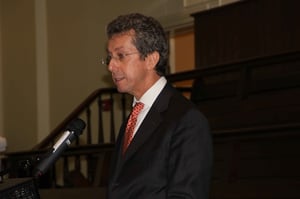
Oct 09, 2013
EDITORIALS: Wyoming Paper Recommends Life Sentences for Sake of Victims
Wyoming’s Casper Star-Tribune recently pointed out why many families of murder victims favor life-without-parole sentences over the death penalty . “[I]t may be a surprise that many families of murder victims prefer the life without parole sentence, simply because it puts the killer away forever without the decades-long court appeals that can accompany a death sentence,” the paper wrote. The editorial noted that there is only one person on the state’s death row, and he is there for a crime…
Read More
Oct 08, 2013
NEW VOICES: Former Attorneys General Agree Virginia’s Death Penalty Needs Change
Former Virginia attorneys general Mark L. Earley Sr. (pictured) and Anthony F. Troy recently called for changes to the state’s death penalty based on a September report from the American Bar Association. Writing in the Washington Post, the past law enforcement leaders called for changes to the restrictive laws governing the sharing of evidence prior to trials, amendments to jury instructions so that jurors in death cases could better understand their responsibilities, and the easing of…
Read More
Oct 07, 2013
SUPREME COURT: High Court Declines to Review Georgia’s Unusual Burden for Proving Mental Retardation
On the opening day of the U.S. Supreme Court’s new term, the Justices announced they would not review the case of Warren Hill, a death row inmate in Georgia with multiple findings of intellectual disability. Hill petitioned the Court after three mental health experts, who initially said he was not mentally disabled, changed their assessment. The execution of inmates with mental retardation was ruled unconstitutional in 2002, but Georgia has the strictest standard in the nation for proving this…
Read More