Publications & Testimony
Testimony and Statements on the Death Penalty
FROM DPIC
For testimony by former Executive Director Robert Dunham and former Executive Director Richard C. Dieter, please visit our page DPIC Testimony.
FROM RELIGIOUS LEADERS AND ORGANIZATIONS
- News Brief: Pope Francis Calls for Prayer to Abolish the Death Penalty (September 1, 2022)
- Jewish Congregation Renews Request for Department of Justice to Drop Death Penalty in Tree of Life Synagogue Killings (June 24, 2021)
- Orthodox Church Patriarch Calls Death Penalty Incompatible with Christian Beliefs (October 20, 2020)
- Presbyterian Church (U.S.A.) — Statement on the Federal Death Penalty (August 5, 2019)
- Louisiana Christian Faith Leaders Call for State to Abolish Death Penalty (April 25, 2019)
- Pittsburgh Rabbi’s Wife Opposes Death Penalty for Tree of Life Synagogue Killings (March 18, 2019)
- Orthodox Jewish Organization Calls for an End to Capital Punishment in the U.S. | Death Penalty Information Center (February 17, 2016)
- Baptist Theologian Says Death Penalty Does Not Fit With Christian Theology (March 8, 2016)
- Civil and Human Rights: Death Penalty — Church & Society, The United Methodist Church
- Religious Views: Over 150 Catholic Theologians Call for Repeal of the Death Penalty (September 27, 2011)
- Power Over Life and Death — The Power to Save a Life (January 15, 2005)
- Responsibility, Rehabilitation, and Restoration: A Catholic Perspective on Crime and Criminal Justice (November 2000)
- The Challenge of Holiness: A Sermon on the Death Penalty (January 10, 2000)
- General Assembly of the Texas Conference of Churches — Resolution Opposing the Death Penalty (February 24, 1998)
- Statement by Catholic Bishops of Texas on Capital Punishment (October 20, 1997)
- Catholic Church Expresses Strong Opposition to Capital Punishment in Catechism (September 9, 1997)
- Catholic Bishops of Iowa Issue Statement on Death Penalty (February 4, 1998)
- To End the Death Penalty: A Report of the National Jewish/Catholic Consultation
- Transcript of Dr. Pat Robertson’s Speech on the Role of Religion and the Death Penalty at The College of William and Mary
- Collection of Official Catholic Statements on the Death Penalty (1980)
FROM THE INTERNATIONAL COMMUNITY
- UN experts call for universal abolition of the death penalty | OHCHR (October 9, 2023)
- Zambia Becomes 25th Sub-Saharan African Nation to Abolish Death Penalty (December 23, 2022)
- Belgium Wants a World Without the Death Penalty (October 20, 2022)
- As France Prepares to Assume Presidency of European Union, Emmanuel Macron Announces Initiative for Worldwide Abolition of Death Penalty (October 11, 2021)
- U.N. Secretary-General, European Union Ambassador Call for Abolition of “Barbaric” Death Penalty (October 11, 2017)
- European Union Calls for Abolition of Capital Punishment as World Coalition Hosts International Death Penalty Conference (June 27, 2017)
- U.N. Investigator Talks About the Future of Solitary and the Death Penalty (November 7, 2016)
- World Congress Against the Death Penalty Renews Call for Global Moratorium, Pope Sends Message of Support (June 27, 2016)
- Declaration by the Presidency on behalf of the European Union on the 400th execution in Texas from the Council of the European Union (August 21, 2007)
- Resolution Supporting Worldwide Moratorium on Executions from the United Nations Commission on Human Rights (April 1999)
- Mary Robinson, U.N. High Commissioner for Human Rights — Message to the Press Conference organized by the Death Penalty Information Center for the release of the report, “International Perspectives on the Death Penalty” (October 12, 1999)
- Status of the International Covenants on Human Rights from the United Nations Commission on Human Rights (April 1998)
FROM ADVOCACY GROUPS
- Advocacy Group Tells Supreme Court that Negative Stereotypes Distort Perception that Latinos in Death-Penalty Cases Pose Future Danger to Society (April 15, 2022)
- Disability Rights Groups, Legal Experts, and Conservative Advocates Urge Supreme Court to Strike Down Georgia’s Uniquely Harsh Proof Requirements in Death-Penalty Intellectual Disabilities Cases (January 11, 2022)
- NAACP Reaffirms Its Support of Abolishing the Death Penalty (2022)
- More Than 80 Civil Rights and Advocacy Organizations Urge President Biden to End Federal Executions | Death Penalty Information Center (February 9, 2021)
- More Than 250 Conservative Leaders Join Call to End Death Penalty (October 29, 2019)
- National Alliance on Mental Illness: The Death Penalty
- Florida League of Women Voters Calls for Halt to Executions (May 28, 2007)
- Victims Organizations Issue Joint Statement for National Victims’ Rights Week (April 19, 2007)
FROM JUDGES, LEGISLATORS, AND OTHER ORGANIZATIONS
- Republican-led Oklahoma committee considers pause on executions amid death case scrutiny (October 5, 2023)
- Former Pro-Death Penalty District Attorney Explains Why He Now Supports Abolition, and Fears Political Promises to Expand the Use of the Death Penalty (August 20, 2023)
- Pressley, Durbin Reintroduce Bill to End the Federal Death Penalty (July 13, 2023)
- The Lancet Editorial: Physician Involvement in Executions Violates Medical Ethics | Death Penalty Information Center (May 20, 2023)
- APA calls for extending ineligibility for the death penalty to adolescent offenders younger than age 21 (August 4, 2022)
- Why some Republicans are turning against the death penalty | Ron Ferguson | Ohio House of Representatives (March 8, 2022)
- Eight years on Texas’ highest criminal court turned Elsa Alcala into a death penalty skeptic. How will the court change without her? (January 26, 2019)
- AMA to Supreme Court: Doctor participation in executions unethical (August 22, 2018)
- Former Governor Bill Richardson: Death Penalty Is Bad for Business, Out of Step With World’s Views (June 16, 2017)
- Capital Punishment and Nurses’ Participation in Capital Punishment (2016)
- Former Ohio Attorney General Jim Petro Says Death Penalty Unfixable, “Not Worth It Any More” (September 12, 2016)
- Resolution Supporting Repeal of the Death Penalty, National Hispanic Caucus of State Legislators (August 11, 2016)
- Retired Police Captain Says Repealing Death Penalty Is “Smart on Crime” (November 24, 2014)
- Resolution Supporting Abolition of the Death Penalty, Natl. Assoc. of Black Psychologists (2012)
- The Road to Justice and Peace by New Jersey State Senator Raymond Lesniak (February 1, 2009)
- Statement On The Federal Death Penalty System by Senator Feingold (June 7, 2001)
- Statement on the Need for a Federal Moratorium on the Death Penalty Senator Feingold (October 29, 2000)
- Death Penalty: The Torah and Today (August 23, 2000)
- Press Release for Senator Russ Feingold’s Introduction of Senate’s First Death Penalty Moratorium Bill (April 20, 2000)
- Amnesty International Southern Regional Conference: Orlando, Florida Remarks by Former Florida Chief Justice Gerald Kogan (October 23, 1999)
- American Bar Association Resolution on the Death Penalty (February 3, 1997)
FROM MURDER VICTIMS’ FAMILY MEMBERS
Items: 3471 — 3480
Sep 09, 2013
INNOCENCE: Faulty Practices Raise Doubts About Accuracy of Crime Labs
A recent article in the ABA Journal drew attention to problems in crime labs across the country that have resulted in wrongful convictions, including some in death penalty cases. Investigations in many states and of the national FBI lab revealed a lack of written procedures, improper mixing of samples from different cases, improper testimony, and even falsification of test results. An Oklahoma City chemist who testified in 23 death penalty cases was later fired for giving false or misleading…
Read More
Sep 06, 2013
INNOCENCE: The Role of Journalists in Freeing An Innocent Man
The fortuitous investigation of a case by persistent journalists, rather than the workings of the limited appellate process, has led to the exoneration of a number of innocent individuals. Maurice Possley (l.), a former reporter for the Chicago Tribune, recently wrote how he and fellow-journalist Steve Mills (r.) helped free Daniel Taylor (c.) in Illinois, where he had spent more than 20 years in prison. In 2001, the reporters published a story exposing the false and coerced confession that led…
Read More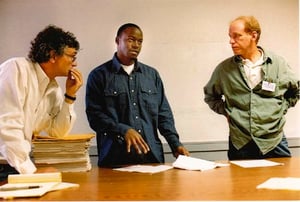
Sep 05, 2013
STUDIES: American Bar Association Releases Assessment of Virginia Death Penalty
On September 5, the American Bar Association’s Death Penalty Due Process Review Project released its latest report, focusing on the fairness and accuracy of Virginia’s death penalty system. The assessment recommended changes to the way the state handles defendants with mental retardation and severe mental illness. It also recommended requiring prosecutors to disclose additional information about testifying witnesses and allowing prosecutors to withdraw the death penalty even after charging a…
Read More
Sep 04, 2013
COSTS: Death Penalty Cases in Colorado Take Six Times Longer Than Life Sentences
A new study of the cost of the death penalty in Colorado revealed that capital proceedings require six times more days in court and take much longer to resolve than life-without-parole (LWOP) cases. The study, published in the University of Denver Criminal Law Review, found that LWOP cases required an average of 24.5 days of in-court time, while the death-penalty cases required 147.6 days. The authors noted that selecting a jury in an LWOP case takes about a day and a half; in a capital case…
Read More
Sep 03, 2013
NEW VOICES: Former Florida Justice Calls for Fundamental Change in Death Penalty
Raoul Cantera (pictured), a former Justice of the Florida Supreme Court, said the state should follow the practice of almost every other death penalty state and require juries to be unanimous when recommending a death sentence. Cantera also said that a a comprehensive review of the state’s death penalty is “long overdue” and should begin by considering the recommendations of a 2006 American Bar Association report on the state’s death penalty. Mark Schlakman, who was a member of the team that…
Read More
Aug 30, 2013
BOOKS: Contemporary Religious Views on the Death Penalty
Anthony Santoro has written a new book about religious perspectives on the death penalty, Exile and Embrace: Contemporary Religious Discourse on the Death Penalty. In describing the book, John D. Bessler, a law professor at the University of Baltimore, said, “Santoro tells the stories of everyone from death row chaplains to bloggers and Bible study participants. In discussing transgression, retribution, and ‘the other,’ he skillfully demonstrates how executions say more about us than about the…
Read More
Aug 29, 2013
STUDIES: The Role of Implicit Racial Bias in the Death Penalty
A new study testing internal attitudes and stereotypes among potential jurors in six death penalty states may help to explain the racial disparities that persist in the application of capital punishment. Researchers Justin Levinson (l.), Robert Smith (r.), and Danielle Young tested 445 jury-eligible individuals and found they harbored two kinds of racial bias: they maintained racial stereotypes about Blacks and Whites and made associations between the race of an individual and the value of his…
Read More
Aug 28, 2013
MENTAL ILLNESS: Man Who Defended Himself in a Cowboy Suit Deemed Sane Enough for Execution
The U.S. Court of Appeals for the Fifth Circuit recently held that Texas death row inmate Scott Panetti is sane enough to be executed, despite his long history of severe mental illness. Panetti was sentenced to death for the 1992 murder of his in-laws. Putting aside Panetti’s bizarre behavior in court, the judge allowed him to represent himself at trial, where he wore a purple cowboy suit and subpoenaed Jesus Christ and Anne Bancroft as witnesses. Panetti had been hospitalized 11 times for…
Read More
Aug 27, 2013
EDITORIALS: Ohio Paper Calls for Transparency and Caution in Selecting Execution Process
As Ohio prepares to change its execution process in October, the Toledo Blade called on the state to stop the secrecy surrounding the selection of an alternative to current lethal injection drugs. The editors wrote, “No state should proceed with scheduled executions until the drug, or multidrug cocktail, it plans to use has been proven to be humane and efficient. The process of changing how people are executed in Ohio should unfold with far more transparency than the state Department of…
Read More
Aug 26, 2013
RECENT LEGISLATION: Texas Law To Protect the Innocent May Curtail Death Penalty
A new Texas law requiring DNA testing of all biological evidence prior to seeking the death penalty could reduce the number of capital cases. District Attorney Billy Byrd of Upshur County noted, “Essentially, every piece of evidence will have to be tested,” he said, which could delay trials more than a year. “Certainly, that will be the case. We will have to deal with certain delays and longer waits,” he added, noting it is not uncommon for DNA evidence to take more than a year to be processed.
Read More