Publications & Testimony
Testimony and Statements on the Death Penalty
FROM DPIC
For testimony by former Executive Director Robert Dunham and former Executive Director Richard C. Dieter, please visit our page DPIC Testimony.
FROM RELIGIOUS LEADERS AND ORGANIZATIONS
- News Brief: Pope Francis Calls for Prayer to Abolish the Death Penalty (September 1, 2022)
- Jewish Congregation Renews Request for Department of Justice to Drop Death Penalty in Tree of Life Synagogue Killings (June 24, 2021)
- Orthodox Church Patriarch Calls Death Penalty Incompatible with Christian Beliefs (October 20, 2020)
- Presbyterian Church (U.S.A.) — Statement on the Federal Death Penalty (August 5, 2019)
- Louisiana Christian Faith Leaders Call for State to Abolish Death Penalty (April 25, 2019)
- Pittsburgh Rabbi’s Wife Opposes Death Penalty for Tree of Life Synagogue Killings (March 18, 2019)
- Orthodox Jewish Organization Calls for an End to Capital Punishment in the U.S. | Death Penalty Information Center (February 17, 2016)
- Baptist Theologian Says Death Penalty Does Not Fit With Christian Theology (March 8, 2016)
- Civil and Human Rights: Death Penalty — Church & Society, The United Methodist Church
- Religious Views: Over 150 Catholic Theologians Call for Repeal of the Death Penalty (September 27, 2011)
- Power Over Life and Death — The Power to Save a Life (January 15, 2005)
- Responsibility, Rehabilitation, and Restoration: A Catholic Perspective on Crime and Criminal Justice (November 2000)
- The Challenge of Holiness: A Sermon on the Death Penalty (January 10, 2000)
- General Assembly of the Texas Conference of Churches — Resolution Opposing the Death Penalty (February 24, 1998)
- Statement by Catholic Bishops of Texas on Capital Punishment (October 20, 1997)
- Catholic Church Expresses Strong Opposition to Capital Punishment in Catechism (September 9, 1997)
- Catholic Bishops of Iowa Issue Statement on Death Penalty (February 4, 1998)
- To End the Death Penalty: A Report of the National Jewish/Catholic Consultation
- Transcript of Dr. Pat Robertson’s Speech on the Role of Religion and the Death Penalty at The College of William and Mary
- Collection of Official Catholic Statements on the Death Penalty (1980)
FROM THE INTERNATIONAL COMMUNITY
- UN experts call for universal abolition of the death penalty | OHCHR (October 9, 2023)
- Zambia Becomes 25th Sub-Saharan African Nation to Abolish Death Penalty (December 23, 2022)
- Belgium Wants a World Without the Death Penalty (October 20, 2022)
- As France Prepares to Assume Presidency of European Union, Emmanuel Macron Announces Initiative for Worldwide Abolition of Death Penalty (October 11, 2021)
- U.N. Secretary-General, European Union Ambassador Call for Abolition of “Barbaric” Death Penalty (October 11, 2017)
- European Union Calls for Abolition of Capital Punishment as World Coalition Hosts International Death Penalty Conference (June 27, 2017)
- U.N. Investigator Talks About the Future of Solitary and the Death Penalty (November 7, 2016)
- World Congress Against the Death Penalty Renews Call for Global Moratorium, Pope Sends Message of Support (June 27, 2016)
- Declaration by the Presidency on behalf of the European Union on the 400th execution in Texas from the Council of the European Union (August 21, 2007)
- Resolution Supporting Worldwide Moratorium on Executions from the United Nations Commission on Human Rights (April 1999)
- Mary Robinson, U.N. High Commissioner for Human Rights — Message to the Press Conference organized by the Death Penalty Information Center for the release of the report, “International Perspectives on the Death Penalty” (October 12, 1999)
- Status of the International Covenants on Human Rights from the United Nations Commission on Human Rights (April 1998)
FROM ADVOCACY GROUPS
- Advocacy Group Tells Supreme Court that Negative Stereotypes Distort Perception that Latinos in Death-Penalty Cases Pose Future Danger to Society (April 15, 2022)
- Disability Rights Groups, Legal Experts, and Conservative Advocates Urge Supreme Court to Strike Down Georgia’s Uniquely Harsh Proof Requirements in Death-Penalty Intellectual Disabilities Cases (January 11, 2022)
- NAACP Reaffirms Its Support of Abolishing the Death Penalty (2022)
- More Than 80 Civil Rights and Advocacy Organizations Urge President Biden to End Federal Executions | Death Penalty Information Center (February 9, 2021)
- More Than 250 Conservative Leaders Join Call to End Death Penalty (October 29, 2019)
- National Alliance on Mental Illness: The Death Penalty
- Florida League of Women Voters Calls for Halt to Executions (May 28, 2007)
- Victims Organizations Issue Joint Statement for National Victims’ Rights Week (April 19, 2007)
FROM JUDGES, LEGISLATORS, AND OTHER ORGANIZATIONS
- Republican-led Oklahoma committee considers pause on executions amid death case scrutiny (October 5, 2023)
- Former Pro-Death Penalty District Attorney Explains Why He Now Supports Abolition, and Fears Political Promises to Expand the Use of the Death Penalty (August 20, 2023)
- Pressley, Durbin Reintroduce Bill to End the Federal Death Penalty (July 13, 2023)
- The Lancet Editorial: Physician Involvement in Executions Violates Medical Ethics | Death Penalty Information Center (May 20, 2023)
- APA calls for extending ineligibility for the death penalty to adolescent offenders younger than age 21 (August 4, 2022)
- Why some Republicans are turning against the death penalty | Ron Ferguson | Ohio House of Representatives (March 8, 2022)
- Eight years on Texas’ highest criminal court turned Elsa Alcala into a death penalty skeptic. How will the court change without her? (January 26, 2019)
- AMA to Supreme Court: Doctor participation in executions unethical (August 22, 2018)
- Former Governor Bill Richardson: Death Penalty Is Bad for Business, Out of Step With World’s Views (June 16, 2017)
- Capital Punishment and Nurses’ Participation in Capital Punishment (2016)
- Former Ohio Attorney General Jim Petro Says Death Penalty Unfixable, “Not Worth It Any More” (September 12, 2016)
- Resolution Supporting Repeal of the Death Penalty, National Hispanic Caucus of State Legislators (August 11, 2016)
- Retired Police Captain Says Repealing Death Penalty Is “Smart on Crime” (November 24, 2014)
- Resolution Supporting Abolition of the Death Penalty, Natl. Assoc. of Black Psychologists (2012)
- The Road to Justice and Peace by New Jersey State Senator Raymond Lesniak (February 1, 2009)
- Statement On The Federal Death Penalty System by Senator Feingold (June 7, 2001)
- Statement on the Need for a Federal Moratorium on the Death Penalty Senator Feingold (October 29, 2000)
- Death Penalty: The Torah and Today (August 23, 2000)
- Press Release for Senator Russ Feingold’s Introduction of Senate’s First Death Penalty Moratorium Bill (April 20, 2000)
- Amnesty International Southern Regional Conference: Orlando, Florida Remarks by Former Florida Chief Justice Gerald Kogan (October 23, 1999)
- American Bar Association Resolution on the Death Penalty (February 3, 1997)
FROM MURDER VICTIMS’ FAMILY MEMBERS
Items: 3931 — 3940
Dec 12, 2011
NEW VOICES: Former Texas Governor Supports Actions by Oregon’s Governor
In a recent op-ed in Oregon’s Statesman Journal, former Texas Governor Mark White (pictured) applauded Oregon Governor John Kitzhaber’s decision to grant a reprieve to death row inmate Gary Haugen and to halt all executions in the state. Governor White wrote, “I think Kitzhaber’s decision is respectable and courageous. In Oregon, as in Texas, it is clearly within the constitutional authority of the governor to grant reprieves and commutations. With that authority comes the responsibility to…
Read More
Dec 09, 2011
BOOKS: “Deathquest: An Introduction to the Theory and Practice of Capital Punishment in the United States”
The fourth edition of Robert Bohm’s “Deathquest: An Introduction to the Theory and Practice of Capital Punishment in the United States,” is now available through Anderson Publishing. The new edition is updated with discussion of the latest research on the effectiveness of the death penalty, the potential for discriminatory application, costs, and new data on miscarriages of justice, public opinion, and the influences of religion. This textbook includes two new chapters on legal challenges to…
Read More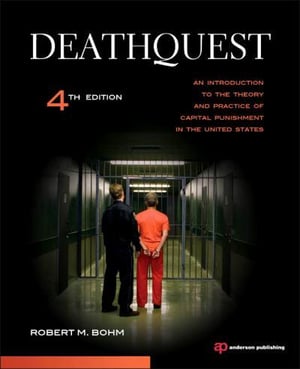
Dec 07, 2011
STUDIES: American Bar Association Releases Assessement of Kentucky’s Death Penalty
On December 7, the American Bar Association released a report assessing Kentucky’s system of capital punishment and calling for a halt to executions in the state. The report was prepared by the Kentucky Assessment Team on the Death Penalty, which included law professors, former state supreme court justices, and practicing attorneys. The two-year study recommended that the state temporarily suspend executions until serious issues of fairness and accuracy are addressed. The review reported that…
Read More
Dec 06, 2011
STUDIES: Virginia Leads the Country in Death Sentences Resulting in Executions
According to a recent study by the Richmond Times-Dispatch, Virginia executes the highest proportion of people sentenced to death of any state in the country. Of the 149 death sentences handed down through 2010, 108 have resulted in an execution, a rate of about 72 percent. Virginia is second to Texas in the total number of executions carried out since 1976, but Texas has executed less than half of those sentenced to death. In many states, less than 1 in 10 death sentences have resulted in an…
Read More
Dec 05, 2011
STUDIES: Eyewitness Identification Comes Under Supreme Court and Scientific Scrutiny
The U.S. Supreme Court recently considered Perry v. New Hampshire, a case questioning the validity of eyewitness testimony when the identification was made under unreliable circumstances. At the same time, years of scientific study on the accuracy of human memory are pointing to the need for reform in the use of eyewitness evidence in criminal cases. Barbara Tversky, a psychology professor at Columbia University, whose experiments on memory were reported in the journal Cognitive Psychology…
Read MoreDec 02, 2011
NEW RESOURCES: DPIC’s Latest Podcast Explores the Impact of International Law and Opinion on the U.S. Death Penalty
The latest edition of the Death Penalty Information Center’s series of podcasts, DPIC on the Issues, is now available for listening or downloading. This podcast — the 17th in the series — discusses international views on the death penalty and how those views might affect capital punishment in the United States. The podcast includes discussions about the role of international pharmaceutical companies in lethal injections being carried out in the United States, and the consideration of…
Read MoreDec 01, 2011
EDITORIALS: “An Intolerable Burden of Proof”
An editorial in the New York Times criticized a recent ruling by the U.S. Court of Appeals for the Eleventh Circuit, upholding the heavy burden Georgia places on offenders with intellectual disabilities. In order to be exempt from the death penalty, defendants must prove “beyond a reasonable doubt” that they are mentally retarded. The U.S. Supreme Court held in 2002 that such defendants cannot receive the death penalty, but the Court left the procedures for determining this status to the…
Read More
Nov 30, 2011
Recently Cleared Tennessee Inmate Added to List of Exonerations
Gussie Vann of Tennessee has been added to the list of those exonerated from death row following the dismissal of all charges against him in September 2011. Vann becomes the 139th former death row inmate exonerated since 1973. Vann was originally convicted and sentenced to death in 1994 for a sexual assault and murder of his own daughter, Necia Vann, in 1992. However, in 2008 following state post-conviction review, Circuit Court Senior Judge Donald P. Harris held that Vann was entitled to a new…
Read More
Nov 29, 2011
North Carolina Legislature Votes to Repeal Racial Justice Act; Governor May Veto
On November 28 the North Carolina Senate voted to repeal the state’s Racial Justice Act, which allowed death row inmates to use statistical evidence of racial bias to challenge their sentences. The House had earlier approved the repeal measure. The Act was passed in 2009, and the first cases brought under the law are just now being considered in state court. There were considerable shifts in the state’s legislature in the wake of the 2010 elections, leading to the repeal bill. Prosecutors had…
Read More
Nov 28, 2011
EDITORIALS: Calls for Florida to Revamp Its Untrustworthy Death Penalty System
The Orlando Sentinel in Florida recently called on the state to change the unusual way in which it arrives at death sentences, recommending instead unanimous jury decisions for a death sentence, the prevailing practice in the vast majority of states. In June, a federal judge declared Florida’s death penalty unconstitutional because it only requires a simple majority to decide whether aggravating factors exist and to recommend a death sentence to the presiding judge. In 2005, former Florida…
Read More