Publications & Testimony
Testimony and Statements on the Death Penalty
FROM DPIC
For testimony by former Executive Director Robert Dunham and former Executive Director Richard C. Dieter, please visit our page DPIC Testimony.
FROM RELIGIOUS LEADERS AND ORGANIZATIONS
- News Brief: Pope Francis Calls for Prayer to Abolish the Death Penalty (September 1, 2022)
- Jewish Congregation Renews Request for Department of Justice to Drop Death Penalty in Tree of Life Synagogue Killings (June 24, 2021)
- Orthodox Church Patriarch Calls Death Penalty Incompatible with Christian Beliefs (October 20, 2020)
- Presbyterian Church (U.S.A.) — Statement on the Federal Death Penalty (August 5, 2019)
- Louisiana Christian Faith Leaders Call for State to Abolish Death Penalty (April 25, 2019)
- Pittsburgh Rabbi’s Wife Opposes Death Penalty for Tree of Life Synagogue Killings (March 18, 2019)
- Orthodox Jewish Organization Calls for an End to Capital Punishment in the U.S. | Death Penalty Information Center (February 17, 2016)
- Baptist Theologian Says Death Penalty Does Not Fit With Christian Theology (March 8, 2016)
- Civil and Human Rights: Death Penalty — Church & Society, The United Methodist Church
- Religious Views: Over 150 Catholic Theologians Call for Repeal of the Death Penalty (September 27, 2011)
- Power Over Life and Death — The Power to Save a Life (January 15, 2005)
- Responsibility, Rehabilitation, and Restoration: A Catholic Perspective on Crime and Criminal Justice (November 2000)
- The Challenge of Holiness: A Sermon on the Death Penalty (January 10, 2000)
- General Assembly of the Texas Conference of Churches — Resolution Opposing the Death Penalty (February 24, 1998)
- Statement by Catholic Bishops of Texas on Capital Punishment (October 20, 1997)
- Catholic Church Expresses Strong Opposition to Capital Punishment in Catechism (September 9, 1997)
- Catholic Bishops of Iowa Issue Statement on Death Penalty (February 4, 1998)
- To End the Death Penalty: A Report of the National Jewish/Catholic Consultation
- Transcript of Dr. Pat Robertson’s Speech on the Role of Religion and the Death Penalty at The College of William and Mary
- Collection of Official Catholic Statements on the Death Penalty (1980)
FROM THE INTERNATIONAL COMMUNITY
- UN experts call for universal abolition of the death penalty | OHCHR (October 9, 2023)
- Zambia Becomes 25th Sub-Saharan African Nation to Abolish Death Penalty (December 23, 2022)
- Belgium Wants a World Without the Death Penalty (October 20, 2022)
- As France Prepares to Assume Presidency of European Union, Emmanuel Macron Announces Initiative for Worldwide Abolition of Death Penalty (October 11, 2021)
- U.N. Secretary-General, European Union Ambassador Call for Abolition of “Barbaric” Death Penalty (October 11, 2017)
- European Union Calls for Abolition of Capital Punishment as World Coalition Hosts International Death Penalty Conference (June 27, 2017)
- U.N. Investigator Talks About the Future of Solitary and the Death Penalty (November 7, 2016)
- World Congress Against the Death Penalty Renews Call for Global Moratorium, Pope Sends Message of Support (June 27, 2016)
- Declaration by the Presidency on behalf of the European Union on the 400th execution in Texas from the Council of the European Union (August 21, 2007)
- Resolution Supporting Worldwide Moratorium on Executions from the United Nations Commission on Human Rights (April 1999)
- Mary Robinson, U.N. High Commissioner for Human Rights — Message to the Press Conference organized by the Death Penalty Information Center for the release of the report, “International Perspectives on the Death Penalty” (October 12, 1999)
- Status of the International Covenants on Human Rights from the United Nations Commission on Human Rights (April 1998)
FROM ADVOCACY GROUPS
- Advocacy Group Tells Supreme Court that Negative Stereotypes Distort Perception that Latinos in Death-Penalty Cases Pose Future Danger to Society (April 15, 2022)
- Disability Rights Groups, Legal Experts, and Conservative Advocates Urge Supreme Court to Strike Down Georgia’s Uniquely Harsh Proof Requirements in Death-Penalty Intellectual Disabilities Cases (January 11, 2022)
- NAACP Reaffirms Its Support of Abolishing the Death Penalty (2022)
- More Than 80 Civil Rights and Advocacy Organizations Urge President Biden to End Federal Executions | Death Penalty Information Center (February 9, 2021)
- More Than 250 Conservative Leaders Join Call to End Death Penalty (October 29, 2019)
- National Alliance on Mental Illness: The Death Penalty
- Florida League of Women Voters Calls for Halt to Executions (May 28, 2007)
- Victims Organizations Issue Joint Statement for National Victims’ Rights Week (April 19, 2007)
FROM JUDGES, LEGISLATORS, AND OTHER ORGANIZATIONS
- Republican-led Oklahoma committee considers pause on executions amid death case scrutiny (October 5, 2023)
- Former Pro-Death Penalty District Attorney Explains Why He Now Supports Abolition, and Fears Political Promises to Expand the Use of the Death Penalty (August 20, 2023)
- Pressley, Durbin Reintroduce Bill to End the Federal Death Penalty (July 13, 2023)
- The Lancet Editorial: Physician Involvement in Executions Violates Medical Ethics | Death Penalty Information Center (May 20, 2023)
- APA calls for extending ineligibility for the death penalty to adolescent offenders younger than age 21 (August 4, 2022)
- Why some Republicans are turning against the death penalty | Ron Ferguson | Ohio House of Representatives (March 8, 2022)
- Eight years on Texas’ highest criminal court turned Elsa Alcala into a death penalty skeptic. How will the court change without her? (January 26, 2019)
- AMA to Supreme Court: Doctor participation in executions unethical (August 22, 2018)
- Former Governor Bill Richardson: Death Penalty Is Bad for Business, Out of Step With World’s Views (June 16, 2017)
- Capital Punishment and Nurses’ Participation in Capital Punishment (2016)
- Former Ohio Attorney General Jim Petro Says Death Penalty Unfixable, “Not Worth It Any More” (September 12, 2016)
- Resolution Supporting Repeal of the Death Penalty, National Hispanic Caucus of State Legislators (August 11, 2016)
- Retired Police Captain Says Repealing Death Penalty Is “Smart on Crime” (November 24, 2014)
- Resolution Supporting Abolition of the Death Penalty, Natl. Assoc. of Black Psychologists (2012)
- The Road to Justice and Peace by New Jersey State Senator Raymond Lesniak (February 1, 2009)
- Statement On The Federal Death Penalty System by Senator Feingold (June 7, 2001)
- Statement on the Need for a Federal Moratorium on the Death Penalty Senator Feingold (October 29, 2000)
- Death Penalty: The Torah and Today (August 23, 2000)
- Press Release for Senator Russ Feingold’s Introduction of Senate’s First Death Penalty Moratorium Bill (April 20, 2000)
- Amnesty International Southern Regional Conference: Orlando, Florida Remarks by Former Florida Chief Justice Gerald Kogan (October 23, 1999)
- American Bar Association Resolution on the Death Penalty (February 3, 1997)
FROM MURDER VICTIMS’ FAMILY MEMBERS
Items: 4201 — 4210
Dec 16, 2010
RELIGIOUS VIEWS: Religious Leaders to Gather in Texas for Unique Dialogue on the Death Penalty
On January 18, 2011, seven religious leaders from Texas will hold a groundbreaking panel discussion in Houston addressing faith-based views on the death penalty. The panel will be moderated by Sister Helen Prejean (pictured), author of Dead Man Walking, and Vicki Schieber of Murder Victims’ Families for Human Rights. The free presentation will include leaders from a diversity of faiths and denominations, including: Cardinal Daniel Dinardo of the Roman Catholic Church; Rev. Daniel Malendez…
Read More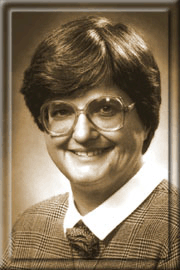
Dec 15, 2010
Oklahoma Set to Execute First Inmate Using New Drug
On December 14, the U.S. Court of Appeals for the Tenth Circuit rejected a claim by Oklahoma death row inmate Jeffrey Matthews that the use of the drug pentobarbital could result in a cruel and unusual punishment. The Court unanimously concluded that the amount of pentobarbital authorities plan to use, as the first in a three-drug procedure, would likely be lethal by itself. The decision also allows the execution of John David Duty, scheduled for December 16, to proceed. Duty would be the first…
Read More
Dec 15, 2010
New Hampshire Study Commission Report on the Death Penalty
On Dec. 1, 2010, the New Hampshire Death Penalty Study Commission released its report to the governor. The majority (12 – 10) report recommended neither the abolition nor the expansion of the death penalty. The report did find that there is an added cost for the death penalty as compared to a life without parole sentence: “There is a significant difference in the cost of prosecution and incarceration of a first degree murder case where the penalty is life without parole as compared with the cost…
Read MoreDec 13, 2010
NEW RESOURCES: ACLU Report Finds Severe Deficiencies in Capital Representation and Appeals
According to a new report by the American Civil Liberties Union (ACLU) entitled, “Slamming the Courthouse Doors: Denial of Access to Justice and Remedy in America,” many states severely restrict access to justice for capital defendants and limit the availability of remedies to correct errors. The problem of inadequate counsel continues to pervade death penalty systems across the country: “Few states provide adequate funds to compensate lawyers for their work or to investigate cases properly. In…
Read More
Dec 10, 2010
EDITORIALS: New Hampshire’s Concord Monitor Says “Abolish the Death Penalty”
Following the release of the report from the New Hampshire Commission to Study the Death Penalty, New Hampshire’s Concord Monitor called for an end to capital punishment in the state. The Commission concluded a year of public hearings and careful study and chose by a 12 – 10 vote to recommend neither expanding nor abolishing the death penalty. However, the Monitor pointed out that the evidence presented to the commission was primarily in favor of repealing the death penalty. One of the many…
Read MoreDec 09, 2010
Possible Case of Innocence on California’s Death Row
A recent op-ed by Pulitzer Prize-winning columnist Nicholas Kristof (pictured) of the New York Times focuses on the possible innocence of Kevin Cooper, a black defendant on California’s death row. Kristof writes, “This case is a travesty. It underscores the central pitfall of capital punishment: no system is fail-safe. How can we be about to execute a man when even some of America’s leading judges believe he has been framed?” Cooper faces execution for a 1983 quadruple-murder of a white family.
Read More
Dec 08, 2010
NEW RESOURCES: Costs of Representation in Federal Death Penalty Cases
A recent report to the Committee on Defender Services of the Judicial Conference of the United States by Jon Gould and Lisa Greenman provided an update on the costs of representation in federal death penalty cases. The report examined all cases in which the federal death penalty was authorized by the U.S. Attorney General between 1998 and 2004. The authors found that “The median cost of a case in which the Attorney General authorized seeking the death penalty was nearly eight times greater than…
Read MoreDec 07, 2010
Supreme Court Declines to Take Case of Federal Death Row Inmate With Mental Retardation
The U.S. Supreme Court has declined to hear the appeal of Bruce Webster, an inmate on the federal death row with evidence that he is intellectually disabed. In 2002, the Supreme Court ruled in Atkins v. Virginia that the execution of a person with intellectual disabilities (mental retardation) would be unconstitutional. Webster’s evidence indicates that three federal doctors determined he had an intellectual disability when he applied for disability benefits in 1993, a year before he committed…
Read More
Dec 06, 2010
Lack of Qualified Attorneys in California Delays Death Penalty Cases
A shortage of qualified criminal defense lawyers in California has caused major delays in the state’s capital punishment system. Nearly half of those sentenced to death in California are waiting for the state to appoint them a post-conviction attorney. Death row inmates wait an average of 10 – 12 years. The long delay is attributed to the lack of experienced lawyers to take on this part of the appeals process. The California Supreme Court requires that lawyers have experience in trial and…
Read More
Dec 03, 2010
OP-ED: “Capital Punishment and Human Fallibility”
A recent op-ed in the Wall Street Journal by Barry Scheck, co-director of the Innocence Project, highlighs flaws in Texas’s death penalty system that led to the execution of Claude Jones (pictured). Then-governor George Bush rejected Jones’s application for a reprieve. Bush was not informed that the reprieve would allow time for DNA tests to be performed on a strand of hair that was found at the crime scene. This hair had been attributed to Jones at his trial and was the only piece of evidence…
Read More