Publications & Testimony
Testimony and Statements on the Death Penalty
FROM DPIC
For testimony by former Executive Director Robert Dunham and former Executive Director Richard C. Dieter, please visit our page DPIC Testimony.
FROM RELIGIOUS LEADERS AND ORGANIZATIONS
- News Brief: Pope Francis Calls for Prayer to Abolish the Death Penalty (September 1, 2022)
- Jewish Congregation Renews Request for Department of Justice to Drop Death Penalty in Tree of Life Synagogue Killings (June 24, 2021)
- Orthodox Church Patriarch Calls Death Penalty Incompatible with Christian Beliefs (October 20, 2020)
- Presbyterian Church (U.S.A.) — Statement on the Federal Death Penalty (August 5, 2019)
- Louisiana Christian Faith Leaders Call for State to Abolish Death Penalty (April 25, 2019)
- Pittsburgh Rabbi’s Wife Opposes Death Penalty for Tree of Life Synagogue Killings (March 18, 2019)
- Orthodox Jewish Organization Calls for an End to Capital Punishment in the U.S. | Death Penalty Information Center (February 17, 2016)
- Baptist Theologian Says Death Penalty Does Not Fit With Christian Theology (March 8, 2016)
- Civil and Human Rights: Death Penalty — Church & Society, The United Methodist Church
- Religious Views: Over 150 Catholic Theologians Call for Repeal of the Death Penalty (September 27, 2011)
- Power Over Life and Death — The Power to Save a Life (January 15, 2005)
- Responsibility, Rehabilitation, and Restoration: A Catholic Perspective on Crime and Criminal Justice (November 2000)
- The Challenge of Holiness: A Sermon on the Death Penalty (January 10, 2000)
- General Assembly of the Texas Conference of Churches — Resolution Opposing the Death Penalty (February 24, 1998)
- Statement by Catholic Bishops of Texas on Capital Punishment (October 20, 1997)
- Catholic Church Expresses Strong Opposition to Capital Punishment in Catechism (September 9, 1997)
- Catholic Bishops of Iowa Issue Statement on Death Penalty (February 4, 1998)
- To End the Death Penalty: A Report of the National Jewish/Catholic Consultation
- Transcript of Dr. Pat Robertson’s Speech on the Role of Religion and the Death Penalty at The College of William and Mary
- Collection of Official Catholic Statements on the Death Penalty (1980)
FROM THE INTERNATIONAL COMMUNITY
- UN experts call for universal abolition of the death penalty | OHCHR (October 9, 2023)
- Zambia Becomes 25th Sub-Saharan African Nation to Abolish Death Penalty (December 23, 2022)
- Belgium Wants a World Without the Death Penalty (October 20, 2022)
- As France Prepares to Assume Presidency of European Union, Emmanuel Macron Announces Initiative for Worldwide Abolition of Death Penalty (October 11, 2021)
- U.N. Secretary-General, European Union Ambassador Call for Abolition of “Barbaric” Death Penalty (October 11, 2017)
- European Union Calls for Abolition of Capital Punishment as World Coalition Hosts International Death Penalty Conference (June 27, 2017)
- U.N. Investigator Talks About the Future of Solitary and the Death Penalty (November 7, 2016)
- World Congress Against the Death Penalty Renews Call for Global Moratorium, Pope Sends Message of Support (June 27, 2016)
- Declaration by the Presidency on behalf of the European Union on the 400th execution in Texas from the Council of the European Union (August 21, 2007)
- Resolution Supporting Worldwide Moratorium on Executions from the United Nations Commission on Human Rights (April 1999)
- Mary Robinson, U.N. High Commissioner for Human Rights — Message to the Press Conference organized by the Death Penalty Information Center for the release of the report, “International Perspectives on the Death Penalty” (October 12, 1999)
- Status of the International Covenants on Human Rights from the United Nations Commission on Human Rights (April 1998)
FROM ADVOCACY GROUPS
- Advocacy Group Tells Supreme Court that Negative Stereotypes Distort Perception that Latinos in Death-Penalty Cases Pose Future Danger to Society (April 15, 2022)
- Disability Rights Groups, Legal Experts, and Conservative Advocates Urge Supreme Court to Strike Down Georgia’s Uniquely Harsh Proof Requirements in Death-Penalty Intellectual Disabilities Cases (January 11, 2022)
- NAACP Reaffirms Its Support of Abolishing the Death Penalty (2022)
- More Than 80 Civil Rights and Advocacy Organizations Urge President Biden to End Federal Executions | Death Penalty Information Center (February 9, 2021)
- More Than 250 Conservative Leaders Join Call to End Death Penalty (October 29, 2019)
- National Alliance on Mental Illness: The Death Penalty
- Florida League of Women Voters Calls for Halt to Executions (May 28, 2007)
- Victims Organizations Issue Joint Statement for National Victims’ Rights Week (April 19, 2007)
FROM JUDGES, LEGISLATORS, AND OTHER ORGANIZATIONS
- Republican-led Oklahoma committee considers pause on executions amid death case scrutiny (October 5, 2023)
- Former Pro-Death Penalty District Attorney Explains Why He Now Supports Abolition, and Fears Political Promises to Expand the Use of the Death Penalty (August 20, 2023)
- Pressley, Durbin Reintroduce Bill to End the Federal Death Penalty (July 13, 2023)
- The Lancet Editorial: Physician Involvement in Executions Violates Medical Ethics | Death Penalty Information Center (May 20, 2023)
- APA calls for extending ineligibility for the death penalty to adolescent offenders younger than age 21 (August 4, 2022)
- Why some Republicans are turning against the death penalty | Ron Ferguson | Ohio House of Representatives (March 8, 2022)
- Eight years on Texas’ highest criminal court turned Elsa Alcala into a death penalty skeptic. How will the court change without her? (January 26, 2019)
- AMA to Supreme Court: Doctor participation in executions unethical (August 22, 2018)
- Former Governor Bill Richardson: Death Penalty Is Bad for Business, Out of Step With World’s Views (June 16, 2017)
- Capital Punishment and Nurses’ Participation in Capital Punishment (2016)
- Former Ohio Attorney General Jim Petro Says Death Penalty Unfixable, “Not Worth It Any More” (September 12, 2016)
- Resolution Supporting Repeal of the Death Penalty, National Hispanic Caucus of State Legislators (August 11, 2016)
- Retired Police Captain Says Repealing Death Penalty Is “Smart on Crime” (November 24, 2014)
- Resolution Supporting Abolition of the Death Penalty, Natl. Assoc. of Black Psychologists (2012)
- The Road to Justice and Peace by New Jersey State Senator Raymond Lesniak (February 1, 2009)
- Statement On The Federal Death Penalty System by Senator Feingold (June 7, 2001)
- Statement on the Need for a Federal Moratorium on the Death Penalty Senator Feingold (October 29, 2000)
- Death Penalty: The Torah and Today (August 23, 2000)
- Press Release for Senator Russ Feingold’s Introduction of Senate’s First Death Penalty Moratorium Bill (April 20, 2000)
- Amnesty International Southern Regional Conference: Orlando, Florida Remarks by Former Florida Chief Justice Gerald Kogan (October 23, 1999)
- American Bar Association Resolution on the Death Penalty (February 3, 1997)
FROM MURDER VICTIMS’ FAMILY MEMBERS
Items: 4451 — 4460
Jan 14, 2010
NEW RESOURCES: Bureau of Justice Statistics Releases Capital Punishment, 2008
The Bureau of Justice Statistics released the 2008 version of its annual report on the death penalty in the U.S. in December 2009. Information drawn from the report includes: The number of people on death row declined from 3,215 in 2007 to 3,207 in 2008. 50% of those on death row had not graduated from high school; only 9% had any college education. 91% of those on death row had no prior homicide conviction. 13.2% of those on death row at the end of 2008 were hispanic. 22% of those on death…
Read MoreJan 13, 2010
U.S. Supreme Court: Smith v. Spisak
On January 12, the U.S. Supreme Court reversed the U.S. Court of Appeals for the Sixth Circuit in Smith v. Spisak. After Frank Spisak was sentenced to death in Ohio and his initial appeals were denied, he filed a habeas corpus petition claiming that: 1) the jury instructions and verdict forms used at his trial unconstitutionally required the jury to be unanimous in choosing any mitigating factors; and 2) his attorney’s closing argument was so inadequate as to deprive him of effective assistance…
Read More
Jan 12, 2010
Death Penalty Use in Louisiana Has Sharply Declined
Louisiana has seen a steep decline in executions compared to previous decades, with only three executions in the last ten years. This is in stark contrast to the eight men who were electrocuted within the span of 11 weeks in 1987, and it follows a nationwide trend of declining executions and imposition of death sentences. The state’s most recent execution was on January 7, the first since since 2002. The execution occurred only because the defendant, Gerard Bordelon, waived appeals that may…
Read More
Jan 11, 2010
EDITORIALS: “Death Penalty System ‘Irretrievably Broken’ ”
A recent editorial in the Charlotte Observer in North Carolina cited the American Law Institute’s decision in 2009 to separate itself from the death penalty system as another reason for the state to abolish the practice. The ALI, whose model death penatly standards were instrumental in the U.S. Supreme Court’s decision to allow the reinstatement of capital punishment in 1976, has recently disavowed its own recommendations because the many problems of the system had rendered it unworkable. The…
Read MoreJan 08, 2010
BOOKS: “Media and Criminal Justice: The CSI Effect”
“Media and Criminal Justice: The CSI Effect,” is a new book by Dennis J. Stevens, illustrating how television programs and media coverage affect public perception of criminal justice. The author, who teaches at the University of North Carolina-Charlotte and Belmont Abbey College, maintains that television shows like “CSI” can give the false impression that all crimes are easily solved through advanced forensic science. The author also addresses the problem of wrongful convictions, particularly…
Read More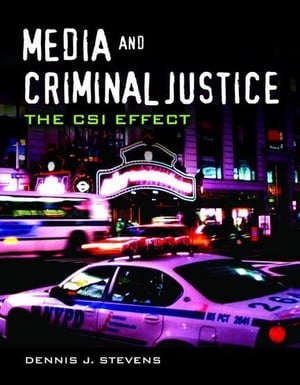
Jan 07, 2010
NEW VOICES: American Police Beat Reports “Death penalty comes with a hefty price tag”
A recent article in the American Police Beat highlights the concerns that police chiefs have with the costs and ineffectiveness of capital punishment. The article notes, “The problem, according to the police chiefs is the fact that capital punishment is costing states hundreds of millions of dollars for relatively few executions and nothing in the way of crime deterrence… Hiring more police officers, fighting drug abuse, longer prison sentences and improved crime databases all are higher…
Read More
Jan 06, 2010
BOOKS: “Anatomy of an Execution”
A new book authored by Todd Peppers and Laura Trevvett Anderson, “Anatomy of An Execution,” follows the story of Douglas Christopher Thomas, a juvenile offender who was executed in Virginia in 2000. Thomas was convicted of a double homicide in 1990 and sentenced to death in 1991. He was one of the last juveniles put to death before the U.S. Supreme Court ruled the execution of those under the age of 18 at the time of their crime to be unconstitutional in 2005 (Roper v. Simmons). The authors…
Read More
Jan 05, 2010
OPINION: “Kill the Death Penalty”
The editor of the editorial page of the Palm Beach Post recently called for an end to the death penalty in Florida. Citing DPIC’s recent report on the costs of the death penalty, Randy Schultz notes that, “Every objective study shows that life imprisonment costs much less than sentencing someone to death.” “Money,” he writes, “drives the new debate in Florida about criminal justice.” In 2009, the state legislature declined the $3 billion for prisons the state’s Department of Corrections needed…
Read MoreJan 04, 2010
EDITORIALS: “Denial of Death: Time to End Capital Punishment”
An editorial in the Salt Lake Tribune recently called for an end to capital punishment, stating that “the legal, moral and practical arguments against capital punishment have evolved from sound to unassailable” since the punishment was reinstated over 30 years ago. The editorial points to the fallibility of the system as a major concern, citing the Death Penalty Information Center’s report that nine inmates have been exonerated and released from death row in 2009 alone. The arbitrary nature of…
Read MoreDec 31, 2009
Law Enforcement Views on Deterrence
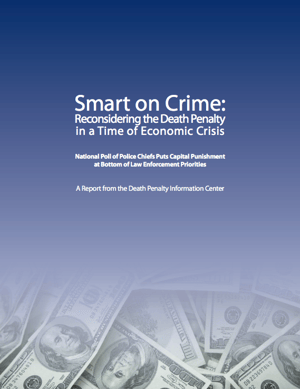
In 2009, the Death Penalty Information Center released a report entitled “Smart on Crime: Reconsidering the Death Penalty in a Time of Economic Crisis.” The report combines an analysis of the costs of the death penalty with a national poll of police chiefs who put capital punishment at the bottom of their law enforcement priorities. The graph above shows the responses of 500 police chiefs in the United States. Police chiefs ranked the death penalty last when asked to name one area as “most…
Read More