Publications & Testimony
Testimony and Statements on the Death Penalty
FROM DPIC
For testimony by former Executive Director Robert Dunham and former Executive Director Richard C. Dieter, please visit our page DPIC Testimony.
FROM RELIGIOUS LEADERS AND ORGANIZATIONS
- News Brief: Pope Francis Calls for Prayer to Abolish the Death Penalty (September 1, 2022)
- Jewish Congregation Renews Request for Department of Justice to Drop Death Penalty in Tree of Life Synagogue Killings (June 24, 2021)
- Orthodox Church Patriarch Calls Death Penalty Incompatible with Christian Beliefs (October 20, 2020)
- Presbyterian Church (U.S.A.) — Statement on the Federal Death Penalty (August 5, 2019)
- Louisiana Christian Faith Leaders Call for State to Abolish Death Penalty (April 25, 2019)
- Pittsburgh Rabbi’s Wife Opposes Death Penalty for Tree of Life Synagogue Killings (March 18, 2019)
- Orthodox Jewish Organization Calls for an End to Capital Punishment in the U.S. | Death Penalty Information Center (February 17, 2016)
- Baptist Theologian Says Death Penalty Does Not Fit With Christian Theology (March 8, 2016)
- Civil and Human Rights: Death Penalty — Church & Society, The United Methodist Church
- Religious Views: Over 150 Catholic Theologians Call for Repeal of the Death Penalty (September 27, 2011)
- Power Over Life and Death — The Power to Save a Life (January 15, 2005)
- Responsibility, Rehabilitation, and Restoration: A Catholic Perspective on Crime and Criminal Justice (November 2000)
- The Challenge of Holiness: A Sermon on the Death Penalty (January 10, 2000)
- General Assembly of the Texas Conference of Churches — Resolution Opposing the Death Penalty (February 24, 1998)
- Statement by Catholic Bishops of Texas on Capital Punishment (October 20, 1997)
- Catholic Church Expresses Strong Opposition to Capital Punishment in Catechism (September 9, 1997)
- Catholic Bishops of Iowa Issue Statement on Death Penalty (February 4, 1998)
- To End the Death Penalty: A Report of the National Jewish/Catholic Consultation
- Transcript of Dr. Pat Robertson’s Speech on the Role of Religion and the Death Penalty at The College of William and Mary
- Collection of Official Catholic Statements on the Death Penalty (1980)
FROM THE INTERNATIONAL COMMUNITY
- UN experts call for universal abolition of the death penalty | OHCHR (October 9, 2023)
- Zambia Becomes 25th Sub-Saharan African Nation to Abolish Death Penalty (December 23, 2022)
- Belgium Wants a World Without the Death Penalty (October 20, 2022)
- As France Prepares to Assume Presidency of European Union, Emmanuel Macron Announces Initiative for Worldwide Abolition of Death Penalty (October 11, 2021)
- U.N. Secretary-General, European Union Ambassador Call for Abolition of “Barbaric” Death Penalty (October 11, 2017)
- European Union Calls for Abolition of Capital Punishment as World Coalition Hosts International Death Penalty Conference (June 27, 2017)
- U.N. Investigator Talks About the Future of Solitary and the Death Penalty (November 7, 2016)
- World Congress Against the Death Penalty Renews Call for Global Moratorium, Pope Sends Message of Support (June 27, 2016)
- Declaration by the Presidency on behalf of the European Union on the 400th execution in Texas from the Council of the European Union (August 21, 2007)
- Resolution Supporting Worldwide Moratorium on Executions from the United Nations Commission on Human Rights (April 1999)
- Mary Robinson, U.N. High Commissioner for Human Rights — Message to the Press Conference organized by the Death Penalty Information Center for the release of the report, “International Perspectives on the Death Penalty” (October 12, 1999)
- Status of the International Covenants on Human Rights from the United Nations Commission on Human Rights (April 1998)
FROM ADVOCACY GROUPS
- Advocacy Group Tells Supreme Court that Negative Stereotypes Distort Perception that Latinos in Death-Penalty Cases Pose Future Danger to Society (April 15, 2022)
- Disability Rights Groups, Legal Experts, and Conservative Advocates Urge Supreme Court to Strike Down Georgia’s Uniquely Harsh Proof Requirements in Death-Penalty Intellectual Disabilities Cases (January 11, 2022)
- NAACP Reaffirms Its Support of Abolishing the Death Penalty (2022)
- More Than 80 Civil Rights and Advocacy Organizations Urge President Biden to End Federal Executions | Death Penalty Information Center (February 9, 2021)
- More Than 250 Conservative Leaders Join Call to End Death Penalty (October 29, 2019)
- National Alliance on Mental Illness: The Death Penalty
- Florida League of Women Voters Calls for Halt to Executions (May 28, 2007)
- Victims Organizations Issue Joint Statement for National Victims’ Rights Week (April 19, 2007)
FROM JUDGES, LEGISLATORS, AND OTHER ORGANIZATIONS
- Republican-led Oklahoma committee considers pause on executions amid death case scrutiny (October 5, 2023)
- Former Pro-Death Penalty District Attorney Explains Why He Now Supports Abolition, and Fears Political Promises to Expand the Use of the Death Penalty (August 20, 2023)
- Pressley, Durbin Reintroduce Bill to End the Federal Death Penalty (July 13, 2023)
- The Lancet Editorial: Physician Involvement in Executions Violates Medical Ethics | Death Penalty Information Center (May 20, 2023)
- APA calls for extending ineligibility for the death penalty to adolescent offenders younger than age 21 (August 4, 2022)
- Why some Republicans are turning against the death penalty | Ron Ferguson | Ohio House of Representatives (March 8, 2022)
- Eight years on Texas’ highest criminal court turned Elsa Alcala into a death penalty skeptic. How will the court change without her? (January 26, 2019)
- AMA to Supreme Court: Doctor participation in executions unethical (August 22, 2018)
- Former Governor Bill Richardson: Death Penalty Is Bad for Business, Out of Step With World’s Views (June 16, 2017)
- Capital Punishment and Nurses’ Participation in Capital Punishment (2016)
- Former Ohio Attorney General Jim Petro Says Death Penalty Unfixable, “Not Worth It Any More” (September 12, 2016)
- Resolution Supporting Repeal of the Death Penalty, National Hispanic Caucus of State Legislators (August 11, 2016)
- Retired Police Captain Says Repealing Death Penalty Is “Smart on Crime” (November 24, 2014)
- Resolution Supporting Abolition of the Death Penalty, Natl. Assoc. of Black Psychologists (2012)
- The Road to Justice and Peace by New Jersey State Senator Raymond Lesniak (February 1, 2009)
- Statement On The Federal Death Penalty System by Senator Feingold (June 7, 2001)
- Statement on the Need for a Federal Moratorium on the Death Penalty Senator Feingold (October 29, 2000)
- Death Penalty: The Torah and Today (August 23, 2000)
- Press Release for Senator Russ Feingold’s Introduction of Senate’s First Death Penalty Moratorium Bill (April 20, 2000)
- Amnesty International Southern Regional Conference: Orlando, Florida Remarks by Former Florida Chief Justice Gerald Kogan (October 23, 1999)
- American Bar Association Resolution on the Death Penalty (February 3, 1997)
FROM MURDER VICTIMS’ FAMILY MEMBERS
Items: 5141 — 5150
Jun 28, 2007
NEW VOICES: Scientific American on the Death Penalty: “Bad Execution”
The July 2007 issue of Scientific American magazine contains both an article discussing the medical implications of lethal injection and an editorial discussing the humaneness of capital punishment generally. The editorial suggests that capital punishment “can never be anything but inhumane,” and offers the opinion that it is “wrong” and an “outrage.” But it further states that even those who believe the death penalty is acceptable, should agree that it not be carried out cruelly. The editorial…
Read MoreJun 28, 2007
Thurgood Marshall Journalism Awards 2007
Thurgood Marshall Journalism Awards — 2007 The Death Penalty Information Center is proud to announce the winners of the organization’s 11th Annual Thurgood Marshall Journalism Awards. The awards honor journalists who have made an exceptional contribution to coverage of capital punishment issues. This year’s ceremony was held at the National Press Club on Thursday June 28 and featured keynote speaker Mike Farrell, star of the television show M*A*S*H and a lifelong human rights activist. This…
Read More
Jun 28, 2007
Supreme Court Blocks Execution of Mentally Ill Inmate
The U.S. Supreme Court ruled on June 28, 2007, that Scott Panetti, a man with severe mental illness on Texas’s death row, deserves a rehearing on his claim of mental incompetence. The Court’s 5 – 4 ruling overturned a decision by the U.S. Court of Appeals for the Fifth Circuit that had used an overly restrictive definition of what constitutes insanity. The lower court had held that mere knowledge of one’s crime, without a rational understanding, was sufficient to allow an execution to go forward.
Read MoreJun 26, 2007
ACLU Releases Report on Racial Disparities in the Federal Death Penalty
The federal death penalty impacts racial minorities differently than it does whites according to a recent report from the American Civil Liberties Union. The report, The Persistent Problem of Racial Disparities in the Federal Death Penalty, notes that defendants of color make up the majority of the federal death row. And the risk of a case being authorized for the death penalty is 84% higher in cases where the victim is white, regardless of the race of the defendant. The report pointed to…
Read MoreJun 25, 2007
Supreme Court Agrees to Hear Louisiana Case with All-White Jury and References to O.J. Simpson
On June 25, 2007, the U.S. Supreme Court agreed to review a capital case from Louisiana in which an all-white jury sentenced a defendant to death after the prosecutor urged a death sentence so that the defendant would not “get away with it” like O.J. Simpson. All five qualified African-Americans had been struck from the jury pool by the prosecution using peremptory challenges. The defense has challenged the selection of the jury as a violation of equal protection. The defendant, Allen Snyder…
Read MoreJun 21, 2007
Pew Poll Shows Modest Decline in Death Penalty Support
The Pew Research Center recently released a poll on a variety of social issues, including the death penalty. The poll found that 64% of the U.S. adults support the imposition of the death penalty for persons convicted of murder. This is a decline of 14 percentage points from 1996, when 78% of respondents said they supported it. The Center reported that support for the death penalty was higher among men than women, and was substantially higher among whites (69%) than among African Americans…
Read More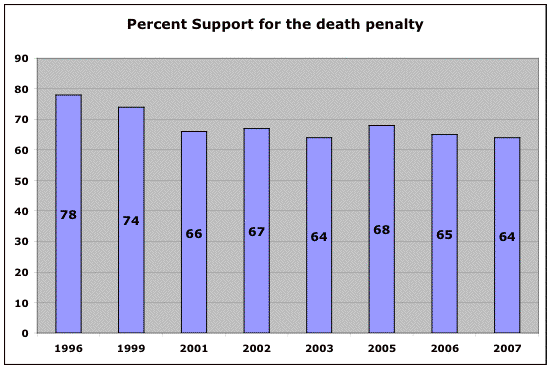
Jun 21, 2007
Strong Criticism of Tennessee’s Death Penalty System from Federal Appellate Judge
Dissenting from a U.S. Court of Appeals decision denying relief to Gary Cone, Judge Merritt sharply criticized the Tennessee Attorney General for “falsification” of the record, and he referred to the state’s judicial system as “broken” and “inattentive.” Cone had been granted relief on two other occasions by the same Sixth Circuit, but those decisions were reversed by the U.S. Supreme Court. In the present case, Cone claimed that significant mitigating evidence had been withheld by the state in…
Read MoreJun 20, 2007
BOOKS: DeathQuest III by Robert Bohm
In the third edition of what some have called “the first true textbook on the death penalty,” author Robert Bohm, a correctional officer turned college professor, engages the reader with a full account of the arguments and issues surrounding capital punishment. His book, “DeathQuest III: An Introduction to the Theory & Practice of Capital Punishment in the United States,” begins with the history of the death penalty from colonial to modern times, and then examines the moral and legal arguments…
Read MoreJun 19, 2007
Texas Scores Poorly in Mental Health Services While Executing Many with Mental Illness
A recent study conducted by the National Alliance on Mental Illness (NAMI) has revealed that Texas is almost last among states in spending on mental health services and performs poorly in other mental health areas. According to the Fort Worth Star-Telegram, Texas ranked 47th in the nation in per-capita spending on mental health services, and received a grade of “D” for information access and a grade of “C” overall. Robin Peyson, NAMI-Texas executive director, observed that one of the main…
Read MoreJun 14, 2007
BOOKS: “The Big Eddy Club” Explores Race and the Death Penalty
In his new book, “The Big Eddy Club: The Stocking Stranglings and Southern Justice,” author David Rose examines issues of race and the death penalty. The book relates the story of Carlton Gary, who was convicted of capital murder in 1986 and remains on Georgia’s death row for the rape and murder of several elderly women in Columbus, Georgia. Rose, a contributing editor at Vanity Fair, links Gary’s conviction to a history of bias in Columbus and the South. “The Big Eddy Club” details the…
Read More