Publications & Testimony
Testimony and Statements on the Death Penalty
FROM DPIC
For testimony by former Executive Director Robert Dunham and former Executive Director Richard C. Dieter, please visit our page DPIC Testimony.
FROM RELIGIOUS LEADERS AND ORGANIZATIONS
- News Brief: Pope Francis Calls for Prayer to Abolish the Death Penalty (September 1, 2022)
- Jewish Congregation Renews Request for Department of Justice to Drop Death Penalty in Tree of Life Synagogue Killings (June 24, 2021)
- Orthodox Church Patriarch Calls Death Penalty Incompatible with Christian Beliefs (October 20, 2020)
- Presbyterian Church (U.S.A.) — Statement on the Federal Death Penalty (August 5, 2019)
- Louisiana Christian Faith Leaders Call for State to Abolish Death Penalty (April 25, 2019)
- Pittsburgh Rabbi’s Wife Opposes Death Penalty for Tree of Life Synagogue Killings (March 18, 2019)
- Orthodox Jewish Organization Calls for an End to Capital Punishment in the U.S. | Death Penalty Information Center (February 17, 2016)
- Baptist Theologian Says Death Penalty Does Not Fit With Christian Theology (March 8, 2016)
- Civil and Human Rights: Death Penalty — Church & Society, The United Methodist Church
- Religious Views: Over 150 Catholic Theologians Call for Repeal of the Death Penalty (September 27, 2011)
- Power Over Life and Death — The Power to Save a Life (January 15, 2005)
- Responsibility, Rehabilitation, and Restoration: A Catholic Perspective on Crime and Criminal Justice (November 2000)
- The Challenge of Holiness: A Sermon on the Death Penalty (January 10, 2000)
- General Assembly of the Texas Conference of Churches — Resolution Opposing the Death Penalty (February 24, 1998)
- Statement by Catholic Bishops of Texas on Capital Punishment (October 20, 1997)
- Catholic Church Expresses Strong Opposition to Capital Punishment in Catechism (September 9, 1997)
- Catholic Bishops of Iowa Issue Statement on Death Penalty (February 4, 1998)
- To End the Death Penalty: A Report of the National Jewish/Catholic Consultation
- Transcript of Dr. Pat Robertson’s Speech on the Role of Religion and the Death Penalty at The College of William and Mary
- Collection of Official Catholic Statements on the Death Penalty (1980)
FROM THE INTERNATIONAL COMMUNITY
- UN experts call for universal abolition of the death penalty | OHCHR (October 9, 2023)
- Zambia Becomes 25th Sub-Saharan African Nation to Abolish Death Penalty (December 23, 2022)
- Belgium Wants a World Without the Death Penalty (October 20, 2022)
- As France Prepares to Assume Presidency of European Union, Emmanuel Macron Announces Initiative for Worldwide Abolition of Death Penalty (October 11, 2021)
- U.N. Secretary-General, European Union Ambassador Call for Abolition of “Barbaric” Death Penalty (October 11, 2017)
- European Union Calls for Abolition of Capital Punishment as World Coalition Hosts International Death Penalty Conference (June 27, 2017)
- U.N. Investigator Talks About the Future of Solitary and the Death Penalty (November 7, 2016)
- World Congress Against the Death Penalty Renews Call for Global Moratorium, Pope Sends Message of Support (June 27, 2016)
- Declaration by the Presidency on behalf of the European Union on the 400th execution in Texas from the Council of the European Union (August 21, 2007)
- Resolution Supporting Worldwide Moratorium on Executions from the United Nations Commission on Human Rights (April 1999)
- Mary Robinson, U.N. High Commissioner for Human Rights — Message to the Press Conference organized by the Death Penalty Information Center for the release of the report, “International Perspectives on the Death Penalty” (October 12, 1999)
- Status of the International Covenants on Human Rights from the United Nations Commission on Human Rights (April 1998)
FROM ADVOCACY GROUPS
- Advocacy Group Tells Supreme Court that Negative Stereotypes Distort Perception that Latinos in Death-Penalty Cases Pose Future Danger to Society (April 15, 2022)
- Disability Rights Groups, Legal Experts, and Conservative Advocates Urge Supreme Court to Strike Down Georgia’s Uniquely Harsh Proof Requirements in Death-Penalty Intellectual Disabilities Cases (January 11, 2022)
- NAACP Reaffirms Its Support of Abolishing the Death Penalty (2022)
- More Than 80 Civil Rights and Advocacy Organizations Urge President Biden to End Federal Executions | Death Penalty Information Center (February 9, 2021)
- More Than 250 Conservative Leaders Join Call to End Death Penalty (October 29, 2019)
- National Alliance on Mental Illness: The Death Penalty
- Florida League of Women Voters Calls for Halt to Executions (May 28, 2007)
- Victims Organizations Issue Joint Statement for National Victims’ Rights Week (April 19, 2007)
FROM JUDGES, LEGISLATORS, AND OTHER ORGANIZATIONS
- Republican-led Oklahoma committee considers pause on executions amid death case scrutiny (October 5, 2023)
- Former Pro-Death Penalty District Attorney Explains Why He Now Supports Abolition, and Fears Political Promises to Expand the Use of the Death Penalty (August 20, 2023)
- Pressley, Durbin Reintroduce Bill to End the Federal Death Penalty (July 13, 2023)
- The Lancet Editorial: Physician Involvement in Executions Violates Medical Ethics | Death Penalty Information Center (May 20, 2023)
- APA calls for extending ineligibility for the death penalty to adolescent offenders younger than age 21 (August 4, 2022)
- Why some Republicans are turning against the death penalty | Ron Ferguson | Ohio House of Representatives (March 8, 2022)
- Eight years on Texas’ highest criminal court turned Elsa Alcala into a death penalty skeptic. How will the court change without her? (January 26, 2019)
- AMA to Supreme Court: Doctor participation in executions unethical (August 22, 2018)
- Former Governor Bill Richardson: Death Penalty Is Bad for Business, Out of Step With World’s Views (June 16, 2017)
- Capital Punishment and Nurses’ Participation in Capital Punishment (2016)
- Former Ohio Attorney General Jim Petro Says Death Penalty Unfixable, “Not Worth It Any More” (September 12, 2016)
- Resolution Supporting Repeal of the Death Penalty, National Hispanic Caucus of State Legislators (August 11, 2016)
- Retired Police Captain Says Repealing Death Penalty Is “Smart on Crime” (November 24, 2014)
- Resolution Supporting Abolition of the Death Penalty, Natl. Assoc. of Black Psychologists (2012)
- The Road to Justice and Peace by New Jersey State Senator Raymond Lesniak (February 1, 2009)
- Statement On The Federal Death Penalty System by Senator Feingold (June 7, 2001)
- Statement on the Need for a Federal Moratorium on the Death Penalty Senator Feingold (October 29, 2000)
- Death Penalty: The Torah and Today (August 23, 2000)
- Press Release for Senator Russ Feingold’s Introduction of Senate’s First Death Penalty Moratorium Bill (April 20, 2000)
- Amnesty International Southern Regional Conference: Orlando, Florida Remarks by Former Florida Chief Justice Gerald Kogan (October 23, 1999)
- American Bar Association Resolution on the Death Penalty (February 3, 1997)
FROM MURDER VICTIMS’ FAMILY MEMBERS
Items: 5781 — 5790
Apr 26, 2005
Death Sentences Decline in 2004
DEATH SENTENCES AT LOWEST LEVEL SINCE REINSTATEMENT OF DEATH PENALTY Death Sentences by State: 2004 2003 1994 U.S. Total 125 144 304 Alabama 8 6 24 Arizona 7 9 10 Arkansas 2 0 8 California 11 19 22 Colorado 0 1 0 Connecticut 1 0 0 Delaware 2 2 0 Florida 8 11 39 Georgia 4 1 6 Idaho 0 1 0 Illinois 3 2 11 Indiana 0 1 2 Kansas 1 1 0 Kentucky 1 0 4 Louisiana 7 1 6 Maryland 1 0 0 Mississippi 2 3 5 Missouri 3 3 9 Montana 0 0 0 Nebraska 1 0 1 Nevada 1 4 8 N. Hampshire 0 0 0 New Jersey 1 0 3 New…
Read More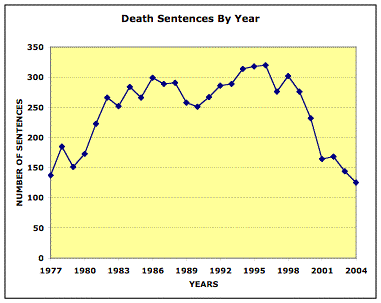
Apr 26, 2005
Supreme Court to Consider “Lingering Doubt” Evidence in Capital Cases
Oregon v. Guzek — The U.S. Supreme Court has announced that it will consider whether capital defendants have a constitutional right to present evidence that would cast doubt on their conviction during the penalty phase of their death penalty trials, a question that has divided state and lower federal courts for many years. The defendant, Randy Lee Guzek, sought to introduce alibi evidence after he was convicted during the sentencing phase of his trial. This evidence tended to show that he had…
Read MoreApr 25, 2005
DEATH SENTENCES CONTINUED TO DECLINE IN 2004
FOR IMMEDIATE RELEASE Monday, April 25, 2005 CONTACT: Brenda Bowser Office: (202) 293‑6970, x215 Cell: (301) 906‑4460 bbowser@deathpenaltyinfo.org DEATH SENTENCES CONTINUED TO DECLINE IN 2004 WASHINGTON, DC – In 2004, 125 people were sentenced to death in the United States, the fewest number since capital punishment was reinstated in 1976. Death sentences have declined by more than 50% since the late 1990’s and the numbers in 2004 represented a drop of 13% compared to 2003. The number of…
Read MoreApr 22, 2005
Los Angeles Times Calls for Moratorium on California Death Penalty
A recent Los Angeles Times editorial called on California lawmakers to impose a moratorium on executions until a state commission charged with examining the fairness and accuracy of California’s death penalty laws can finish its work. The paper noted that a similar review led by New York state lawmakers resulted in findings that effectively ended capital punishment in that state for this year. The editorial stated: Many Californians, lawmakers as well as voters, share those concerns (as…
Read MoreApr 20, 2005
NEW RESOURCE: “A Life and Death Decision” Examines Jury Deliberations
“Scott Sundby’s new book, “A Life and Death Decision: A Jury Weighs the Death Penalty” is an impartial look at capital jury deliberations through the examination of data collected by the Capital Jury Project and other studies of group decision-making. Drawing on the Capital Jury Project’s interviews with more than 1,000 jurors from across the country who had taken part in death penalty cases, the book addresses crucial issues such as jury instructions, jury room setup, and voir dire procedures.
Read MoreApr 20, 2005
NEW RESOURCE: “Executed on a Technicality”
Executed on a Technicality: Lethal Injustice on America’s Death Row, by Professor David Dow, is a behind-the-scenes look at the death penalty through the lens of an attorney who formerly supported capital punishment. Dow, who teaches at the University of Houston Law Center and founded the Texas Innocence Network, provides case histories illustrating serious flaws in the death penalty system. He uses these cases to guide readers through a web of coerced confessions, incompetent representation…
Read MoreApr 20, 2005
Death Penalty Prosecutions May be Halted if Funding is Inadequate
The Louisiana Supreme Court recently ruled that trial judges can halt prosecutions of poor defendants until the state comes up with the money to pay for an adequate defense. Louisiana has in the past failed to adequately fund indigent defense programs. “I think it’s a warning,” said Phyllis Mann, appointed counsel for Benjamin Tonguis and Adrian Citizen, two death penalty defendants whose cases were reviewed by the state supreme court. “The court is saying as plainly as they possibly can not to…
Read MoreApr 20, 2005
POSSIBLE INNOCENCE: DNA Evidence Could Free Man From Arizona’s Death Row
An Arizona court has overturned the conviction of death row inmate Clarence Hill because of new DNA evidence. The court noted that, “It is more likely than not that no reasonable juror would have convicted Mr. Hill in light of the present DNA evidence.” Hill has spent 15 years on death row for the murder of his landlord, but new DNA tests have revealed that the victim was not the source of the blood found on Hill’s clothing and bedsheets during the investigation. The blood was used as evidence…
Read MoreApr 20, 2005
Nebraska Supreme Court to Hear Electric Chair Challenge
The Nebraska Supreme Court has agreed to consider whether the state’s use of the electric chair is cruel and unusual punishment. The case, brought by death row inmate Carey Dean Moore, will be heard on May 5. Every other death penalty state has adopted lethal injection as an alternative method of execution. A bill to offer lethal injection in Nebraska remains stalled in the state’s Senate Judiciary Committee. Three people have been put to death in Nebraska since executions resumed in 1994.
Read More
Apr 19, 2005
Attorneys Seek DNA Testing In Case of Executed Texas Man
Attorney Barry Scheck plans to ask Texas Governor Rick Perry to order DNA testing in the case of Claude Jones, who maintained his innocence until his execution in December 2000. Scheck, co-founder of the Innocence Project, says Jones’ conviction was largely based on dubious evidence. The state’s case against him included testimony from an accomplice linking Jones to the crime and the report of a state forensic scientist who examined a one-inch length of hair found at the crime scene. The…
Read More