Publications & Testimony
Testimony and Statements on the Death Penalty
FROM DPIC
For testimony by former Executive Director Robert Dunham and former Executive Director Richard C. Dieter, please visit our page DPIC Testimony.
FROM RELIGIOUS LEADERS AND ORGANIZATIONS
- News Brief: Pope Francis Calls for Prayer to Abolish the Death Penalty (September 1, 2022)
- Jewish Congregation Renews Request for Department of Justice to Drop Death Penalty in Tree of Life Synagogue Killings (June 24, 2021)
- Orthodox Church Patriarch Calls Death Penalty Incompatible with Christian Beliefs (October 20, 2020)
- Presbyterian Church (U.S.A.) — Statement on the Federal Death Penalty (August 5, 2019)
- Louisiana Christian Faith Leaders Call for State to Abolish Death Penalty (April 25, 2019)
- Pittsburgh Rabbi’s Wife Opposes Death Penalty for Tree of Life Synagogue Killings (March 18, 2019)
- Orthodox Jewish Organization Calls for an End to Capital Punishment in the U.S. | Death Penalty Information Center (February 17, 2016)
- Baptist Theologian Says Death Penalty Does Not Fit With Christian Theology (March 8, 2016)
- Civil and Human Rights: Death Penalty — Church & Society, The United Methodist Church
- Religious Views: Over 150 Catholic Theologians Call for Repeal of the Death Penalty (September 27, 2011)
- Power Over Life and Death — The Power to Save a Life (January 15, 2005)
- Responsibility, Rehabilitation, and Restoration: A Catholic Perspective on Crime and Criminal Justice (November 2000)
- The Challenge of Holiness: A Sermon on the Death Penalty (January 10, 2000)
- General Assembly of the Texas Conference of Churches — Resolution Opposing the Death Penalty (February 24, 1998)
- Statement by Catholic Bishops of Texas on Capital Punishment (October 20, 1997)
- Catholic Church Expresses Strong Opposition to Capital Punishment in Catechism (September 9, 1997)
- Catholic Bishops of Iowa Issue Statement on Death Penalty (February 4, 1998)
- To End the Death Penalty: A Report of the National Jewish/Catholic Consultation
- Transcript of Dr. Pat Robertson’s Speech on the Role of Religion and the Death Penalty at The College of William and Mary
- Collection of Official Catholic Statements on the Death Penalty (1980)
FROM THE INTERNATIONAL COMMUNITY
- UN experts call for universal abolition of the death penalty | OHCHR (October 9, 2023)
- Zambia Becomes 25th Sub-Saharan African Nation to Abolish Death Penalty (December 23, 2022)
- Belgium Wants a World Without the Death Penalty (October 20, 2022)
- As France Prepares to Assume Presidency of European Union, Emmanuel Macron Announces Initiative for Worldwide Abolition of Death Penalty (October 11, 2021)
- U.N. Secretary-General, European Union Ambassador Call for Abolition of “Barbaric” Death Penalty (October 11, 2017)
- European Union Calls for Abolition of Capital Punishment as World Coalition Hosts International Death Penalty Conference (June 27, 2017)
- U.N. Investigator Talks About the Future of Solitary and the Death Penalty (November 7, 2016)
- World Congress Against the Death Penalty Renews Call for Global Moratorium, Pope Sends Message of Support (June 27, 2016)
- Declaration by the Presidency on behalf of the European Union on the 400th execution in Texas from the Council of the European Union (August 21, 2007)
- Resolution Supporting Worldwide Moratorium on Executions from the United Nations Commission on Human Rights (April 1999)
- Mary Robinson, U.N. High Commissioner for Human Rights — Message to the Press Conference organized by the Death Penalty Information Center for the release of the report, “International Perspectives on the Death Penalty” (October 12, 1999)
- Status of the International Covenants on Human Rights from the United Nations Commission on Human Rights (April 1998)
FROM ADVOCACY GROUPS
- Advocacy Group Tells Supreme Court that Negative Stereotypes Distort Perception that Latinos in Death-Penalty Cases Pose Future Danger to Society (April 15, 2022)
- Disability Rights Groups, Legal Experts, and Conservative Advocates Urge Supreme Court to Strike Down Georgia’s Uniquely Harsh Proof Requirements in Death-Penalty Intellectual Disabilities Cases (January 11, 2022)
- NAACP Reaffirms Its Support of Abolishing the Death Penalty (2022)
- More Than 80 Civil Rights and Advocacy Organizations Urge President Biden to End Federal Executions | Death Penalty Information Center (February 9, 2021)
- More Than 250 Conservative Leaders Join Call to End Death Penalty (October 29, 2019)
- National Alliance on Mental Illness: The Death Penalty
- Florida League of Women Voters Calls for Halt to Executions (May 28, 2007)
- Victims Organizations Issue Joint Statement for National Victims’ Rights Week (April 19, 2007)
FROM JUDGES, LEGISLATORS, AND OTHER ORGANIZATIONS
- Republican-led Oklahoma committee considers pause on executions amid death case scrutiny (October 5, 2023)
- Former Pro-Death Penalty District Attorney Explains Why He Now Supports Abolition, and Fears Political Promises to Expand the Use of the Death Penalty (August 20, 2023)
- Pressley, Durbin Reintroduce Bill to End the Federal Death Penalty (July 13, 2023)
- The Lancet Editorial: Physician Involvement in Executions Violates Medical Ethics | Death Penalty Information Center (May 20, 2023)
- APA calls for extending ineligibility for the death penalty to adolescent offenders younger than age 21 (August 4, 2022)
- Why some Republicans are turning against the death penalty | Ron Ferguson | Ohio House of Representatives (March 8, 2022)
- Eight years on Texas’ highest criminal court turned Elsa Alcala into a death penalty skeptic. How will the court change without her? (January 26, 2019)
- AMA to Supreme Court: Doctor participation in executions unethical (August 22, 2018)
- Former Governor Bill Richardson: Death Penalty Is Bad for Business, Out of Step With World’s Views (June 16, 2017)
- Capital Punishment and Nurses’ Participation in Capital Punishment (2016)
- Former Ohio Attorney General Jim Petro Says Death Penalty Unfixable, “Not Worth It Any More” (September 12, 2016)
- Resolution Supporting Repeal of the Death Penalty, National Hispanic Caucus of State Legislators (August 11, 2016)
- Retired Police Captain Says Repealing Death Penalty Is “Smart on Crime” (November 24, 2014)
- Resolution Supporting Abolition of the Death Penalty, Natl. Assoc. of Black Psychologists (2012)
- The Road to Justice and Peace by New Jersey State Senator Raymond Lesniak (February 1, 2009)
- Statement On The Federal Death Penalty System by Senator Feingold (June 7, 2001)
- Statement on the Need for a Federal Moratorium on the Death Penalty Senator Feingold (October 29, 2000)
- Death Penalty: The Torah and Today (August 23, 2000)
- Press Release for Senator Russ Feingold’s Introduction of Senate’s First Death Penalty Moratorium Bill (April 20, 2000)
- Amnesty International Southern Regional Conference: Orlando, Florida Remarks by Former Florida Chief Justice Gerald Kogan (October 23, 1999)
- American Bar Association Resolution on the Death Penalty (February 3, 1997)
FROM MURDER VICTIMS’ FAMILY MEMBERS
Items: 5871 — 5880
Jan 12, 2005
NEW RESOURCE: “Executed on a Technicality” Scheduled for April Release
Executed on a Technicality: Lethal Injustice on America’s Death Row, by Professor David Dow, to be released in April 2005, is a behind-the-scenes look at the death penalty through the lens of an attorney who formerly supported capital punishment. Dow, who teaches at the University of Houston Law Center and founded the Texas Innocence Network, provides case histories illustrating serious flaws in the death penalty system. He uses these cases to guide readers through a web of coerced confessions…
Read MoreJan 11, 2005
Arizona Case Exposes Prosecutorial Misconduct and Wrongful Convictions
In an examination of the case against three men sentenced to death for a triple murder that occurred in Tucson’s El Grande Market, reporter Jeffrey Toobin in the New Yorker describes the incidents that led to the fall of the lead prosecutor, Kenneth Peasley, for presenting false evidence in the case. Only one of the co-defendants, Martin Soto-Fong, remains on Arizona’s death row. Of the other two defendants, Christopher McCrimmon was acquitted at a re-trial in 1997, and Andre Minnett had his…
Read MoreJan 10, 2005
Indiana Governor Grants Clemency While Calling for Death Penalty Review
With just days remaining in his term, Indiana Governor Joe Kernan (pictured) has granted clemency to Michael Daniels, whose case underscored the Governor’s concerns about the death penalty. “I have now encountered two cases where doubt about an offender’s personal responsibility and the quality of the legal process leading to the capital sentence has led me to grant clemency. These instances should cause us to take a hard look at how Indiana administers and reviews capital sentences,” said…
Read MoreJan 07, 2005
RELIGIOUS VIEWS: Connecticut Archbishop Asks Parishoners to Protest the Death Penalty
As Connecticut prepares to carry out its first execution in over 40 years, Catholic Archbishop Henry J. Mansell of Hartford called on local parishes to sign a Church petition that calls for an end to capital punishment. “The death penalty offers the tragic illusion that we can defend life only by taking life,” Mansell wrote in a letter that will be read during Masses on January 8 and 9. Other bishops in Connecticut are taking similar actions prior to the scheduled execution of Michael Ross on…
Read MoreJan 06, 2005
Washington Post Explores Gonzales Clemency Memos
The Washington Post has conducted further research into the clemency memos prepared by U.S. Attorney General nominee Alberto R. Gonzales, who served as lead counsel to then-Governor George W. Bush in Texas. Gonzales crafted 62 memos regarding clemency requests from Texas death row inmates, and several Texas attorneys have voiced their criticisms that the clemency memos contained incomplete and unfair summaries of evidence and mitigating circumstances. The memos, first reviewed in 2003 by…
Read MoreJan 05, 2005
NEW RESOURCES: Conversations With Extraordinary Women — Sister Helen Prejean
The book In Sweet Company: Conversations With Extraordinary Women About Living a Spiritual Life by Margaret Wolff features Sister Helen Prejean as one of 14 women whose spiritual beliefs have served as the compass for their decision-making and life’s work. Prejean, author of the Pulitzer Prize-nominated book “Dead Man Walking” and the newly released “The Death of Innocents: An Eyewitness Account of Wrongful Executions,” has been an advisor to those on death row and an advocate against the death…
Read MoreJan 03, 2005
NEW RESOURCE: Sister Helen Prejean’s New Book: The Death of Innocents
In her new book, The Death of Innocents: An Eyewitness Account of Wrongful Executions, Sister Helen Prejean uses her personal experiences as a counselor to those on death row to explore the issue of innocence and the likelihood of executing a wrongly convicted person. The book also traces the historical and legal underpinnings of the death penalty in the U.S. Prejean, who authored the #1 New York Times bestseller “Dead Man Walking,” begins her new book by focusing on the cases of Joseph Roger…
Read MoreJan 03, 2005
NEW VOICES: Federal Judge Discusses His Concerns About the Death Penalty
In an interview with The New York Times, Judge Jed S. Rakoff (pictured) discussed his reasons for finding the federal death penalty to be unconstitutional. Judge Rakoff ruled in April 2002 that the death penalty failed to secure due process because of the demonstrated risk of executing an innocent person. He noted that his conclusions on capital punishment were based in part on his extensive review of cases included on the Death Penalty Information Center’s innocence list. He remarked that the…
Read More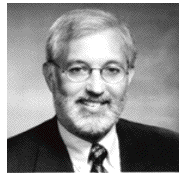
Jan 01, 2005
Juveniles News and Developments 2004
Juveniles and the Mentally Disabled More Likely to Give False Confessions Studies and surveys have found that both minors and the mentally impaired are more likely to make false confessions, in part because they are more vulnerable to suggestion. A recent study conducted by Northwestern University law professor Steve Drizin and UC Irvine criminologist Richard Leo examined 125 cases in which individuals were exonerated after giving false confessions. The researchers found that 32% of the cases…
Read MoreDec 31, 2004
Executions News and Developments: 2004 — 1998
Autopsies of Executed Inmates by State Medical Examiners Reveal Probability of Botched Procedures An autopsy of the last man executed in Kentucky, Edward L. Harper, found only 3 to 6.5 milligrams per liter of barbiturate in Harper’s blood — a level leaving a high chance that Harper was conscious throughout the execution and that he felt pain when he was injected with subsequent drugs that paralyzed and suffocated him, and then stopped his heart. Dr. Mark Dershwitz, the prosecution expert who…
Read More