Publications & Testimony
Testimony and Statements on the Death Penalty
FROM DPIC
For testimony by former Executive Director Robert Dunham and former Executive Director Richard C. Dieter, please visit our page DPIC Testimony.
FROM RELIGIOUS LEADERS AND ORGANIZATIONS
- News Brief: Pope Francis Calls for Prayer to Abolish the Death Penalty (September 1, 2022)
- Jewish Congregation Renews Request for Department of Justice to Drop Death Penalty in Tree of Life Synagogue Killings (June 24, 2021)
- Orthodox Church Patriarch Calls Death Penalty Incompatible with Christian Beliefs (October 20, 2020)
- Presbyterian Church (U.S.A.) — Statement on the Federal Death Penalty (August 5, 2019)
- Louisiana Christian Faith Leaders Call for State to Abolish Death Penalty (April 25, 2019)
- Pittsburgh Rabbi’s Wife Opposes Death Penalty for Tree of Life Synagogue Killings (March 18, 2019)
- Orthodox Jewish Organization Calls for an End to Capital Punishment in the U.S. | Death Penalty Information Center (February 17, 2016)
- Baptist Theologian Says Death Penalty Does Not Fit With Christian Theology (March 8, 2016)
- Civil and Human Rights: Death Penalty — Church & Society, The United Methodist Church
- Religious Views: Over 150 Catholic Theologians Call for Repeal of the Death Penalty (September 27, 2011)
- Power Over Life and Death — The Power to Save a Life (January 15, 2005)
- Responsibility, Rehabilitation, and Restoration: A Catholic Perspective on Crime and Criminal Justice (November 2000)
- The Challenge of Holiness: A Sermon on the Death Penalty (January 10, 2000)
- General Assembly of the Texas Conference of Churches — Resolution Opposing the Death Penalty (February 24, 1998)
- Statement by Catholic Bishops of Texas on Capital Punishment (October 20, 1997)
- Catholic Church Expresses Strong Opposition to Capital Punishment in Catechism (September 9, 1997)
- Catholic Bishops of Iowa Issue Statement on Death Penalty (February 4, 1998)
- To End the Death Penalty: A Report of the National Jewish/Catholic Consultation
- Transcript of Dr. Pat Robertson’s Speech on the Role of Religion and the Death Penalty at The College of William and Mary
- Collection of Official Catholic Statements on the Death Penalty (1980)
FROM THE INTERNATIONAL COMMUNITY
- UN experts call for universal abolition of the death penalty | OHCHR (October 9, 2023)
- Zambia Becomes 25th Sub-Saharan African Nation to Abolish Death Penalty (December 23, 2022)
- Belgium Wants a World Without the Death Penalty (October 20, 2022)
- As France Prepares to Assume Presidency of European Union, Emmanuel Macron Announces Initiative for Worldwide Abolition of Death Penalty (October 11, 2021)
- U.N. Secretary-General, European Union Ambassador Call for Abolition of “Barbaric” Death Penalty (October 11, 2017)
- European Union Calls for Abolition of Capital Punishment as World Coalition Hosts International Death Penalty Conference (June 27, 2017)
- U.N. Investigator Talks About the Future of Solitary and the Death Penalty (November 7, 2016)
- World Congress Against the Death Penalty Renews Call for Global Moratorium, Pope Sends Message of Support (June 27, 2016)
- Declaration by the Presidency on behalf of the European Union on the 400th execution in Texas from the Council of the European Union (August 21, 2007)
- Resolution Supporting Worldwide Moratorium on Executions from the United Nations Commission on Human Rights (April 1999)
- Mary Robinson, U.N. High Commissioner for Human Rights — Message to the Press Conference organized by the Death Penalty Information Center for the release of the report, “International Perspectives on the Death Penalty” (October 12, 1999)
- Status of the International Covenants on Human Rights from the United Nations Commission on Human Rights (April 1998)
FROM ADVOCACY GROUPS
- Advocacy Group Tells Supreme Court that Negative Stereotypes Distort Perception that Latinos in Death-Penalty Cases Pose Future Danger to Society (April 15, 2022)
- Disability Rights Groups, Legal Experts, and Conservative Advocates Urge Supreme Court to Strike Down Georgia’s Uniquely Harsh Proof Requirements in Death-Penalty Intellectual Disabilities Cases (January 11, 2022)
- NAACP Reaffirms Its Support of Abolishing the Death Penalty (2022)
- More Than 80 Civil Rights and Advocacy Organizations Urge President Biden to End Federal Executions | Death Penalty Information Center (February 9, 2021)
- More Than 250 Conservative Leaders Join Call to End Death Penalty (October 29, 2019)
- National Alliance on Mental Illness: The Death Penalty
- Florida League of Women Voters Calls for Halt to Executions (May 28, 2007)
- Victims Organizations Issue Joint Statement for National Victims’ Rights Week (April 19, 2007)
FROM JUDGES, LEGISLATORS, AND OTHER ORGANIZATIONS
- Republican-led Oklahoma committee considers pause on executions amid death case scrutiny (October 5, 2023)
- Former Pro-Death Penalty District Attorney Explains Why He Now Supports Abolition, and Fears Political Promises to Expand the Use of the Death Penalty (August 20, 2023)
- Pressley, Durbin Reintroduce Bill to End the Federal Death Penalty (July 13, 2023)
- The Lancet Editorial: Physician Involvement in Executions Violates Medical Ethics | Death Penalty Information Center (May 20, 2023)
- APA calls for extending ineligibility for the death penalty to adolescent offenders younger than age 21 (August 4, 2022)
- Why some Republicans are turning against the death penalty | Ron Ferguson | Ohio House of Representatives (March 8, 2022)
- Eight years on Texas’ highest criminal court turned Elsa Alcala into a death penalty skeptic. How will the court change without her? (January 26, 2019)
- AMA to Supreme Court: Doctor participation in executions unethical (August 22, 2018)
- Former Governor Bill Richardson: Death Penalty Is Bad for Business, Out of Step With World’s Views (June 16, 2017)
- Capital Punishment and Nurses’ Participation in Capital Punishment (2016)
- Former Ohio Attorney General Jim Petro Says Death Penalty Unfixable, “Not Worth It Any More” (September 12, 2016)
- Resolution Supporting Repeal of the Death Penalty, National Hispanic Caucus of State Legislators (August 11, 2016)
- Retired Police Captain Says Repealing Death Penalty Is “Smart on Crime” (November 24, 2014)
- Resolution Supporting Abolition of the Death Penalty, Natl. Assoc. of Black Psychologists (2012)
- The Road to Justice and Peace by New Jersey State Senator Raymond Lesniak (February 1, 2009)
- Statement On The Federal Death Penalty System by Senator Feingold (June 7, 2001)
- Statement on the Need for a Federal Moratorium on the Death Penalty Senator Feingold (October 29, 2000)
- Death Penalty: The Torah and Today (August 23, 2000)
- Press Release for Senator Russ Feingold’s Introduction of Senate’s First Death Penalty Moratorium Bill (April 20, 2000)
- Amnesty International Southern Regional Conference: Orlando, Florida Remarks by Former Florida Chief Justice Gerald Kogan (October 23, 1999)
- American Bar Association Resolution on the Death Penalty (February 3, 1997)
FROM MURDER VICTIMS’ FAMILY MEMBERS
Items: 5941 — 5950
Nov 02, 2004
California’s Record on Wrongful Convictions
A recent San Francisco magazine article entitled “Innocence Lost,” examines California’s record of wrongful convictions. The researchers report that the nation’s largest criminal justice system has sent more innocent people to prison for longer terms than any other state. Among the exonerees are three from the state’s death row and nearly 200 people who were serving either life or very long terms. The magazine notes that despite these numbers, state lawmakers have repeatedly passed up…
Read MoreNov 02, 2004
FBI Releases 2003 Uniform Crime Report: South Has Highest Murder Rate
The FBI recently released its Uniform Crime Report for 2003. The number of murders in the United States increased slightly from 16,229 to 16,503. Once again, the South had the highest murder rate (6.9 murders per 100,000 people). In 2003, the South carried out 89% of the executions in the country. The Northeast had the lowest murder rate in the country (4.2 murders per 100,000 people) and carried out no executions in 2003. (2003 FBI Uniform Crime Report, October 27, 2004 (execution numbers from…
Read MoreNov 02, 2004
LEGISLATION: Innocence Protection Act Signed Into Law
President Bush signed into law the Justice for All Act (H.R.5107) that includes a version of the Innocence Protection Act. The bill was co-sponsored by Senators Patrick Leahy (D‑Vt.) and Orrin Hatch (R.-Ut.). It will create a post-conviction testing process to protect innocent defendants and provide training funds for the defense and prosecution in death penalty cases. (Salt Lake Tribune, Nov. 2, 2004). See the Justice Project for more details on the law.
Read MoreNov 02, 2004
Arguments Heard in Roper v. Simmons
ARGUMENTS HEARD IN ROPER v. SIMMONS Marsha Levick (2d right) and Dr. David Fassler (far right) On Wednesday, October 13, the United States Supreme Court heard arguments in Roper v. Simmons, a case that will determine the constitutionality of executing juvenile offenders. Marsha Levick, Chief Counsel of the Juvenile Law Center, and Dr. David Fassler, Trustee of the American Psychiatric Association, were among the juvenile law and medical experts who spoke to reporters following the arguments.
Read More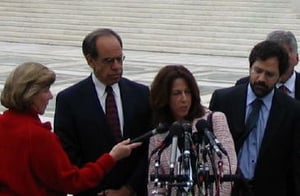
Nov 01, 2004
Texas Execution Proceeds Despite Widespread Concerns About Houston Lab’s Role
Dominique Green was executed in Texas on October 26 despite calls for a stay from a federal judge, Nobel Peace Prize winner Desmond Tutu, and the victim’s family. A U.S. District Court judge in Houston had postponed the execution until the city’s police department could complete cataloging 280 boxes of recently discovered evidence that could impact thousands of criminal cases. That stay was overturned by the U.S. Court of Appeals for the Fifth Circuit. Green had admitted that he was present…
Read MoreOct 30, 2004
DPIC SUMMARY: The Innocence Protection Act of 2004
The Justice for All Act of 2004, Public Law No: 108 – 405, became law on October 30, 2004, and affects the death penalty by creating a DNA testing program and authorizing grants to states for capital prosecution and capital defense improvement. Specifically, the act: Provides rules and procedures for federal inmates applying for DNA testing. Creates the Kirk Bloodsworth Post-Conviction DNA Testing Grant Program and authorizes $25 million over five years to help states pay the cost of…
Read More
Oct 29, 2004
INTERNATIONAL: Iran Poised to End Juvenile Death Penalty
According to an Iranian justice department spokesperson, the Iranian Parliament is expected to approve legislation that would end the death penalty for offenders under the age of 18. The measure would also prohibit lashings for those under 18. Under pressure from the European Union to reform its human rights record, Iran has had no recorded stonings since late 2002, and the parliament has enacted laws banning torture and the upholding of citizens’ rights. (AFP, October 26, 2004). The U.S.
Read MoreOct 29, 2004
RELIGIOUS VIEWS: Catholic Bishops Oppose Expansion of Federal Death Penalty for Terrorism
Cardinal Theodore E. McCarrick, the Catholic Archbishop of Washington and acting as Chairman of the Domestic Policy Committee of the United States Conference of Catholic Bishops, has urged House and Senate conferees working on anti-terrorism legislation to report out a final bill that would not expand the federal death penalty for terrorists. McCarrick wrote a letter to House and Senate leaders crafting their final version of the National Intelligence Reform Act (S. 2845). The House version of…
Read MoreOct 29, 2004
Poll Finds Tepid Support for Death Penalty as State Sets Execution Date
As Maryland Circuit Court Judge Steven I. Platt signed a death warrant scheduling the execution of Heath W. Burch for the week of December 6, a Potomac Inc. poll of state residents revealed that only 53% support capital punishment. Burch has been on death row since 1996 and would be the first person since 1953 to be executed for a crime committed in Prince George’s County. Experts predict that his execution would be met with resistance from county residents, 50% of whom oppose capital…
Read MoreOct 28, 2004
Justice O’Connor Notes Importance of International Law
During a recent speech at Georgetown Law School, U.S. Supreme Court Justice Sandra Day O’Connor emphasized the growing importance of international law in U.S. courts, saying judges would be negligent if they disregarded its importance in a post-September 11th world of heightened tensions. O’Connor said the Supreme Court is taking cases that demand a better understanding of foreign legal systems, noting, “International law is no longer a specialty. … It is vital if judges are to faithfully…
Read More