Publications & Testimony
Testimony and Statements on the Death Penalty
FROM DPIC
For testimony by former Executive Director Robert Dunham and former Executive Director Richard C. Dieter, please visit our page DPIC Testimony.
FROM RELIGIOUS LEADERS AND ORGANIZATIONS
- News Brief: Pope Francis Calls for Prayer to Abolish the Death Penalty (September 1, 2022)
- Jewish Congregation Renews Request for Department of Justice to Drop Death Penalty in Tree of Life Synagogue Killings (June 24, 2021)
- Orthodox Church Patriarch Calls Death Penalty Incompatible with Christian Beliefs (October 20, 2020)
- Presbyterian Church (U.S.A.) — Statement on the Federal Death Penalty (August 5, 2019)
- Louisiana Christian Faith Leaders Call for State to Abolish Death Penalty (April 25, 2019)
- Pittsburgh Rabbi’s Wife Opposes Death Penalty for Tree of Life Synagogue Killings (March 18, 2019)
- Orthodox Jewish Organization Calls for an End to Capital Punishment in the U.S. | Death Penalty Information Center (February 17, 2016)
- Baptist Theologian Says Death Penalty Does Not Fit With Christian Theology (March 8, 2016)
- Civil and Human Rights: Death Penalty — Church & Society, The United Methodist Church
- Religious Views: Over 150 Catholic Theologians Call for Repeal of the Death Penalty (September 27, 2011)
- Power Over Life and Death — The Power to Save a Life (January 15, 2005)
- Responsibility, Rehabilitation, and Restoration: A Catholic Perspective on Crime and Criminal Justice (November 2000)
- The Challenge of Holiness: A Sermon on the Death Penalty (January 10, 2000)
- General Assembly of the Texas Conference of Churches — Resolution Opposing the Death Penalty (February 24, 1998)
- Statement by Catholic Bishops of Texas on Capital Punishment (October 20, 1997)
- Catholic Church Expresses Strong Opposition to Capital Punishment in Catechism (September 9, 1997)
- Catholic Bishops of Iowa Issue Statement on Death Penalty (February 4, 1998)
- To End the Death Penalty: A Report of the National Jewish/Catholic Consultation
- Transcript of Dr. Pat Robertson’s Speech on the Role of Religion and the Death Penalty at The College of William and Mary
- Collection of Official Catholic Statements on the Death Penalty (1980)
FROM THE INTERNATIONAL COMMUNITY
- UN experts call for universal abolition of the death penalty | OHCHR (October 9, 2023)
- Zambia Becomes 25th Sub-Saharan African Nation to Abolish Death Penalty (December 23, 2022)
- Belgium Wants a World Without the Death Penalty (October 20, 2022)
- As France Prepares to Assume Presidency of European Union, Emmanuel Macron Announces Initiative for Worldwide Abolition of Death Penalty (October 11, 2021)
- U.N. Secretary-General, European Union Ambassador Call for Abolition of “Barbaric” Death Penalty (October 11, 2017)
- European Union Calls for Abolition of Capital Punishment as World Coalition Hosts International Death Penalty Conference (June 27, 2017)
- U.N. Investigator Talks About the Future of Solitary and the Death Penalty (November 7, 2016)
- World Congress Against the Death Penalty Renews Call for Global Moratorium, Pope Sends Message of Support (June 27, 2016)
- Declaration by the Presidency on behalf of the European Union on the 400th execution in Texas from the Council of the European Union (August 21, 2007)
- Resolution Supporting Worldwide Moratorium on Executions from the United Nations Commission on Human Rights (April 1999)
- Mary Robinson, U.N. High Commissioner for Human Rights — Message to the Press Conference organized by the Death Penalty Information Center for the release of the report, “International Perspectives on the Death Penalty” (October 12, 1999)
- Status of the International Covenants on Human Rights from the United Nations Commission on Human Rights (April 1998)
FROM ADVOCACY GROUPS
- Advocacy Group Tells Supreme Court that Negative Stereotypes Distort Perception that Latinos in Death-Penalty Cases Pose Future Danger to Society (April 15, 2022)
- Disability Rights Groups, Legal Experts, and Conservative Advocates Urge Supreme Court to Strike Down Georgia’s Uniquely Harsh Proof Requirements in Death-Penalty Intellectual Disabilities Cases (January 11, 2022)
- NAACP Reaffirms Its Support of Abolishing the Death Penalty (2022)
- More Than 80 Civil Rights and Advocacy Organizations Urge President Biden to End Federal Executions | Death Penalty Information Center (February 9, 2021)
- More Than 250 Conservative Leaders Join Call to End Death Penalty (October 29, 2019)
- National Alliance on Mental Illness: The Death Penalty
- Florida League of Women Voters Calls for Halt to Executions (May 28, 2007)
- Victims Organizations Issue Joint Statement for National Victims’ Rights Week (April 19, 2007)
FROM JUDGES, LEGISLATORS, AND OTHER ORGANIZATIONS
- Republican-led Oklahoma committee considers pause on executions amid death case scrutiny (October 5, 2023)
- Former Pro-Death Penalty District Attorney Explains Why He Now Supports Abolition, and Fears Political Promises to Expand the Use of the Death Penalty (August 20, 2023)
- Pressley, Durbin Reintroduce Bill to End the Federal Death Penalty (July 13, 2023)
- The Lancet Editorial: Physician Involvement in Executions Violates Medical Ethics | Death Penalty Information Center (May 20, 2023)
- APA calls for extending ineligibility for the death penalty to adolescent offenders younger than age 21 (August 4, 2022)
- Why some Republicans are turning against the death penalty | Ron Ferguson | Ohio House of Representatives (March 8, 2022)
- Eight years on Texas’ highest criminal court turned Elsa Alcala into a death penalty skeptic. How will the court change without her? (January 26, 2019)
- AMA to Supreme Court: Doctor participation in executions unethical (August 22, 2018)
- Former Governor Bill Richardson: Death Penalty Is Bad for Business, Out of Step With World’s Views (June 16, 2017)
- Capital Punishment and Nurses’ Participation in Capital Punishment (2016)
- Former Ohio Attorney General Jim Petro Says Death Penalty Unfixable, “Not Worth It Any More” (September 12, 2016)
- Resolution Supporting Repeal of the Death Penalty, National Hispanic Caucus of State Legislators (August 11, 2016)
- Retired Police Captain Says Repealing Death Penalty Is “Smart on Crime” (November 24, 2014)
- Resolution Supporting Abolition of the Death Penalty, Natl. Assoc. of Black Psychologists (2012)
- The Road to Justice and Peace by New Jersey State Senator Raymond Lesniak (February 1, 2009)
- Statement On The Federal Death Penalty System by Senator Feingold (June 7, 2001)
- Statement on the Need for a Federal Moratorium on the Death Penalty Senator Feingold (October 29, 2000)
- Death Penalty: The Torah and Today (August 23, 2000)
- Press Release for Senator Russ Feingold’s Introduction of Senate’s First Death Penalty Moratorium Bill (April 20, 2000)
- Amnesty International Southern Regional Conference: Orlando, Florida Remarks by Former Florida Chief Justice Gerald Kogan (October 23, 1999)
- American Bar Association Resolution on the Death Penalty (February 3, 1997)
FROM MURDER VICTIMS’ FAMILY MEMBERS
Items: 6101 — 6110
Jun 16, 2004
UPCOMING EVENTS: World Congress Against the Death Penalty to Convene in Montreal
The 2nd World Congress Against the Death Penalty will take place in Montreal, Canada, October 6 – 9, 2004. The conference is sponsored by Penal Reform International, the End to Capital Punishment Movement (ECPM USA), and the ECPM Network (Together Against the Death Penalty). During the four-day event, government officials, representatives from death penalty and law-related organizations, and victims’ family members from around the world will host a series of workshops, plenary sessions, and…
Read MoreJun 16, 2004
New Resource: Study Encourages Police to Record Interviews
A recent study conducted by former U.S. Attorney Thomas Sullivan and released by the Center on Wrongful Convictions at Northwestern University School of Law concluded that electronic recording of interrogations of criminal suspects is a cost-effective method that results in more convictions and speedier justice. The researchers contacted 238 law enforcement agencies in 38 states that record interrogations in felony crimes and found that “virtually every officer with whom we spoke, having given…
Read MoreJun 16, 2004
NEW RESOURCE: The Angolite Highlights Long Road to Clemency for Man with Mental Retardation
The Angolite, a news magazine produced by inmates at Louisiana’s Angola State Penitentiary, highlights the commutation of Herbert Welcome, a man with mental retardation whose death sentence was lifted by Governor Mike Foster in 2003. The article follows Welcome’s decades-long struggle to have his sentence commuted, including a 1988 recommendation for clemency that was never signed. Years later, Welcome’s clemency effort was reignited by his attorneys from the Center for Equal Justice in New…
Read MoreJun 16, 2004
Texas Relies on “Junk Science” in Choosing Who Will Be Sentenced to Death
Texas plans to execute David Harris on June 30th on the basis of a prediction in 1986 that he would be a future danger even if sentenced to life in prison. Dr. Edward Gripon testified that Harris posed a substantial risk of committing further violent acts, even though Gripon had never met or examined Harris. During his nearly two decades on death row, Harris has had only minor infractions, such as having too many postage stamps or hanging a clothesline in his cell. In a 1983 brief to the U.S.
Read MoreJun 15, 2004
Nichols’ Sentencing Demonstrates Heavy Burden on Jurors
After deliberating for 20 hours over three days, the jurors who recently found Terry Nichols (pictured) guilty of murder in the 1995 Oklahoma City bombing expressed some of the anguish that choosing between life and death caused them. “It was tough. We had found it much easier to arrive at a guilty verdict, but the penalty phase was much harder,” said juror Terry Zellmer. Cecil Reeder, a Korean War veteran who supported the death penalty for Nichols, said, “This shook me as deep as I’ve ever…
Read MoreJun 14, 2004
Another Victims’ Family Provides Perspective on the Death Penalty as Maryland Execution Approaches
As Maryland prepares for the execution of Steven Oken this week, two Maryland parents whose daughter was murdered six years ago provided a victims’ family perspective on capital punishment in The Washington Post: “Oken committed the crimes for which he is sentenced to die back in 1987. Anyone who has seen the survivors of victims feels sorrow for the pain they have had to bear as the case has worn on. But the death penalty holds little promise of helping survivors deal with their emotional…
Read MoreJun 11, 2004
NEW VOICES: Prosecutor Withdraws from Death Penalty Case
A Kentucky prosecutor raised religious objections to the death penalty in asking to step aside in the case of two men charged with murder. J. Stewart Schneider, the commonwealth’s attorney in Boyd County in northeastern Kentucky, said Thursday he filed his motion to withdraw from the case after reflections at a religious retreat. Schneider also is a minister with the Christian Church (Disciples of Christ). “I spent that weekend in prayer,” he said. “The more I thought about it, the more…
Read MoreJun 10, 2004
New Gallup Poll Results
NEW GALLUP POLL RESULTS Over the years, support for the sentence of Life Without Parole as an alternative to the death penalty has steadily increased, to the point where now the country is evenly split on capital punishment. In 1994, only 32% favored Life, with 50% favoring death. In 2004, support for life without parole had grown to 46%. In less than 20 years, public opinion regarding the deterrent effect of the death penalty — long the backbone of its support — has reversed itself. In 1986…
Read More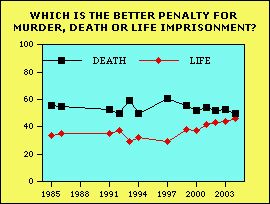
Jun 10, 2004
NEW RESOURCES: Three New Items Of Interest
Three new items have been added to DPIC’s Web site, including a summary of a new report from The Sentencing Project, the complete results of a recent North Carolina poll, and an updated “Special Resources from DPIC” Web page: 1. A summary of important facts from The Sentencing Project’s new report: “The Meaning of ‘Life’: Long Prison Sentences in Context.” For example, the report notes that the use of life-without-parole sentences has expanded significantly — of the lifers in prison, one in four…
Read MoreJun 09, 2004
Death Penalty Fading Away in Europe and Central Asia
In a unanimous vote that will soon add their nation to a lengthy list of countries around the world that have either halted executions or abandoned capital punishment altogether, the lower house of Tajikistan’s Parliament has adopted a moratorium on the death penalty. Passage by the upper house and the signature of the President are reportedly assured. The Tajik moratorium will leave Uzbekistan as the only republic in Central Asia that continues to carry out executions. Experts on Central Asia…
Read More