Studies
Items: 331 — 340
Sep 30, 2009
NEW RESOURCES: Death Row Database Now Available
A new database of death row prisoners in the U.S. is now available on DPIC’s Web site. The database contains current sortable and searchable information on death row inmates in each state, including their name, race, county, and date of birth. The information in the database is also editable, meaning that individuals with knowledge of death row inmates may change or add new information. This new database may be a useful tool in exploring how the death penalty is applied. Click here to access…
Read MoreAug 28, 2009
RESOURCES: Legacy of Watt Espy’s Research Lives on After His Death
Probably the most complete collection of information on executions carried out in the United States from colonial times to the modern era was assembled by Watt Espy of Headland, Alabama. Espy died on August 13, 2009 at age 76, but his files and catalog of executions was preserved and transformed over the years into a searchable database by friends and scholars who appreciated his work. Much of his archive is now located at the State University of New York at Albany. DPIC has information from…
Read MoreAug 26, 2009
NEW RESOURCES: State Instructions for Juries Regarding Life Without Parole Sentences in Capital Cases
In all states that use the death penalty, there are provisions for sentencing inmates to the alternative sentence of life without parole (LWOP). Prior to the U.S. Supreme Court’s ruling in Simmons v. South Carolina (1994), some states with LWOP did not inform the jury of this alternative even when so requested by the defense. Today, states apply a variety of conditions and use differing instructions to inform the jury about this alternative sentence. Opinion polls and surveys of capital jurors…
Read MoreAug 12, 2009
NEW RESOURCES: A Report on Mandatory Death Sentences
The Death Penalty Project of London recently published A Penalty Without Legitimacy: The Mandatory Death Penalty In Trinidad And Tobago (2009), a collection of papers presented at a conference in Trinidad & Tobago in March 2009. The papers include a study of opinions of judges, prosecutors, and counsel on the use of the mandatory death penalty in Trinidad and Tobago and ways to bring its practice in line with other countries that have retained the death penalty. The report also includes…
Read More
Jul 28, 2009
Study: 88% of criminologists do not believe the death penalty is an effective deterrent
A recent study by Professor Michael Radelet and Traci Lacock of the University of Colorado found that 88% of the nation’s leading criminologists do not believe the death penalty is an effective deterrent to crime. The study, Do Executions Lower Homicide Rates? The Views of Leading Criminologists, published in the Journal of Criminal Law and Crimonology, concluded, “There is overwhelming consensus among America’s top criminologists that the empirical research conducted on the deterrence question…
Read More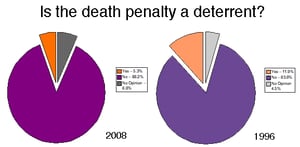
Jul 27, 2009
REALITY CHECK: Death Penalty in Pennsylvania Most Often Results in Life Sentences
In Pennsylvania, the state goes through the expensive and time-consuming process of trying many death penalty cases and fighting appeals, but almost all cases end with a life sentence. According to a recent Associated Press study of what happens in capital cases in the state, 124 death sentences have been overturned and resentenced. When these cases went through the justice system a second time with the original errors corrected, 95% (118) resulted in life sentences or less. Only 6 inmates were…
Read More
Jul 22, 2009
NEW RESOURCES: “Reevaluating Lineups: Why Witnesses Make Mistakes and How to Reduce the Chance of a Misidentification”
The Innocence Project has released a new report pointing to the problems with eyewitness identifications in criminal cases and offering recommendations for making the system more reliable. The report, “Reevaluating Lineups: Why Witnesses Make Mistakes and How to Reduce the Chance of a Misidentification,” states that over 175 people (including some who were sentenced to death) have been wrongfully convicted based, in part, on eyewitness misidentification and later proven innocent through DNA…
Read More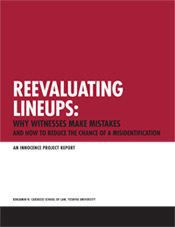
Jul 12, 2009
STUDIES: Death Penalty for Female Offenders
The latest issue of the report, “Death Penalty for Female Offenders,” has been released by Professor Victor Streib of the Ohio Northern University School of Law. The report includes national trends regarding women and the death penalty and case details about individual female death row inmates from 1973 through June 30, 2009. The report notes that while women account for one in ten murder arrests (10%), only one in forty-nine death sentences imposed at trial are for women (2%); women account…
Read MoreJul 10, 2009
STUDIES: “Double Tragedies”: Mental Illness and the Death Penalty
A new report, “Double Tragedies,” addresses the question of whether people with severe mental illness should face the death penalty. The report was authored by the National Alliance on Mental Illness (NAMI) and Murder Victims’ Families for Human Rights (MVFHR) and called for treatment and prevention instead of execution for such offenders. The report, based on extensive interviews with 21 family members in 10 different states, calls the death penalty “inappropriate and unwarranted” for people…
Read More
Jun 26, 2009
COSTS: North Carolina Spent At Least $36 Million Extra Pursuing Capital Cases over 7 Years
According to a study by the Independent Weekly, North Carolina conservatively spent at least $36 million dollars by seeking the death penalty instead of life in prison without parole over the past 7 years, just on defense costs. The state’s Indigent Defense Services organization said the average cost of a death penalty defense was $63,700, and the state sought the death penalty 733 times between 2001 and 2008. The average cost of the 1,785 potentially capital cases where the state instead…
Read More