For decades, Texas performed executions at the highest rate in the country. It has carried out the most executions in the modern era, with nearly five times the number as the next highest state. However, that trend has changed in recent years, as both the number of new death sentences and executions has significantly declined. The Texas Coalition to Abolish the Death Penalty’s (TCADP) 2025 Annual Report examines the dwindling use of capital punishment and the factors that impacted this significant shift.
Use of the death penalty peaked in Texas in 1999, with 48 new death sentences, and 2000, with 40 executions. TCADP notes that 72% of Texas’ executions took place between 1996 and 2015; the last decade accounts for 11%. New death sentences have seen a similar decline, with fewer than ten people sentenced to death in each of the last 11 years. The Report details that in 2025, Texas judges set seven execution dates, the fewest of any year in the last three decades. Of those seven, five were executed, and the remaining two received stays from the Texas Court of Criminal Appeals (TCCA).
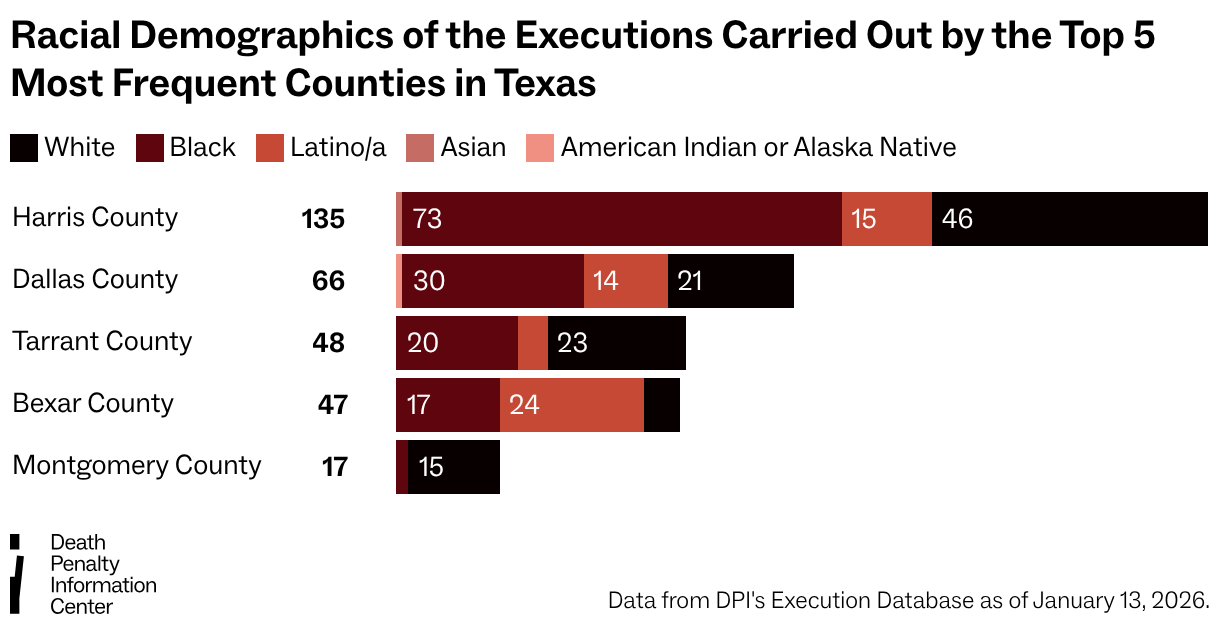
One striking feature of the Texas capital system is that a few counties are responsible for the majority of executions and death sentences in the state. As the Report states, “In Texas, whether a person receives a death sentence continues to be driven not by the underlying crime, but by geography.” Racial disparities are evident in these high-use counties. For example, 23 of the last 24 defendants sentenced to death in Harris County are people of color. In Tarrant County, eight of the nine men condemned since 2012 are also people of color.
Where the death penalty is still used in Texas, it is arbitrary and racially biased, and it continues to ensnare innocent and vulnerable people, all at a tremendous expense to the taxpayers.
Recent trends indicate that fewer prosecutors are pursuing death sentences and fewer juries are imposing them for a myriad of reasons, including concerns about costs and the effect of capital trials and appeals on victims’ families. TCADP’s report discussed two notable capital cases in 2025 where these issues were cited. The first is Patrick Crusius, an individual with serious mental illness who was already serving 90 life sentences for a mass shooting. This past year, the El Paso County District Attorney dismissed capital charges against Mr. Crusius, as the judicial process had already cost $6 million in taxpayer dollars over six years. At the sentencing hearing, multiple victims’ family members forgave Mr. Crusius, and two family members even hugged him with the judge’s consent. The second notable example was the trial of Francisco Oropeza. AsTCADP wrote, “The District Attorney consulted with the victim’ families and reached a consensus that this punishment would spare the trauma and risk of a trial while ensuring accountability for Oropeza [who would plead guilty].”
The current estimate for trying this [Francisco Oropeza’s] case ranges from $1.2 million to $2 million – four times our annual budget for indigent cases. That doesn’t include the cost of appeals, which could last for many years. This agreement allows us to achieve justice without placing a massive financial burden on the county.
Concerns about the ethics and costs of using the death penalty are also increasingly mentioned by state actors and during judicial proceedings. During Texas’ past legislative session, legislators filed death penalty abolition bills in both the House and State Senate, but none of them advanced. However, a bill to expand the scope of the death penalty also failed.
Beyond cost and ethics, court systems are weighing the standing of cases involving shielded evidence and evolving science concerns being brought to light. In 2025, the Texas Court of Criminal Appeals stayed the execution dates of two individuals, David Wood and Robert Roberson, granting them both new trials. Additionally, on June 26, 2025, the Supreme Court voted in favor to allow Ruben Gutierrez to continue his lawsuit challenging Texas’ post-conviction DNA statute, which has restricted Mr. Guiterrez from DNA testing for over a decade.
The Report concludes by reiterating the factors that are influencing Texans to abandon “the death penalty as a path of justice… It is incumbent of policymakers at both the State and county level to examine the collective costs of capital punishment. Texans should embrace a vision of justice that leaves the death penalty behind and reallocates limited public resources to measures proven to enhance public safety.”
- Ali, A. (2026, January 13). Texas Report Highlights Decline of New Death Sentences and Executions. Death Penalty Information Center. Retrieved October 12, 2026, from https://deathpenaltyinfo.org/texas-report-highlights-decline-of-new-death-sentences-and-executions
- Ali, Anumta. “Texas Report Highlights Decline of New Death Sentences and Executions.” Death Penalty Information Center. January 13, 2026. Accessed October 12, 2026. https://deathpenaltyinfo.org/texas-report-highlights-decline-of-new-death-sentences-and-executions.
- Ali, Anumta. “Texas Report Highlights Decline of New Death Sentences and Executions.” Death Penalty Information Center, 13 Jan. 2026, https://deathpenaltyinfo.org/texas-report-highlights-decline-of-new-death-sentences-and-executions. Accessed 12 Oct. 2026.
Texas Death Penalty Developments in 2025: The Year in Review, Texas Coalition to Abolish the Death Penalty