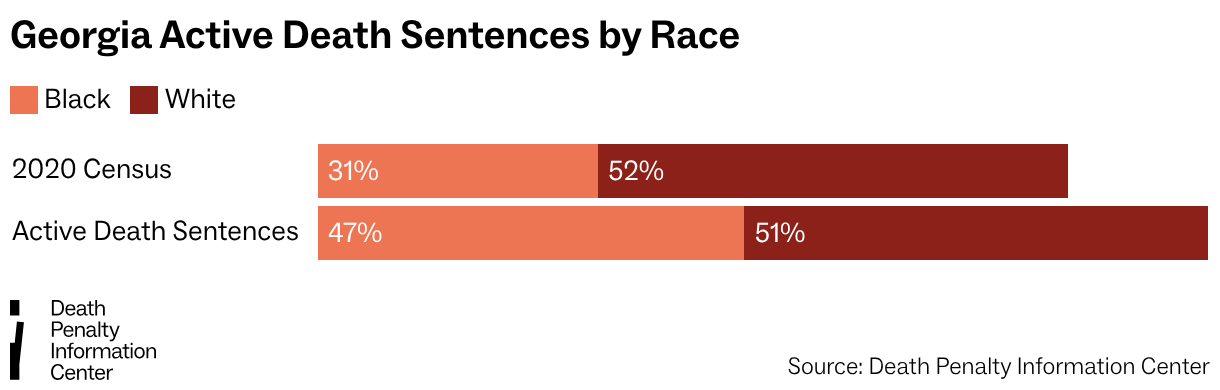
The Death Penalty Information Center’s new report on race and the death penalty in Georgia places the state’s death penalty system in historical context, documenting how racial and state sanctioned violence continue to influence today’s administration of the death penalty. Examining Georgia’s History of Racial Violence and Capital Punishment released August 2026, notes the state’s well-documented use of state-sanctioned violence that has disproportionately affected Black communities for nearly 150 years.
The report is the latest in a series on race and the death penalty, detailing how acts of extra-judicial racial terror influence contemporary legal systems of punishment. Georgia counties such as Fulton and Muscogee reflect continuity with the state’s history of racial violence by jointly accounting for 44 documented racial terror lynchings, while imposing 27 death sentences on Black defendants since 1973.
Three landmark cases have profoundly shaped death penalty litigation in the United States: Furman v. Georgia (1972), Gregg v. Georgia (1976), and McCleskey v. Kemp (1987). In Furman, the lead petitioner, William Henry Furman, was a Black man whose case prompted the Supreme Court of the United States (SCOTUS) to invalidate existing death penalty statutes across the nation, finding it unconstitutional when applied in an “arbitrary and capricious manner that leads to discriminatory results.” Four years later, Gregg signaled the beginning of the modern era of capital punishment with the Court’s authorization for executions to resume. Then McCleskey brought the serious racial disparities in Georgia’s death penalty system before SCOTUS, with empirical evidence showing race to be a significant factor in capital sentencing; the capital sentencing rate in cases involving white victims was nearly 11 times higher than in cases involving Black victims. And Black people with white victims were sentenced to death at nearly 22 times the rate of Black people with Black victims and more than 7 times the rate of white people with Black victims. The Court’s refusal to remedy the racial bias in the McCleskey decision has been widely criticized as “the Dred Scott of our time.”
The report also examines the lived experiences of Georgia death-sentenced persons Keith Leroy Tharpe, Johnny Lee Gates, and Troy Davis. Their cases illustrate how racial bias can manifest throughout the capital punishment process — from the use of racial epithets and discriminatory practices in jury selection to broader concerns about prosecutorial misconduct and juror bias. In each case, the defendants’ experiences reflect a long history of racial inequality within Georgia’s legal system, while also echoing patterns documented in many capital cases across the country.
Near the time of publication of this report, the legal and death penalty communities marked the 50th anniversary of the Gregg decision. Since its imposition, nearly 200 Black people in Georgia have been sentenced to death.
Commenting on the execution of Troy Davis in a September 2008 Democracy Now interview American civil rights activist and former Representative for Georgia’s 5th congressional district, John Lewis provides perspective:
“…[T]his has a long history. This is not something that just happened in the past few years, but [has] a long history in the state of Georgia, and especially in the American South, of being so quick and so apt to electrocute or provide capital punishment for low-income people and for people of color.”

- Bonner, T. (2026, August 27). NEW DPI Racial Justice Report Examines Racially Disparate Impact of the Death Penalty in Georgia. Death Penalty Information Center. Retrieved October 10, 2026, from https://deathpenaltyinfo.org/new-dpi-racial-justice-report-examines-racially-disparate-impact-of-the-death-penalty-in-georgia
- Bonner, Taylor. “NEW DPI Racial Justice Report Examines Racially Disparate Impact of the Death Penalty in Georgia.” Death Penalty Information Center. August 27, 2026. Accessed October 10, 2026. https://deathpenaltyinfo.org/new-dpi-racial-justice-report-examines-racially-disparate-impact-of-the-death-penalty-in-georgia.
- Bonner, Taylor. “NEW DPI Racial Justice Report Examines Racially Disparate Impact of the Death Penalty in Georgia.” Death Penalty Information Center, 27 Aug. 2026, https://deathpenaltyinfo.org/new-dpi-racial-justice-report-examines-racially-disparate-impact-of-the-death-penalty-in-georgia. Accessed 10 Oct. 2026.
To read the full report, visit Examining Georgia’s History of Racial Violence and Capital Punishment