
Death Penalty Information Center
    • Issues
    • Biases & Vulnerabilities
      • Race
      • Intellectual Disability
      • Mental Illness
      • LGBTQ+ People
      • Youth
    • Policy
      • Arbitrariness How non-legal factors affect use of the death penalty
      • Clemency Death sentence reductions and pardons by state and federal executives
      • Costs The death penalty’s monetary cost to taxpayers
      • Deterrence Whether the death penalty deters future violent crime
      • Human Rights How international human rights law and treaties view the death penalty
      • Innocence People wrongfully sentenced to death
      • International How the death penalty is used in countries outside the U.S.
      • Junk Science How faulty science affects death penalty cases
      • Legal Representation How the quality of defense counsel affects death penalty outcomes
      • Official Misconduct How wrongful government action affects death penalty outcomes
      • Public Opinion What the public says about the death penalty
      • Sentencing Alternatives Sentencing options for death-eligible crimes
      • US Supreme Court Supreme Court death penalty cases
    • Research
    • Background
      • Crimes Punishable by Death
      • Fact Sheet
      • History of the Death Penalty
    • Data
      • Death Penalty Census
      • Execution Database
      • Innocence Database
      • Legislative Activity
      • Sentencing Data
    • Analysis
      • DPI Reports
    • DPI Reports Dec 15, 2025 The Death Penalty in 2025 Majority of Capital Juries in 2025 Rejected Death Sentences
    • Death Row
      • Death Row Overview
      • Conditions on Death Row
      • Time on Death Row
      • Foreign Nationals
      • Native Americans
      • Women
    • Executions
      • Executions Overview
      • Upcoming Executions
      • Execution Database
      • Methods of Execution
      • Botched Executions
    • State & Federal Info
    • State by State
    • Federal Death Penalty
    • Military
    • Explore by State

      • Death Penalty
      • Pause on Executions
      • No Death Penalty
      AL AK AZ AR CA CO CT DE FL GA HI ID IL IN IA KS KY LA ME MD MA MI MN MS MO MT NE NV NH NJ NM NY NC ND OH OK OR PA RI SC SD TN TX UT VT VA WA WV WI WY DC
    • Resources
    • Links
      • Additional Resources Articles, Books and Websites about the death penalty, organized by topic
      • College Curriculum Case narratives and resources to guide college discussions
      • DPI Podcasts DPI’s monthly podcast series where we speak with death penalty experts.
      • High School Curriculum Materials designed for high school educators and students
      • Publications & Testimony How DPI and others speak about the death penalty
      • Related Websites Links to governmental, advocacy, and legal organizations
      • Student Research Center Resources for students researching the death penalty
      • Teacher's Guide Two-week lesson plans for middle and high school classes
      • En Español Información sobre la pena de muerte en español
      • What to Know Series Essential facts on the death penalty, one topic at a time
    • DPI Resource Fact Sheet PDF handout with facts about the Death Penalty.
  • About DPI
  • Media Contact
  • Donate

Breaking News: Christa Pike is still alive after two doses of lethal injection drugs were administered by Tennessee officials. Her attorneys report that she is in critical condition and receiving life-saving care at a hospital.

Official Misconduct

Misconduct and Wrongful Convictions

  • Copy Link
  • Email

DPIC’s Special Report: The Innocence Epidemic documented that 69% of death-row exonerations have included official misconduct. Official misconduct — defined as misconduct by police, prosecutors, or other government officials — is disproportionately prevalent in death-row exonerations of defendants of color, especially Black defendants. While official misconduct was a significant factor in exonerations of white death-row survivors, present in 58% of those cases, it contributed to 79% of the wrongful convictions of Black death-row exonerees and 69% of Latinx death-row exonerees. The odds that official misconduct contributed to a death-row exoneree’s wrongful capital conviction were 2.7 times greater if the exoneree was Black than if he or she was white, and 1.6 times greater if the exoneree was Latinx.

Further, exonerations take longer in cases involving official misconduct because of on-going efforts by government officials to hide misconduct and false testimony or accusations. Prosecutorial offices also tend to more aggressively defend cases and legal claims in which official misconduct is charged. Official misconduct was present in all eight of the cases in which an exoneration occurred 31 or more years after conviction. It also was a factor in 88% of the twenty-five cases in which exonerations occurred 21 – 30 years after the conviction.

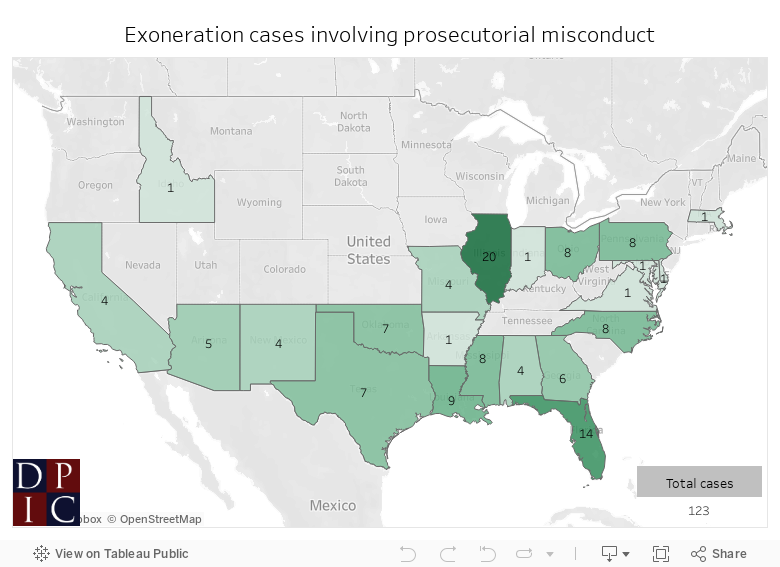
DPIC’s examination of misconduct exonerations has uncovered more than 120 trial or in post-conviction proceedings in which there was strong evidence of prosecutorial misconduct. This includes misconduct in multiple trials for defendants like Curtis Flowers, who had four different convictions and death sentences overturned because of prosecutorial misconduct before he eventually was exonerated.
The 2020 exoneration of Kareem Johnson highlights many of the issues with prosecutorial misconduct in death penalty proceedings. Johnson was convicted and sentenced to death in Philadelphia in 2007 based upon evidence and argument falsely informing the jury that DNA evidence linked him to the murder. The prosecution, police, and a prosecution forensic analyst told the jury that Johnson shot the victim, Walter Smith, at such close range that Smith’s blood spattered onto a red baseball cap Johnson was wearing that was recovered at the murder scene. Philadelphia homicide prosecutor Michael Barry falsely linked Johnson to the murder through the hat, telling jurors in his opening statement that it “was left at th[e] scene in the middle of the street [and] has Kareem Johnson’s sweat on it and has Walter Smith’s blood on it.”

In reality, there was no blood on the red hat, nor did the police property receipt for the hat contain any indication of blood. Smith’s blood was actually on a second hat — a black hat he was wearing at the time he was shot in the head. The DNA reports for the red hat also raised questions about the sweat stain attributed to Johnson. The initial DNA report on the sweat stain — which was supplemented twice without explanation — did not link the hat to Johnson. When Johnson’s post-conviction counsel discovered the discrepancies with the hats, the Philadelphia District Attorney’s office agreed that Johnson’s conviction should be overturned. However, the DA’s office stipulated that the reversal was “on ineffective assistance of counsel at the guilty-innocence phase of trial.”

Johnson sought to bar the retrial on double jeopardy grounds. Although the lower courts described the prosecution’s mishandling of the evidence in the case as “extremely negligent, perhaps even reckless” and called Johnson’s trial a “farce,” they allowed the retrial to proceed. However, on May 19, 2020, the Pennsylvania Supreme Court reversed, finding that the misconduct — even if not deemed intentional — was so severe that retrying Johnson would violate his constitutional rights. “Under Article I, Section 10 of the Pennsylvania Constitution,” it wrote, “prosecutorial overreaching sufficient to invoke double jeopardy protections includes misconduct which not only deprives the defendant of his right to a fair trial, but is undertaken recklessly, that is, with a conscious disregard for a substantial risk that such will be the result.”

In This Section

  • Official Misconduct
  • Barriers to Accountability
  • Misconduct and Wrongful Convictions
  • Misconduct Reversals and Exonerations by Type
  • Withholding Favorable Evidence
  • Discrimination in Jury Selection
  • Improper Argument: Skewing Jury Decisionmaking
  • Misconduct Reversals and Exonerations by County and State

12:01 The Death Penalty in Context

Innocence and Prosecutorial Misconduct

North Carolina Jury Awards Death-Row Exonerees Henry McCollum and Leon Brown $75M for Their Wrongful Capital Convictions

North Carolina Jury Awards Death-Row Exonerees Henry McCollum and Leon Brown $75M for Their Wrongful Capital Convictions

On May 14, 2021, a North Carolina federal jury awarded death-row exonerees Henry McCollum and Leon Brown $75 million for the police misconduct that sent them to death row. They were coerced into providing false evidence, and crucial evidence was suppressed for decades.

National Registry of Exonerations: Government Misconduct and Convicting the Innocent

National Registry of Exonerations: Government Misconduct and Convicting the Innocent

A 2020 report by the National Registry of Exonerations has found that police or prosecutorial misconduct is rampant in death-row exoneration cases and occurs even more frequently when the wrongfully death-sentenced exoneree is Black.

Invest in the Evidence

We rely entirely on donations from people like you to provide critical data and analysis about the death penalty so you have the facts.

Make a Donation Today Learn More About DPI
Death Penalty Information Center
    • Overview
    • Biases & Vulnerabilities
      • Race
      • Intellectual Disability
      • Mental Illness
      • LGBTQ+ People
      • Youth
    • Policy
      • Arbitrariness
      • Clemency
      • Costs
      • Deterrence
      • Human Rights
      • Innocence
      • International
      • Junk Science
      • Legal Representation
      • Official Misconduct
      • Public Opinion
      • Sentencing Alternatives
      • US Supreme Court
    • Overview
    • Background
      • Crimes Punishable by Death
      • Fact Sheet
      • History of the Death Penalty
    • Data
      • Death Penalty Census
      • Execution Database
      • Innocence Database
      • Legislative Activity
      • Sentencing Data
    • Analysis
      • DPI Reports
      • Overview
      • Conditions on Death Row
      • Time on Death Row
      • Foreign Nationals
      • Native Americans
      • Women
      • Overview
      • Upcoming Executions
      • Execution Database
      • Methods of Execution
      • Botched Executions
    • Overview
    • State by State
    • Federal Death Penalty
    • Military
    • About DPI
    • Staff & Board of Directors
    • Press Releases
    • Work for DPI
    • Privacy Policy
    • Overview
    • Links
      • Additional Resources
      • College Curriculum
      • DPI Podcasts
      • High School Curriculum
      • Publications & Testimony
      • Related Websites
      • Student Research Center
      • Teacher's Guide
      • En Español
      • What to Know Series
Subscribe to our Newsletter

Subscribe to our Newsletter

Weekly updated from DPI

Get our full length featured story in your inbox weekly.

  • X
  • Facebook
  • Instagram
  • LinkedIn
Death Penalty Information Center | 1701 K Street NW, Suite 750, Washington, DC 20006
Privacy Policy | ©2026 Death Penalty Information Center