
Death Penalty Information Center
    • Issues
    • Biases & Vulnerabilities
      • Race
      • Intellectual Disability
      • Mental Illness
      • LGBTQ+ People
      • Youth
    • Policy
      • Arbitrariness How non-legal factors affect use of the death penalty
      • Clemency Death sentence reductions and pardons by state and federal executives
      • Costs The death penalty’s monetary cost to taxpayers
      • Deterrence Whether the death penalty deters future violent crime
      • Human Rights How international human rights law and treaties view the death penalty
      • Innocence People wrongfully sentenced to death
      • International How the death penalty is used in countries outside the U.S.
      • Junk Science How faulty science affects death penalty cases
      • Legal Representation How the quality of defense counsel affects death penalty outcomes
      • Official Misconduct How wrongful government action affects death penalty outcomes
      • Public Opinion What the public says about the death penalty
      • Sentencing Alternatives Sentencing options for death-eligible crimes
      • US Supreme Court Supreme Court death penalty cases
    • Research
    • Background
      • Crimes Punishable by Death
      • Fact Sheet
      • History of the Death Penalty
    • Data
      • Death Penalty Census
      • Execution Database
      • Innocence Database
      • Legislative Activity
      • Sentencing Data
    • Analysis
      • DPI Reports
    • DPI Reports Dec 15, 2025 The Death Penalty in 2025 Majority of Capital Juries in 2025 Rejected Death Sentences
    • Death Row
      • Death Row Overview
      • Conditions on Death Row
      • Time on Death Row
      • Foreign Nationals
      • Native Americans
      • Women
    • Executions
      • Executions Overview
      • Upcoming Executions
      • Execution Database
      • Methods of Execution
      • Botched Executions
    • State & Federal Info
    • State by State
    • Federal Death Penalty
    • Military
    • Explore by State

      • Death Penalty
      • Pause on Executions
      • No Death Penalty
      AL AK AZ AR CA CO CT DE FL GA HI ID IL IN IA KS KY LA ME MD MA MI MN MS MO MT NE NV NH NJ NM NY NC ND OH OK OR PA RI SC SD TN TX UT VT VA WA WV WI WY DC
    • Resources
    • Links
      • Additional Resources Articles, Books and Websites about the death penalty, organized by topic
      • College Curriculum Case narratives and resources to guide college discussions
      • DPI Podcasts DPI’s monthly podcast series where we speak with death penalty experts.
      • High School Curriculum Materials designed for high school educators and students
      • Publications & Testimony How DPI and others speak about the death penalty
      • Related Websites Links to governmental, advocacy, and legal organizations
      • Student Research Center Resources for students researching the death penalty
      • Teacher's Guide Two-week lesson plans for middle and high school classes
      • En Español Información sobre la pena de muerte en español
      • What to Know Series Essential facts on the death penalty, one topic at a time
    • DPI Resource Fact Sheet PDF handout with facts about the Death Penalty.
  • About DPI
  • Media Contact
  • Donate

Breaking News: Christa Pike is still alive after two doses of lethal injection drugs were administered by Tennessee officials. Her attorneys report that she is in critical condition and receiving life-saving care at a hospital. [As of the morning of October 5, there is no new public information; new information will be updated here]

Official Misconduct

Withholding Favorable Evidence

  • Copy Link
  • Email
There is an epidemic of Brady violations abroad in the land. Only judges can put a stop to it.

United States v. Olsen, 737 F.3d 625, 626 (9th Cir. 2013)

Chief Judge Alex Kozinski dissenting from the denial of rehearing en banc

The Supreme Court held in Brady v. Maryland that prosecutors have an “affirmative duty” to disclose all evidence that is favorable to the defense and material to guilt and/or punishment. Under Brady and related Supreme Court cases, prosecutors must reveal all evidence that could be used to support a defendant’s case, including information that could undermine the credibility of prosecution witnesses. Brady violations also extend to evidence hidden by the police, because that evidence is considered to be in the control of the government.

The prosecution has an affirmative duty to correct the false testimony of its witnesses and to provide information about incentives for state witnesses’ testimony. Even if a state witness responds falsely to a question asked by the defense or the court, prosecutors cannot stand idly by. Due process requires prosecutors to promptly correct such testimony. Prosecutors must also disclose all deals offered to witnesses in exchange for their testimony. Knowledge of these deals is essential to the defense as they can be used to question the witnesses’ credibility.

There are significant challenges to defendants discovering and obtaining relief based on prosecutors’ withholding of favorable evidence. The evidence can be difficult to discover because it may never be released by the prosecution. Even when hidden evidence comes to light, courts have significant discretion in determining whether the disclosure of the evidence would have changed the outcome of the case. This means that even when a court finds that the prosecution hid favorable evidence, it may not reverse the case.
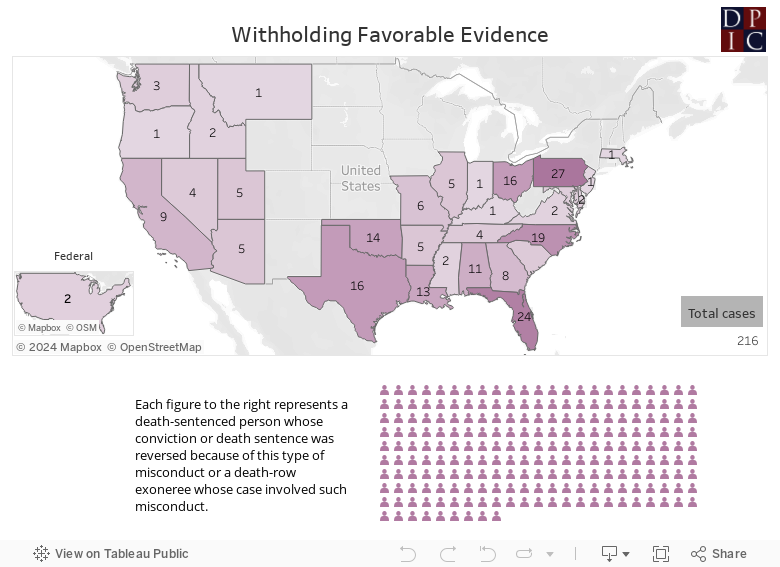
Examples of individuals affected by the withholding of favorable evidence:

Joe D’Ambrosio was sentenced to death in Cuyahoga County, Ohio in 1989. Decades later, litigation and community advocacy led to the discovery that the prosecution withheld multiple pieces of evidence including physical evidence that could have been tested, a motive for a prosecution witness to have committed the murder, and witness statements about the date of the murder and who committed it. A federal district court barred the state from retrying D’Ambrosio, writing:

For 20 years, the State held D’Ambrosio on death row, despite wrongfully withholding evidence that ‘would have substantially increased a reasonable juror’s doubt of D’Ambrosio’s guilt.’ Despite being ordered to do so by this Court … the State still failed to turn over all relevant and material evidence relating to the crime of which D’Ambrosio was convicted. Then, once it was ordered to provide D’Ambrosio a constitutional trial or release him within 180 days, the State did neither. During those 180 days, the State engaged in substantial inequitable conduct, wrongfully retaining and delaying the production of yet more potentially exculpatory evidence… To fail to bar retrial in such extraordinary circumstances surely would fail to serve the interests of justice.

D’Ambrosio was exonerated in 2012 after 23 years on Ohio’s death row.

Roderick Johnson was sentenced to death in Berks County, Pennsylvania in 1997. Johnson spent 23 years on Pennsylvania’s death row before being exonerated in 2020. The prosecutor in Johnson’s case, Mark Baldwin, suppressed police records documenting a witness’ uncharged criminal activity and his cooperation with police. Baldwin then lied to the court when the trial judge said “I think he’s a dealer of drugs or a paid informant by the Reading Bureau of Police,” calling the judge’s statement “absurd.” In denying retrial, Judge Eleni Geishauer of the Berks County Court of Common Pleas in Pennsylvania castigated Baldwin, writing,

[h]ad these acts been committed by a witness, the individual could have been, and in all likelihood would have been, charged with obstruction of justice. Had these acts been committed by defense counsel, in addition to charges, a disciplinary action would have been initiated that would potentially result in the suspension or loss of legal license. Mr. Baldwin’s position as District Attorney seems to have protected him from such censure. But in this matter, all men are equal before the law and this court renders judgment of Mr. Baldwin’s egregious behavior.

Shirley Jo Phillips was sentenced to death in Greene County, Missouri in 1992. The Supreme Court of Missouri overturned Phillips’ death sentence because the prosecutors withheld a taped interview in which a witness reported to police that Phillips’ son admitted to participating in the murder. According to the witness, Phillips’ son dismembered the victim’s body. The jury largely relied on the fact that Phillips dismembered the body when deciding that Phillips should get the death penalty. The Supreme Court of Missouri ruled that the interview was exculpatory and, while not changing the outcome of the guilt phase, could have changed the outcome of the penalty phase. Phillips was later resentenced to life without parole.

In This Section

  • Official Misconduct
  • Barriers to Accountability
  • Misconduct and Wrongful Convictions
  • Misconduct Reversals and Exonerations by Type
  • Withholding Favorable Evidence
  • Discrimination in Jury Selection
  • Improper Argument: Skewing Jury Decisionmaking
  • Misconduct Reversals and Exonerations by County and State

12:01 The Death Penalty in Context

Contra Costa County, California District Attorney Diana Becton on Fair and Just Legal Reform and Ending the Death Penalty

Contra Costa County, California District Attorney Diana Becton on Fair and Just Legal Reform and Ending the Death Penalty

Special Reports

DPIC Special Report: The Innocence Epidemic

DPIC Special Report: The Innocence Epidemic

Read More
National Registry of Exonerations: Government Misconduct and Convicting the Innocent

National Registry of Exonerations: Government Misconduct and Convicting the Innocent

A 2020 report by the National Registry of Exonerations has found that police or prosecutorial misconduct is rampant in death-row exoneration cases and occurs even more frequently when the wrongfully death-sentenced exoneree is Black.

Fair Punishment Project:  America's Top Five Deadliest Prosecutors

Fair Punishment Project: America’s Top Five Deadliest Prosecutors

A report by Harvard Law School’s Fair Punishment Project has found that a small number of overzealous prosecutors with high rates of misconduct have a hugely disproportionate impact on the death penalty in the United States. The report, “America’s Top Five Deadliest Prosecutors: How Overzealous Personalities Drive the Death Penalty,” shows that, by themselves, these prosecutors are responsible for more than 440 death sentences, the equivalent of 15% of the entire U.S. death row population today.

1 In 20 Capital Convictions or Death Sentences Reversed Because of Prosecutor Misconduct

1 In 20 Capital Convictions or Death Sentences Reversed Because of Prosecutor Misconduct

Death Penalty Information Center Executive Director Robert Dunham speaks with Law360 about DPIC's Prosecutorial Accountability Project.

Invest in the Evidence

We rely entirely on donations from people like you to provide critical data and analysis about the death penalty so you have the facts.

Make a Donation Today Learn More About DPI
Death Penalty Information Center
    • Overview
    • Biases & Vulnerabilities
      • Race
      • Intellectual Disability
      • Mental Illness
      • LGBTQ+ People
      • Youth
    • Policy
      • Arbitrariness
      • Clemency
      • Costs
      • Deterrence
      • Human Rights
      • Innocence
      • International
      • Junk Science
      • Legal Representation
      • Official Misconduct
      • Public Opinion
      • Sentencing Alternatives
      • US Supreme Court
    • Overview
    • Background
      • Crimes Punishable by Death
      • Fact Sheet
      • History of the Death Penalty
    • Data
      • Death Penalty Census
      • Execution Database
      • Innocence Database
      • Legislative Activity
      • Sentencing Data
    • Analysis
      • DPI Reports
      • Overview
      • Conditions on Death Row
      • Time on Death Row
      • Foreign Nationals
      • Native Americans
      • Women
      • Overview
      • Upcoming Executions
      • Execution Database
      • Methods of Execution
      • Botched Executions
    • Overview
    • State by State
    • Federal Death Penalty
    • Military
    • About DPI
    • Staff & Board of Directors
    • Press Releases
    • Work for DPI
    • Privacy Policy
    • Overview
    • Links
      • Additional Resources
      • College Curriculum
      • DPI Podcasts
      • High School Curriculum
      • Publications & Testimony
      • Related Websites
      • Student Research Center
      • Teacher's Guide
      • En Español
      • What to Know Series
Subscribe to our Newsletter

Subscribe to our Newsletter

Weekly updated from DPI

Get our full length featured story in your inbox weekly.

  • X
  • Facebook
  • Instagram
  • LinkedIn
Death Penalty Information Center | 1701 K Street NW, Suite 750, Washington, DC 20006
Privacy Policy | ©2026 Death Penalty Information Center