Publications & Testimony
Testimony and Statements on the Death Penalty
FROM DPIC
For testimony by former Executive Director Robert Dunham and former Executive Director Richard C. Dieter, please visit our page DPIC Testimony.
FROM RELIGIOUS LEADERS AND ORGANIZATIONS
- News Brief: Pope Francis Calls for Prayer to Abolish the Death Penalty (September 1, 2022)
- Jewish Congregation Renews Request for Department of Justice to Drop Death Penalty in Tree of Life Synagogue Killings (June 24, 2021)
- Orthodox Church Patriarch Calls Death Penalty Incompatible with Christian Beliefs (October 20, 2020)
- Presbyterian Church (U.S.A.) — Statement on the Federal Death Penalty (August 5, 2019)
- Louisiana Christian Faith Leaders Call for State to Abolish Death Penalty (April 25, 2019)
- Pittsburgh Rabbi’s Wife Opposes Death Penalty for Tree of Life Synagogue Killings (March 18, 2019)
- Orthodox Jewish Organization Calls for an End to Capital Punishment in the U.S. | Death Penalty Information Center (February 17, 2016)
- Baptist Theologian Says Death Penalty Does Not Fit With Christian Theology (March 8, 2016)
- Civil and Human Rights: Death Penalty — Church & Society, The United Methodist Church
- Religious Views: Over 150 Catholic Theologians Call for Repeal of the Death Penalty (September 27, 2011)
- Power Over Life and Death — The Power to Save a Life (January 15, 2005)
- Responsibility, Rehabilitation, and Restoration: A Catholic Perspective on Crime and Criminal Justice (November 2000)
- The Challenge of Holiness: A Sermon on the Death Penalty (January 10, 2000)
- General Assembly of the Texas Conference of Churches — Resolution Opposing the Death Penalty (February 24, 1998)
- Statement by Catholic Bishops of Texas on Capital Punishment (October 20, 1997)
- Catholic Church Expresses Strong Opposition to Capital Punishment in Catechism (September 9, 1997)
- Catholic Bishops of Iowa Issue Statement on Death Penalty (February 4, 1998)
- To End the Death Penalty: A Report of the National Jewish/Catholic Consultation
- Transcript of Dr. Pat Robertson’s Speech on the Role of Religion and the Death Penalty at The College of William and Mary
- Collection of Official Catholic Statements on the Death Penalty (1980)
FROM THE INTERNATIONAL COMMUNITY
- UN experts call for universal abolition of the death penalty | OHCHR (October 9, 2023)
- Zambia Becomes 25th Sub-Saharan African Nation to Abolish Death Penalty (December 23, 2022)
- Belgium Wants a World Without the Death Penalty (October 20, 2022)
- As France Prepares to Assume Presidency of European Union, Emmanuel Macron Announces Initiative for Worldwide Abolition of Death Penalty (October 11, 2021)
- U.N. Secretary-General, European Union Ambassador Call for Abolition of “Barbaric” Death Penalty (October 11, 2017)
- European Union Calls for Abolition of Capital Punishment as World Coalition Hosts International Death Penalty Conference (June 27, 2017)
- U.N. Investigator Talks About the Future of Solitary and the Death Penalty (November 7, 2016)
- World Congress Against the Death Penalty Renews Call for Global Moratorium, Pope Sends Message of Support (June 27, 2016)
- Declaration by the Presidency on behalf of the European Union on the 400th execution in Texas from the Council of the European Union (August 21, 2007)
- Resolution Supporting Worldwide Moratorium on Executions from the United Nations Commission on Human Rights (April 1999)
- Mary Robinson, U.N. High Commissioner for Human Rights — Message to the Press Conference organized by the Death Penalty Information Center for the release of the report, “International Perspectives on the Death Penalty” (October 12, 1999)
- Status of the International Covenants on Human Rights from the United Nations Commission on Human Rights (April 1998)
FROM ADVOCACY GROUPS
- Advocacy Group Tells Supreme Court that Negative Stereotypes Distort Perception that Latinos in Death-Penalty Cases Pose Future Danger to Society (April 15, 2022)
- Disability Rights Groups, Legal Experts, and Conservative Advocates Urge Supreme Court to Strike Down Georgia’s Uniquely Harsh Proof Requirements in Death-Penalty Intellectual Disabilities Cases (January 11, 2022)
- NAACP Reaffirms Its Support of Abolishing the Death Penalty (2022)
- More Than 80 Civil Rights and Advocacy Organizations Urge President Biden to End Federal Executions | Death Penalty Information Center (February 9, 2021)
- More Than 250 Conservative Leaders Join Call to End Death Penalty (October 29, 2019)
- National Alliance on Mental Illness: The Death Penalty
- Florida League of Women Voters Calls for Halt to Executions (May 28, 2007)
- Victims Organizations Issue Joint Statement for National Victims’ Rights Week (April 19, 2007)
FROM JUDGES, LEGISLATORS, AND OTHER ORGANIZATIONS
- Republican-led Oklahoma committee considers pause on executions amid death case scrutiny (October 5, 2023)
- Former Pro-Death Penalty District Attorney Explains Why He Now Supports Abolition, and Fears Political Promises to Expand the Use of the Death Penalty (August 20, 2023)
- Pressley, Durbin Reintroduce Bill to End the Federal Death Penalty (July 13, 2023)
- The Lancet Editorial: Physician Involvement in Executions Violates Medical Ethics | Death Penalty Information Center (May 20, 2023)
- APA calls for extending ineligibility for the death penalty to adolescent offenders younger than age 21 (August 4, 2022)
- Why some Republicans are turning against the death penalty | Ron Ferguson | Ohio House of Representatives (March 8, 2022)
- Eight years on Texas’ highest criminal court turned Elsa Alcala into a death penalty skeptic. How will the court change without her? (January 26, 2019)
- AMA to Supreme Court: Doctor participation in executions unethical (August 22, 2018)
- Former Governor Bill Richardson: Death Penalty Is Bad for Business, Out of Step With World’s Views (June 16, 2017)
- Capital Punishment and Nurses’ Participation in Capital Punishment (2016)
- Former Ohio Attorney General Jim Petro Says Death Penalty Unfixable, “Not Worth It Any More” (September 12, 2016)
- Resolution Supporting Repeal of the Death Penalty, National Hispanic Caucus of State Legislators (August 11, 2016)
- Retired Police Captain Says Repealing Death Penalty Is “Smart on Crime” (November 24, 2014)
- Resolution Supporting Abolition of the Death Penalty, Natl. Assoc. of Black Psychologists (2012)
- The Road to Justice and Peace by New Jersey State Senator Raymond Lesniak (February 1, 2009)
- Statement On The Federal Death Penalty System by Senator Feingold (June 7, 2001)
- Statement on the Need for a Federal Moratorium on the Death Penalty Senator Feingold (October 29, 2000)
- Death Penalty: The Torah and Today (August 23, 2000)
- Press Release for Senator Russ Feingold’s Introduction of Senate’s First Death Penalty Moratorium Bill (April 20, 2000)
- Amnesty International Southern Regional Conference: Orlando, Florida Remarks by Former Florida Chief Justice Gerald Kogan (October 23, 1999)
- American Bar Association Resolution on the Death Penalty (February 3, 1997)
FROM MURDER VICTIMS’ FAMILY MEMBERS
Items: 2331 — 2340
Dec 26, 2017
Alabama Cancels Cancer Surgery, Sets Execution Date for Terminally Ill Prisoner
Alabama has set an execution date for Doyle Lee Hamm (pictured), a 60-year-old man with terminal cranial and lymphatic cancer that his lawyer says has rendered his veins unusable for lethal injection. Hamm has received radiation and chemotherapy, and was scheduled for surgery to remove a cancerous lesion on December 13, but Alabama prison officials cancelled the surgery and instead informed Hamm that a death warrant had been issued scheduling his execution for February 22, 2018. In September…
Read More
Dec 22, 2017
Clark County, Nevada Losing Capital Convictions Because of Prosecutors’ Race Discrimination in Jury Selection
The racially discriminatory jury selection practices of the Clark County, Nevada, District Attorney’s office are now causing it to lose convictions in capital cases. In a December 18 article, the prosecutorial watchdog, The Open File, details repeated violations by Clark County death-penalty prosecutors of the constitutional proscription against striking prospective jurors from service on the basis of race. Four times in the past four years, the Nevada Supreme Court has ordered new trials in…
Read More
Dec 21, 2017
Arizona Ends Death-Row Solitary Confinement, Sees Reduced Prisoner Anxiety, Lowered Costs, and Increased Safety
Several months after Arizona settled a lawsuit over the conditions of confinement on the state’s death row, the state has ended the practice of automatically housing condemned prisoners in solitary confinement, and prisoners and prison officials alike are praising the changes. Carson McWilliams (pictured), Division Director for Offender Operations in the Arizona Department of Corrections (ADC), told the Arizona Republic that the new incarceration conditions provide an “atmosphere where…
Read More
Dec 20, 2017
As North Carolina Juries Reject Death Penalty, Legislators Accused of Playing Politics With Executions
For the third time since 2012, no one in North Carolina was sentenced to death in 2017. All four trials in 2017 in which prosecutors sought a death sentence ended with a jury either acquitting the defendant of capital murder or returning a lesser sentence. Despite the historical decline in death sentencing in North Carolina, two state legislative leaders, in a letter derided by editorial boards as political posturing, used the recent killing of three prison guards to demand that Governor Roy…
Read More
Dec 19, 2017
Supreme Court of Kenya Declares Nation’s Mandatory Death Sentences Unconstitutional
The Supreme Court of Kenya has declared the nation’s mandatory death sentencing procedures unconstitutional. In a December 14, 2017 ruling that could affect 7,000 death-row prisoners, the high court overturned Section 204 of Kenya’s Penal Code, which required that judges impose death sentences upon conviction of murder or armed robbery. The decision resolves conflicting rulings by the country’s lower courts of appeal, and grants new sentencing hearings to those currently sentenced to death.
Read More
Dec 18, 2017
New Jersey Marks Tenth Anniversary of Abolition of Capital Punishment
On December 17, 2007, New Jersey abolished the death penalty. On the tenth anniversary of abolition, the editorial board of the New Jersey Law Journal writes, “On the Death Penalty, New Jersey Got it Right.” The editorial board wrote, “Abolition has proven its worth, in that there has been no surge of murders, a significant decline of prosecution and appeal expenses, and the elimination of unremediable judicial mistakes. [Abolition] was and remains both the right thing and the sensible thing to…
Read More
Dec 15, 2017
DPIC Year End Report: New Death Sentences Demonstrate Increasing Geographic Isolation
Nearly one-third (31%) of the 39 new death sentences imposed in the United States in 2017 came from just three counties, Riverside, California; Clark, Nevada; and Maricopa, Arizona, according to statistics compiled for DPIC’s annual year end report. In a press release accompanying the annual report, DPIC said that the year’s sentences reflect “the increasing geographic isolation and arbitrary nature of the death penalty.” Riverside imposed five death sentences in 2017, Clark four, and Maricopa…
Read More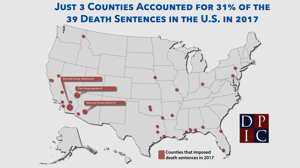
Dec 14, 2017
DPIC 2017 Year End Report: Death Sentences, Executions At Near-Historic Lows
Executions and new death sentences remained near historic lows in 2017, and public support for the death penalty polled at its lowest level in 45 years, according to DPIC’s annual report, “The Death Penalty in 2017: Year End Report,” released December 14. Both the 23 executions and the 39 projected new death sentences in 2017 were the second lowest totals in more than a quarter-century. Four more people were exonerated from death row in 2017, bringing the total to 160 death-row exonerations…
Read More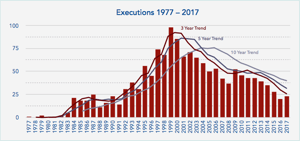
Dec 13, 2017
Nevada Says Fentanyl Was Easy to Obtain, But Execution Protocol Draws Criticism from Doctors, Legal Experts
As U.S. pharmaceutical companies have strengthened distribution controls on their medicines to prevent their use in executions, states have been changing their execution protocols in search of new or more readily available drugs. That search has led Nebraska and Nevada to build their execution protocols around fentanyl — the drug known for its role in the current opioid crisis in America — and the paralytic cisatracurium, which have never been used in executions before. According to a report in…
Read More
Dec 12, 2017
Report: Deterrence is Based on Certainty of Apprehension, Not Severity of Punishment
The certainty of apprehension, not the severity of punishment, is more effective as a deterrent. So argues Daniel S. Nagin (pictured), one of the nation’s foremost scholars on deterrence and criminal justice policy, in his chapter on Deterrence in the recently released Academy for Justice four-volume study, Reforming Criminal Justice. Reviewing deterrence scholarship since the 1960s and five leading studies from the past two decades, Dr. Nagin concludes that evidence supporting a deterrent…
Read More