Publications & Testimony
Testimony and Statements on the Death Penalty
FROM DPIC
For testimony by former Executive Director Robert Dunham and former Executive Director Richard C. Dieter, please visit our page DPIC Testimony.
FROM RELIGIOUS LEADERS AND ORGANIZATIONS
- News Brief: Pope Francis Calls for Prayer to Abolish the Death Penalty (September 1, 2022)
- Jewish Congregation Renews Request for Department of Justice to Drop Death Penalty in Tree of Life Synagogue Killings (June 24, 2021)
- Orthodox Church Patriarch Calls Death Penalty Incompatible with Christian Beliefs (October 20, 2020)
- Presbyterian Church (U.S.A.) — Statement on the Federal Death Penalty (August 5, 2019)
- Louisiana Christian Faith Leaders Call for State to Abolish Death Penalty (April 25, 2019)
- Pittsburgh Rabbi’s Wife Opposes Death Penalty for Tree of Life Synagogue Killings (March 18, 2019)
- Orthodox Jewish Organization Calls for an End to Capital Punishment in the U.S. | Death Penalty Information Center (February 17, 2016)
- Baptist Theologian Says Death Penalty Does Not Fit With Christian Theology (March 8, 2016)
- Civil and Human Rights: Death Penalty — Church & Society, The United Methodist Church
- Religious Views: Over 150 Catholic Theologians Call for Repeal of the Death Penalty (September 27, 2011)
- Power Over Life and Death — The Power to Save a Life (January 15, 2005)
- Responsibility, Rehabilitation, and Restoration: A Catholic Perspective on Crime and Criminal Justice (November 2000)
- The Challenge of Holiness: A Sermon on the Death Penalty (January 10, 2000)
- General Assembly of the Texas Conference of Churches — Resolution Opposing the Death Penalty (February 24, 1998)
- Statement by Catholic Bishops of Texas on Capital Punishment (October 20, 1997)
- Catholic Church Expresses Strong Opposition to Capital Punishment in Catechism (September 9, 1997)
- Catholic Bishops of Iowa Issue Statement on Death Penalty (February 4, 1998)
- To End the Death Penalty: A Report of the National Jewish/Catholic Consultation
- Transcript of Dr. Pat Robertson’s Speech on the Role of Religion and the Death Penalty at The College of William and Mary
- Collection of Official Catholic Statements on the Death Penalty (1980)
FROM THE INTERNATIONAL COMMUNITY
- UN experts call for universal abolition of the death penalty | OHCHR (October 9, 2023)
- Zambia Becomes 25th Sub-Saharan African Nation to Abolish Death Penalty (December 23, 2022)
- Belgium Wants a World Without the Death Penalty (October 20, 2022)
- As France Prepares to Assume Presidency of European Union, Emmanuel Macron Announces Initiative for Worldwide Abolition of Death Penalty (October 11, 2021)
- U.N. Secretary-General, European Union Ambassador Call for Abolition of “Barbaric” Death Penalty (October 11, 2017)
- European Union Calls for Abolition of Capital Punishment as World Coalition Hosts International Death Penalty Conference (June 27, 2017)
- U.N. Investigator Talks About the Future of Solitary and the Death Penalty (November 7, 2016)
- World Congress Against the Death Penalty Renews Call for Global Moratorium, Pope Sends Message of Support (June 27, 2016)
- Declaration by the Presidency on behalf of the European Union on the 400th execution in Texas from the Council of the European Union (August 21, 2007)
- Resolution Supporting Worldwide Moratorium on Executions from the United Nations Commission on Human Rights (April 1999)
- Mary Robinson, U.N. High Commissioner for Human Rights — Message to the Press Conference organized by the Death Penalty Information Center for the release of the report, “International Perspectives on the Death Penalty” (October 12, 1999)
- Status of the International Covenants on Human Rights from the United Nations Commission on Human Rights (April 1998)
FROM ADVOCACY GROUPS
- Advocacy Group Tells Supreme Court that Negative Stereotypes Distort Perception that Latinos in Death-Penalty Cases Pose Future Danger to Society (April 15, 2022)
- Disability Rights Groups, Legal Experts, and Conservative Advocates Urge Supreme Court to Strike Down Georgia’s Uniquely Harsh Proof Requirements in Death-Penalty Intellectual Disabilities Cases (January 11, 2022)
- NAACP Reaffirms Its Support of Abolishing the Death Penalty (2022)
- More Than 80 Civil Rights and Advocacy Organizations Urge President Biden to End Federal Executions | Death Penalty Information Center (February 9, 2021)
- More Than 250 Conservative Leaders Join Call to End Death Penalty (October 29, 2019)
- National Alliance on Mental Illness: The Death Penalty
- Florida League of Women Voters Calls for Halt to Executions (May 28, 2007)
- Victims Organizations Issue Joint Statement for National Victims’ Rights Week (April 19, 2007)
FROM JUDGES, LEGISLATORS, AND OTHER ORGANIZATIONS
- Republican-led Oklahoma committee considers pause on executions amid death case scrutiny (October 5, 2023)
- Former Pro-Death Penalty District Attorney Explains Why He Now Supports Abolition, and Fears Political Promises to Expand the Use of the Death Penalty (August 20, 2023)
- Pressley, Durbin Reintroduce Bill to End the Federal Death Penalty (July 13, 2023)
- The Lancet Editorial: Physician Involvement in Executions Violates Medical Ethics | Death Penalty Information Center (May 20, 2023)
- APA calls for extending ineligibility for the death penalty to adolescent offenders younger than age 21 (August 4, 2022)
- Why some Republicans are turning against the death penalty | Ron Ferguson | Ohio House of Representatives (March 8, 2022)
- Eight years on Texas’ highest criminal court turned Elsa Alcala into a death penalty skeptic. How will the court change without her? (January 26, 2019)
- AMA to Supreme Court: Doctor participation in executions unethical (August 22, 2018)
- Former Governor Bill Richardson: Death Penalty Is Bad for Business, Out of Step With World’s Views (June 16, 2017)
- Capital Punishment and Nurses’ Participation in Capital Punishment (2016)
- Former Ohio Attorney General Jim Petro Says Death Penalty Unfixable, “Not Worth It Any More” (September 12, 2016)
- Resolution Supporting Repeal of the Death Penalty, National Hispanic Caucus of State Legislators (August 11, 2016)
- Retired Police Captain Says Repealing Death Penalty Is “Smart on Crime” (November 24, 2014)
- Resolution Supporting Abolition of the Death Penalty, Natl. Assoc. of Black Psychologists (2012)
- The Road to Justice and Peace by New Jersey State Senator Raymond Lesniak (February 1, 2009)
- Statement On The Federal Death Penalty System by Senator Feingold (June 7, 2001)
- Statement on the Need for a Federal Moratorium on the Death Penalty Senator Feingold (October 29, 2000)
- Death Penalty: The Torah and Today (August 23, 2000)
- Press Release for Senator Russ Feingold’s Introduction of Senate’s First Death Penalty Moratorium Bill (April 20, 2000)
- Amnesty International Southern Regional Conference: Orlando, Florida Remarks by Former Florida Chief Justice Gerald Kogan (October 23, 1999)
- American Bar Association Resolution on the Death Penalty (February 3, 1997)
FROM MURDER VICTIMS’ FAMILY MEMBERS
Items: 2441 — 2450
Jul 20, 2017
Diverse Coalition Urges Ohio Governor to Halt Resumption of Executions
The Chairman of a state task force to reform Ohio’s death penalty and two former state Attorney Generals have joined a diverse coalition of public officials, death-row exonerees, family members of murder victims, former corrections officials, and religious leaders urging Ohio Governor John Kasich to halt the state’s planned resumption of executions. Citing legislative inaction on critical reforms, the high risk of error, and botched executions, the groups held a press conference (pictured) on…
Read More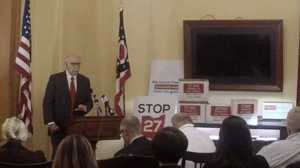
Jul 19, 2017
New Generation of Prosecutors May Signal Shift in Death Penalty Policies
A new generation of prosecutors, elected across the country on a platform of criminal justice reform, are taking a different approach to criminal justice policies than their predecessors, including a reduction in the use of capital punishment. A Christian Science Monitor profile of these prosecutors — focusing on Mark Gonzalez (pictured), the Nueces County, Texas, district attorney — says “[f]rom Texas to Florida to Illinois, many of these young prosecutors are eschewing the death penalty, talking…
Read More
Jul 18, 2017
Lawyers Say Utah Is Underfunding Death-Penalty Appellate Defense
Utah is not providing sufficient funding to competently represent death-row prisoners during their appeals, according to a motion filed on behalf of Douglas Lovell, the man most recently sentenced to death in the state. Because of that, Lovell’s lawyer Samuel Newton says, Lovell’s death sentence should be vacated and he should be resentenced to life in prison. Newton bases his claim on a 2008 Utah Supreme Court opinion, Archuleta v. Galetka, in which the court warned that “low levels of public…
Read More
Jul 17, 2017
Report Finds High Levels of Misconduct in Four Top Death Sentencing Counties
Four counties that rank among the most aggressive users of capital punishment in the United States have prolonged patterns of prosecutorial misconduct, according to a new report by the Harvard-based Fair Punishment Project. The report, “The Recidivists: Four Prosecutors Who Repeatedly Violate the Constitution,” examined state appellate court decisions in California, Louisiana, Missouri, and Tennessee from 2010 – 2015, and found that prosecutors in Orange County, CA; Orleans Parish, LA; St. Louis…
Read More
Jul 14, 2017
Pioneers in Efforts to Defend Death-Penalty Cases, End Capital Punishment Remembered in New Book, Obituary
The legacies of Scharlette Holdman (pictured) and Marie Deans — two women who changed the landscape of capital punishment in the United States — are memorialized in a recent story in the Marshall Project and a new book scheduled for release in August. Maurice Chammah’s article, We Saw Monsters. She Saw Humans, marks the July 12, 2017 passing of mitigation pioneer Scharlette Holdman and tells the story of her forty-year fight on behalf of capital defendants and death-row prisoners. The forthcoming…
Read More
Jul 13, 2017
Florida Death-Row Population Drops to 12-Year Low As Jury Unanimity Ruling Takes Effect
The number of prisoners on Florida’s death row is now lower than it was on June 30, 2005, as the pace of death sentencing slows and courts reverse the unconstitutional non-unanimous death sentences by which numerous capital defendants had been condemned. Applying the U.S. Supreme Court’s 2014 ruling in Hurst v. Florida and subsequent Florida Supreme Court decisions in Hurst v. State and Perry v. State, state courts declared unconstitutional Florida’s practice of permitting trial judges to…
Read More
Jul 12, 2017
Federal Appeals Court Grants Texas Prisoner’s Request for Evaluation of Competency to Be Executed
The U.S. Court of Appeals for the Fifth Circuit has reversed a ruling by a Texas federal district court that had denied Scott Panetti (pictured), a severely mentally ill death-row prisoner, the appointment of counsel and funding for a mental health expert and investigator to evaluate his competency to be executed. In a 2 – 1 ruling issued July 11, 2017, the Fifth Circuit, noting that “a decade has now passed since the last determination of whether this concededly mentally ill petitioner is…
Read More
Jul 11, 2017
Journal of Psychiatrist Who Presided Over 14 Texas Executions Reveals Mental Toll That May Have Contributed to Suicide
As a psychiatrist in the Wayne Unit of Texas’ Huntsville prison from 1960 to 1963, Dr. Lee Hartman presided over 14 electric-chair executions. When his grandson, Ben Hartman, a journalist, began investigating Dr. Hartman’s life, he discovered journals that chronicle those executions and the psychological toll they took, possibly contributing to Dr. Hartman’s suicide in 1964. Dr. Hartman’s journals contain basic data on the men who were executed, including their names, race, a summary of the…
Read More
Jul 10, 2017
Independent Pathologist Says Autopsy Reveals Problems With Virginia’s Execution of Ricky Gray
Something went wrong during the execution of Ricky Gray (pictured), who was put to death in Virginia on January 18, 2017, according to an independent expert who reviewed the official autopsy report of Gray’s death. Dr. Mark Edgar, associate director of bone and soft tissue pathology at the Emory University School of Medicine, reviewed the official autopsy report, which Gray’s family obtained from the Virginia medical examiner’s office. Dr. Edgar says Gray suffered an acute pulmonary edema…
Read More
Jul 07, 2017
Resentencing of Intellectually Disabled Prisoner Highlights Death Penalty Decline in South Carolina and Nationwide
In 1989, William Henry Bell, Jr. was convicted of murdering an elementary school principal. Nearly 30 years later, South Carolina’s Free Times reports that the reversal of his death sentence because of intellectual disability provides evidence of the death penalty’s continuing decline in the state and across the country. At the time of the murder, Bell maintained that he was innocent, but after four days in jail, he confessed to the murder. Prior appeals — including one alleging a pattern of…
Read More