Publications & Testimony
Testimony and Statements on the Death Penalty
FROM DPIC
For testimony by former Executive Director Robert Dunham and former Executive Director Richard C. Dieter, please visit our page DPIC Testimony.
FROM RELIGIOUS LEADERS AND ORGANIZATIONS
- News Brief: Pope Francis Calls for Prayer to Abolish the Death Penalty (September 1, 2022)
- Jewish Congregation Renews Request for Department of Justice to Drop Death Penalty in Tree of Life Synagogue Killings (June 24, 2021)
- Orthodox Church Patriarch Calls Death Penalty Incompatible with Christian Beliefs (October 20, 2020)
- Presbyterian Church (U.S.A.) — Statement on the Federal Death Penalty (August 5, 2019)
- Louisiana Christian Faith Leaders Call for State to Abolish Death Penalty (April 25, 2019)
- Pittsburgh Rabbi’s Wife Opposes Death Penalty for Tree of Life Synagogue Killings (March 18, 2019)
- Orthodox Jewish Organization Calls for an End to Capital Punishment in the U.S. | Death Penalty Information Center (February 17, 2016)
- Baptist Theologian Says Death Penalty Does Not Fit With Christian Theology (March 8, 2016)
- Civil and Human Rights: Death Penalty — Church & Society, The United Methodist Church
- Religious Views: Over 150 Catholic Theologians Call for Repeal of the Death Penalty (September 27, 2011)
- Power Over Life and Death — The Power to Save a Life (January 15, 2005)
- Responsibility, Rehabilitation, and Restoration: A Catholic Perspective on Crime and Criminal Justice (November 2000)
- The Challenge of Holiness: A Sermon on the Death Penalty (January 10, 2000)
- General Assembly of the Texas Conference of Churches — Resolution Opposing the Death Penalty (February 24, 1998)
- Statement by Catholic Bishops of Texas on Capital Punishment (October 20, 1997)
- Catholic Church Expresses Strong Opposition to Capital Punishment in Catechism (September 9, 1997)
- Catholic Bishops of Iowa Issue Statement on Death Penalty (February 4, 1998)
- To End the Death Penalty: A Report of the National Jewish/Catholic Consultation
- Transcript of Dr. Pat Robertson’s Speech on the Role of Religion and the Death Penalty at The College of William and Mary
- Collection of Official Catholic Statements on the Death Penalty (1980)
FROM THE INTERNATIONAL COMMUNITY
- UN experts call for universal abolition of the death penalty | OHCHR (October 9, 2023)
- Zambia Becomes 25th Sub-Saharan African Nation to Abolish Death Penalty (December 23, 2022)
- Belgium Wants a World Without the Death Penalty (October 20, 2022)
- As France Prepares to Assume Presidency of European Union, Emmanuel Macron Announces Initiative for Worldwide Abolition of Death Penalty (October 11, 2021)
- U.N. Secretary-General, European Union Ambassador Call for Abolition of “Barbaric” Death Penalty (October 11, 2017)
- European Union Calls for Abolition of Capital Punishment as World Coalition Hosts International Death Penalty Conference (June 27, 2017)
- U.N. Investigator Talks About the Future of Solitary and the Death Penalty (November 7, 2016)
- World Congress Against the Death Penalty Renews Call for Global Moratorium, Pope Sends Message of Support (June 27, 2016)
- Declaration by the Presidency on behalf of the European Union on the 400th execution in Texas from the Council of the European Union (August 21, 2007)
- Resolution Supporting Worldwide Moratorium on Executions from the United Nations Commission on Human Rights (April 1999)
- Mary Robinson, U.N. High Commissioner for Human Rights — Message to the Press Conference organized by the Death Penalty Information Center for the release of the report, “International Perspectives on the Death Penalty” (October 12, 1999)
- Status of the International Covenants on Human Rights from the United Nations Commission on Human Rights (April 1998)
FROM ADVOCACY GROUPS
- Advocacy Group Tells Supreme Court that Negative Stereotypes Distort Perception that Latinos in Death-Penalty Cases Pose Future Danger to Society (April 15, 2022)
- Disability Rights Groups, Legal Experts, and Conservative Advocates Urge Supreme Court to Strike Down Georgia’s Uniquely Harsh Proof Requirements in Death-Penalty Intellectual Disabilities Cases (January 11, 2022)
- NAACP Reaffirms Its Support of Abolishing the Death Penalty (2022)
- More Than 80 Civil Rights and Advocacy Organizations Urge President Biden to End Federal Executions | Death Penalty Information Center (February 9, 2021)
- More Than 250 Conservative Leaders Join Call to End Death Penalty (October 29, 2019)
- National Alliance on Mental Illness: The Death Penalty
- Florida League of Women Voters Calls for Halt to Executions (May 28, 2007)
- Victims Organizations Issue Joint Statement for National Victims’ Rights Week (April 19, 2007)
FROM JUDGES, LEGISLATORS, AND OTHER ORGANIZATIONS
- Republican-led Oklahoma committee considers pause on executions amid death case scrutiny (October 5, 2023)
- Former Pro-Death Penalty District Attorney Explains Why He Now Supports Abolition, and Fears Political Promises to Expand the Use of the Death Penalty (August 20, 2023)
- Pressley, Durbin Reintroduce Bill to End the Federal Death Penalty (July 13, 2023)
- The Lancet Editorial: Physician Involvement in Executions Violates Medical Ethics | Death Penalty Information Center (May 20, 2023)
- APA calls for extending ineligibility for the death penalty to adolescent offenders younger than age 21 (August 4, 2022)
- Why some Republicans are turning against the death penalty | Ron Ferguson | Ohio House of Representatives (March 8, 2022)
- Eight years on Texas’ highest criminal court turned Elsa Alcala into a death penalty skeptic. How will the court change without her? (January 26, 2019)
- AMA to Supreme Court: Doctor participation in executions unethical (August 22, 2018)
- Former Governor Bill Richardson: Death Penalty Is Bad for Business, Out of Step With World’s Views (June 16, 2017)
- Capital Punishment and Nurses’ Participation in Capital Punishment (2016)
- Former Ohio Attorney General Jim Petro Says Death Penalty Unfixable, “Not Worth It Any More” (September 12, 2016)
- Resolution Supporting Repeal of the Death Penalty, National Hispanic Caucus of State Legislators (August 11, 2016)
- Retired Police Captain Says Repealing Death Penalty Is “Smart on Crime” (November 24, 2014)
- Resolution Supporting Abolition of the Death Penalty, Natl. Assoc. of Black Psychologists (2012)
- The Road to Justice and Peace by New Jersey State Senator Raymond Lesniak (February 1, 2009)
- Statement On The Federal Death Penalty System by Senator Feingold (June 7, 2001)
- Statement on the Need for a Federal Moratorium on the Death Penalty Senator Feingold (October 29, 2000)
- Death Penalty: The Torah and Today (August 23, 2000)
- Press Release for Senator Russ Feingold’s Introduction of Senate’s First Death Penalty Moratorium Bill (April 20, 2000)
- Amnesty International Southern Regional Conference: Orlando, Florida Remarks by Former Florida Chief Justice Gerald Kogan (October 23, 1999)
- American Bar Association Resolution on the Death Penalty (February 3, 1997)
FROM MURDER VICTIMS’ FAMILY MEMBERS
Items: 3061 — 3070
Apr 03, 2015
INNOCENCE: Anthony Ray Hinton Exonerated After 30 Years on Alabama’s Death Row
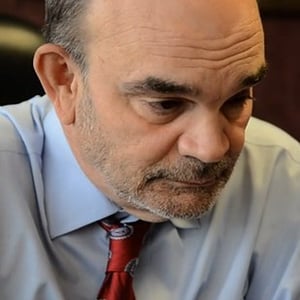
Anthony Ray Hinton (pictured, l.) has been exonerated after spending nearly 30 years on Alabama’s death row. He will be released on April 3. Hinton was convicted of the 1985 murders of two fast-food restaurant managers based upon the testimony of a state forensic examiner that the bullets in the two murders came from a gun found in Hinton’s house. The prosecutor, who had a documented history of racial bias, said he could tell Hinton was guilty and “evil” just by looking at him. Hinton was…
Read More
Apr 02, 2015
NEW VOICES: Warden Says Death Penalty Imposes “Immeasurable Burden” on Correctional Officers
Former prison warden, Frank Thompson, has urged repeal of Delaware’s death penalty. In an op-ed for The News Journal of Delaware, the former warden, who has personally overseen two executions, describes “the immeasurable burden that th[e execution] process places on correctional officers” and the trauma experienced by correctional officers who must carry out executions. Thompson says, “Many of us who have taken part in this process live with nightmares, especially those of us who have…
Read More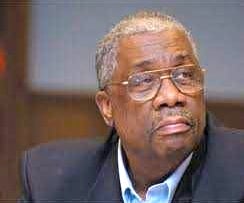
Apr 01, 2015
Amnesty International Reports Worldwide Decline in Executions
Executions around the world declined by 22% last year, according to Amnesty International’s 2014 annual report on death sentences and executions. The report — released on April 1 — indicates that an estimated 607 people were executed worldwide in 2014, compared to 778 in 2013. The global totals do not include executions in China, where data on the death penalty is considered a state secret. On a regional level, Amnesty reported notable declines in Sub-Saharan Africa, where both the total number…
Read More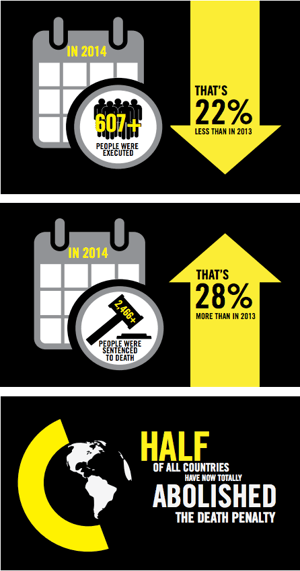
Mar 31, 2015
American Pharmacists Association: Assisting Executions “Fundamentally Contrary to the Role of Pharmacists”
On March 30, the American Pharmacists Association (APhA) adopted a resolution discouraging pharmacist participation in executions. The House of Delegates of the 62,000 member organization passed the policy, which states, “The American Pharmacists Association discourages pharmacist participation in executions on the basis that such activities are fundamentally contrary to the role of pharmacists as providers of health care.” William Fassett, professor emeritus of pharmacotherapy at Washington…
Read More
Mar 30, 2015
Supreme Court Grants Review in Three Kansas Cases; Hears Case on Intellectual Disability
On Monday, March 30, the U.S. Supreme Court granted review of three Kansas death penalty cases and heard oral argument in a Louisiana case that presented questions on the role of the federal courts in determining whether a state prisoner who faces the death penalty has intellectual disability. In the cases of Kansas v. Reginald Carr, Kansas v. Jonathan Carr, and Kansas v. Sidney Gleason, the Court granted review of the Kansas Supreme Court’s decisions overturning the defendants’ death sentences…
Read More
Mar 27, 2015
LAW REVIEW: “The American Death Penalty and the (In)Visibility of Race”
In a new article for the University of Chicago Law Review, Professors Carol S. Steiker (left) of the University of Texas School of Law and Jordan M. Steiker (right) of Harvard Law School examine the racial history of the American death penalty and what they describe as the U.S. Supreme Court’s “deafening silence” on the subject of race and capital punishment. They assert that the story of the death penalty “cannot be told without detailed attention to race.” The Steikers’ article recounts the…
Read More
Mar 26, 2015
States Struggle with Determinations of Competency to Be Executed
A recent article in Mother Jones examines lingering questions in the determination of which inmates are exempt from execution because of mental incompetency. In 1986, the U.S. Supreme Court ruled in Ford v. Wainwright that a person could not be executed if he or she was “unaware of the punishment they’re about to suffer and why they are to suffer it.” The 2007 ruling in Panetti v. Quarterman updated that decision, with Justice Anthony Kennedy writing, “A prisoner’s awareness of the State’s…
Read More
Mar 25, 2015
PUBLIC OPINION: Majority of Pennsylvanians Prefer Life Sentences, Support Moratorium on Death Penalty
According to a new poll by Public Policy Polling, a majority of Pennsylvanians find some form of a life sentence to be preferable to the death penalty, and more support the death penalty moratorium imposed by Governor Tom Wolf than oppose it. When asked what sentence they preferred for people convicted of murder, 54% of respondents selected some form of life sentence, while 42% preferred the death penalty. 50% were in favor of the Commonwealth’s death penalty moratorium, including 29% who say…
Read More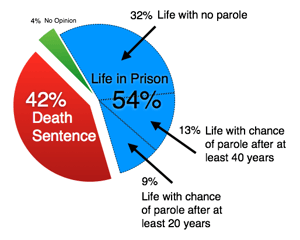
Mar 24, 2015
Caring for Patients
The International Academy of Compounding Pharmacists (IACP) is one of the primary organizations concerned with compounding pharmacies, and it stresses “patient care” as a primary concern. On March 24, 2015, IACP announced a position discouraging members from providing drugs for executions. The Board of Directors said, “While the pharmacy profession recognizes an individual practitioner’s right to determine whether to dispense a medication based upon his or her personal, ethical and religious…
Read MoreMar 24, 2015
NEW VOICES: Lead Prosecutor Apologizes to Death Row Exoneree, Urges State to Offer Compensation
UPDATE: After Louisiana denied compensation to Mr. Ford — who is in hospice care, dying from Stage 4 cancer — Stroud gave an interview to the Huffington Post in which he says “death penalty prosecutions are a badge of showing how out-of-touch we are with other civilized societies… . We can’t trust the government to fix potholes. Why should we believe they can design a death penalty system that’s fair?” PREVIOUSLY: In a letter to the Shreveport (Louisiana) Times, attorney A.M. “Marty” Stroud III…
Read More