Publications & Testimony
Testimony and Statements on the Death Penalty
FROM DPIC
For testimony by former Executive Director Robert Dunham and former Executive Director Richard C. Dieter, please visit our page DPIC Testimony.
FROM RELIGIOUS LEADERS AND ORGANIZATIONS
- News Brief: Pope Francis Calls for Prayer to Abolish the Death Penalty (September 1, 2022)
- Jewish Congregation Renews Request for Department of Justice to Drop Death Penalty in Tree of Life Synagogue Killings (June 24, 2021)
- Orthodox Church Patriarch Calls Death Penalty Incompatible with Christian Beliefs (October 20, 2020)
- Presbyterian Church (U.S.A.) — Statement on the Federal Death Penalty (August 5, 2019)
- Louisiana Christian Faith Leaders Call for State to Abolish Death Penalty (April 25, 2019)
- Pittsburgh Rabbi’s Wife Opposes Death Penalty for Tree of Life Synagogue Killings (March 18, 2019)
- Orthodox Jewish Organization Calls for an End to Capital Punishment in the U.S. | Death Penalty Information Center (February 17, 2016)
- Baptist Theologian Says Death Penalty Does Not Fit With Christian Theology (March 8, 2016)
- Civil and Human Rights: Death Penalty — Church & Society, The United Methodist Church
- Religious Views: Over 150 Catholic Theologians Call for Repeal of the Death Penalty (September 27, 2011)
- Power Over Life and Death — The Power to Save a Life (January 15, 2005)
- Responsibility, Rehabilitation, and Restoration: A Catholic Perspective on Crime and Criminal Justice (November 2000)
- The Challenge of Holiness: A Sermon on the Death Penalty (January 10, 2000)
- General Assembly of the Texas Conference of Churches — Resolution Opposing the Death Penalty (February 24, 1998)
- Statement by Catholic Bishops of Texas on Capital Punishment (October 20, 1997)
- Catholic Church Expresses Strong Opposition to Capital Punishment in Catechism (September 9, 1997)
- Catholic Bishops of Iowa Issue Statement on Death Penalty (February 4, 1998)
- To End the Death Penalty: A Report of the National Jewish/Catholic Consultation
- Transcript of Dr. Pat Robertson’s Speech on the Role of Religion and the Death Penalty at The College of William and Mary
- Collection of Official Catholic Statements on the Death Penalty (1980)
FROM THE INTERNATIONAL COMMUNITY
- UN experts call for universal abolition of the death penalty | OHCHR (October 9, 2023)
- Zambia Becomes 25th Sub-Saharan African Nation to Abolish Death Penalty (December 23, 2022)
- Belgium Wants a World Without the Death Penalty (October 20, 2022)
- As France Prepares to Assume Presidency of European Union, Emmanuel Macron Announces Initiative for Worldwide Abolition of Death Penalty (October 11, 2021)
- U.N. Secretary-General, European Union Ambassador Call for Abolition of “Barbaric” Death Penalty (October 11, 2017)
- European Union Calls for Abolition of Capital Punishment as World Coalition Hosts International Death Penalty Conference (June 27, 2017)
- U.N. Investigator Talks About the Future of Solitary and the Death Penalty (November 7, 2016)
- World Congress Against the Death Penalty Renews Call for Global Moratorium, Pope Sends Message of Support (June 27, 2016)
- Declaration by the Presidency on behalf of the European Union on the 400th execution in Texas from the Council of the European Union (August 21, 2007)
- Resolution Supporting Worldwide Moratorium on Executions from the United Nations Commission on Human Rights (April 1999)
- Mary Robinson, U.N. High Commissioner for Human Rights — Message to the Press Conference organized by the Death Penalty Information Center for the release of the report, “International Perspectives on the Death Penalty” (October 12, 1999)
- Status of the International Covenants on Human Rights from the United Nations Commission on Human Rights (April 1998)
FROM ADVOCACY GROUPS
- Advocacy Group Tells Supreme Court that Negative Stereotypes Distort Perception that Latinos in Death-Penalty Cases Pose Future Danger to Society (April 15, 2022)
- Disability Rights Groups, Legal Experts, and Conservative Advocates Urge Supreme Court to Strike Down Georgia’s Uniquely Harsh Proof Requirements in Death-Penalty Intellectual Disabilities Cases (January 11, 2022)
- NAACP Reaffirms Its Support of Abolishing the Death Penalty (2022)
- More Than 80 Civil Rights and Advocacy Organizations Urge President Biden to End Federal Executions | Death Penalty Information Center (February 9, 2021)
- More Than 250 Conservative Leaders Join Call to End Death Penalty (October 29, 2019)
- National Alliance on Mental Illness: The Death Penalty
- Florida League of Women Voters Calls for Halt to Executions (May 28, 2007)
- Victims Organizations Issue Joint Statement for National Victims’ Rights Week (April 19, 2007)
FROM JUDGES, LEGISLATORS, AND OTHER ORGANIZATIONS
- Republican-led Oklahoma committee considers pause on executions amid death case scrutiny (October 5, 2023)
- Former Pro-Death Penalty District Attorney Explains Why He Now Supports Abolition, and Fears Political Promises to Expand the Use of the Death Penalty (August 20, 2023)
- Pressley, Durbin Reintroduce Bill to End the Federal Death Penalty (July 13, 2023)
- The Lancet Editorial: Physician Involvement in Executions Violates Medical Ethics | Death Penalty Information Center (May 20, 2023)
- APA calls for extending ineligibility for the death penalty to adolescent offenders younger than age 21 (August 4, 2022)
- Why some Republicans are turning against the death penalty | Ron Ferguson | Ohio House of Representatives (March 8, 2022)
- Eight years on Texas’ highest criminal court turned Elsa Alcala into a death penalty skeptic. How will the court change without her? (January 26, 2019)
- AMA to Supreme Court: Doctor participation in executions unethical (August 22, 2018)
- Former Governor Bill Richardson: Death Penalty Is Bad for Business, Out of Step With World’s Views (June 16, 2017)
- Capital Punishment and Nurses’ Participation in Capital Punishment (2016)
- Former Ohio Attorney General Jim Petro Says Death Penalty Unfixable, “Not Worth It Any More” (September 12, 2016)
- Resolution Supporting Repeal of the Death Penalty, National Hispanic Caucus of State Legislators (August 11, 2016)
- Retired Police Captain Says Repealing Death Penalty Is “Smart on Crime” (November 24, 2014)
- Resolution Supporting Abolition of the Death Penalty, Natl. Assoc. of Black Psychologists (2012)
- The Road to Justice and Peace by New Jersey State Senator Raymond Lesniak (February 1, 2009)
- Statement On The Federal Death Penalty System by Senator Feingold (June 7, 2001)
- Statement on the Need for a Federal Moratorium on the Death Penalty Senator Feingold (October 29, 2000)
- Death Penalty: The Torah and Today (August 23, 2000)
- Press Release for Senator Russ Feingold’s Introduction of Senate’s First Death Penalty Moratorium Bill (April 20, 2000)
- Amnesty International Southern Regional Conference: Orlando, Florida Remarks by Former Florida Chief Justice Gerald Kogan (October 23, 1999)
- American Bar Association Resolution on the Death Penalty (February 3, 1997)
FROM MURDER VICTIMS’ FAMILY MEMBERS
Items: 3831 — 3840
Apr 22, 2012
DPIC’s Summary of North Carolina v. Marcus Robinson
(Superior Court, Judge Gregory Weeks, April 22, 2012) The first ruling under North Carolina’s Racial Justice Act Read the complete opinion. Discrimination in jury selection frustrates the commitment of African-Americans to full participation in civic life. One of the stereotypes particularly offensive to African-American citizens is that they are not interested in seeing criminals brought to justice. African-Americans who have been excluded from jury service on account of race compare their…
Read More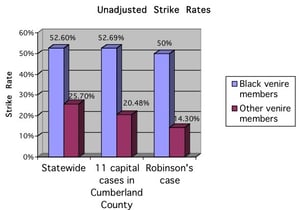
Apr 22, 2012
The Case of Marcus Robinson
Marcus Robinson was the first defendant to receive a hearing under North Carolina’s Racial Justice Act. His sentence was reduced to life without parole due to evidence of racial bias in jury selection. Timeline of Robinson’s case: August 5, 1991: Marcus Robinson is indicted for the murder of Eric Tornblom. August 5, 1994: Robinson is sentenced to death. 1999: State post-conviction appeal is unsuccessful. 2006: Federal post-conviction appeal is unsuccessful. January 25, 2007: Judge orders…
Read More
Apr 20, 2012
RACE: North Carolina Judge Overturns Death Sentence Under Racial Justice Act
On April 20, North Carolina Superior Court Judge Gregory Weeks issued an historic ruling under the state’s Racial Justice Act finding intentional bias by the state in selecting juries for death penalty cases. In what may be the first ruling of its kind in the country, the court held that “race was a materially, practically and statistically significant factor in the decision to exercise peremptory challenges during jury selection by prosecutors” at the time of Marcus Robinson’s (pictured)…
Read More
Apr 19, 2012
NEW VOICES: Senior Florida Judge Says Death Penalty Is Excessively Expensive and Not Needed
In a recent op-ed in the Gainesville Sun, Florida Judge Charles M. Harris (pictured) called the state’s capital punishment system “totally defective” and “far less satisfactory” than alternatives like life without parole. Judge Harris, who has been on the bench for over 20 years, argued that life without parole “has rendered death by execution redundant and the amount we spend on it wasted.” He continued, “[D]eath by execution is excessively expensive. Most people who support the death penalty…
Read More
Apr 18, 2012
DETERRENCE: National Research Council Concludes Deterrence Studies Should Not Influence Death Penalty Policy
A report released on April 18 by the prestigious National Research Council of the National Academies based on a review of more than three decades of research concluded that studies claiming a deterrent effect on murder rates from the death penalty are fundamentally flawed. The report concluded: “The committee concludes that research to date on the effect of capital punishment on homicide is not informative about whether capital punishment decreases, increases, or has no effect on homicide…
Read More
Apr 17, 2012
RACE: April 22 Marks 25th Anniversary of Landmark Decision in McCleskey v. Kemp
April 22 will mark the 25th anniversary of the Supreme Court’s decision in McCleskey v. Kemp in which the Court rejected (5 – 4) a claim of racial bias based on a sophisticated statistical study of the death penalty in Georgia. Warren McCleskey, an African-American death row inmate convicted of killing a white police officer, presented the Court with analysis showing that defendants charged with killing white victims had odds of receiving a death sentence that were 4.3 times higher than…
Read More
Apr 16, 2012
COSTS: Death Penalty Cases in Nevada Cost $200K Extra, Just for Defense
A recent study of the death penalty in Nevada compared the costs of defending capital and non-capital murder cases. The study, conducted by Dr. Terance Miethe of the Department of Criminal Justice at the University of Nevada, Las Vegas, looked at the time spent by defense attorneys at various stages of a case. The study’s findings included: — Clark County public defense attorneys spent an average of 2,298 hours on a capital murder case compared to an average of 1,087 hours on a non-capital…
Read More
Apr 13, 2012
EDITORIALS: New York Times Recommends All States to Follow Connecticut’s Lead
A recent editorial in the New York Times called Connecticut’s decision to repeal the death penalty part of “a growing movement against capital punishment.” The editorial attributed the trend away from the death penalty to new research that shows “gross injustice in its application and enormous costs in continuing to impose it.” The problem of arbitrariness recently came to light in Connecticut, where “a powerful, comprehensive study provided evidence that state death sentences are haphazardly…
Read More
Apr 12, 2012
RECENT LEGISLATION: Death Penalty Repeal Passes Second Connecticut House, Awaits Governor’s Signature
On April 11, the Connecticut House of Representatives passed (86 – 62) a bill to abolish the death penalty for future crimes. The same bill passed the Connecticut Senate on April 5. Governor Dannel Malloy has pledged to sign the bill, which will make Connecticut the 17th state to abolish the death penalty, and the 5th to do so in the last 5 years. In a statement released after the House vote, Gov. Malloy said, “When I sign this bill, Connecticut will join 16 other states and almost every other…
Read More
Apr 11, 2012
Systemic Flaws in Capital Representation Cited for Recent Pennsylvania Death Sentence
Following the recent handing down of a death sentence in Philadelphia, the Executive Director of the Atlantic Center for Capital Representation blamed the outcome on an inadequate indigent-defense system. Marc Bookman (pictured), writing in the Philadelphia Inquirer, reviewed the case and found, “There isn’t a single motion filed by the attorneys in defense of their client. Nor is there a request for a jury questionnaire, which is standard in most jurisdictions that regularly handle capital…
Read More