Publications & Testimony
Testimony and Statements on the Death Penalty
FROM DPIC
For testimony by former Executive Director Robert Dunham and former Executive Director Richard C. Dieter, please visit our page DPIC Testimony.
FROM RELIGIOUS LEADERS AND ORGANIZATIONS
- News Brief: Pope Francis Calls for Prayer to Abolish the Death Penalty (September 1, 2022)
- Jewish Congregation Renews Request for Department of Justice to Drop Death Penalty in Tree of Life Synagogue Killings (June 24, 2021)
- Orthodox Church Patriarch Calls Death Penalty Incompatible with Christian Beliefs (October 20, 2020)
- Presbyterian Church (U.S.A.) — Statement on the Federal Death Penalty (August 5, 2019)
- Louisiana Christian Faith Leaders Call for State to Abolish Death Penalty (April 25, 2019)
- Pittsburgh Rabbi’s Wife Opposes Death Penalty for Tree of Life Synagogue Killings (March 18, 2019)
- Orthodox Jewish Organization Calls for an End to Capital Punishment in the U.S. | Death Penalty Information Center (February 17, 2016)
- Baptist Theologian Says Death Penalty Does Not Fit With Christian Theology (March 8, 2016)
- Civil and Human Rights: Death Penalty — Church & Society, The United Methodist Church
- Religious Views: Over 150 Catholic Theologians Call for Repeal of the Death Penalty (September 27, 2011)
- Power Over Life and Death — The Power to Save a Life (January 15, 2005)
- Responsibility, Rehabilitation, and Restoration: A Catholic Perspective on Crime and Criminal Justice (November 2000)
- The Challenge of Holiness: A Sermon on the Death Penalty (January 10, 2000)
- General Assembly of the Texas Conference of Churches — Resolution Opposing the Death Penalty (February 24, 1998)
- Statement by Catholic Bishops of Texas on Capital Punishment (October 20, 1997)
- Catholic Church Expresses Strong Opposition to Capital Punishment in Catechism (September 9, 1997)
- Catholic Bishops of Iowa Issue Statement on Death Penalty (February 4, 1998)
- To End the Death Penalty: A Report of the National Jewish/Catholic Consultation
- Transcript of Dr. Pat Robertson’s Speech on the Role of Religion and the Death Penalty at The College of William and Mary
- Collection of Official Catholic Statements on the Death Penalty (1980)
FROM THE INTERNATIONAL COMMUNITY
- UN experts call for universal abolition of the death penalty | OHCHR (October 9, 2023)
- Zambia Becomes 25th Sub-Saharan African Nation to Abolish Death Penalty (December 23, 2022)
- Belgium Wants a World Without the Death Penalty (October 20, 2022)
- As France Prepares to Assume Presidency of European Union, Emmanuel Macron Announces Initiative for Worldwide Abolition of Death Penalty (October 11, 2021)
- U.N. Secretary-General, European Union Ambassador Call for Abolition of “Barbaric” Death Penalty (October 11, 2017)
- European Union Calls for Abolition of Capital Punishment as World Coalition Hosts International Death Penalty Conference (June 27, 2017)
- U.N. Investigator Talks About the Future of Solitary and the Death Penalty (November 7, 2016)
- World Congress Against the Death Penalty Renews Call for Global Moratorium, Pope Sends Message of Support (June 27, 2016)
- Declaration by the Presidency on behalf of the European Union on the 400th execution in Texas from the Council of the European Union (August 21, 2007)
- Resolution Supporting Worldwide Moratorium on Executions from the United Nations Commission on Human Rights (April 1999)
- Mary Robinson, U.N. High Commissioner for Human Rights — Message to the Press Conference organized by the Death Penalty Information Center for the release of the report, “International Perspectives on the Death Penalty” (October 12, 1999)
- Status of the International Covenants on Human Rights from the United Nations Commission on Human Rights (April 1998)
FROM ADVOCACY GROUPS
- Advocacy Group Tells Supreme Court that Negative Stereotypes Distort Perception that Latinos in Death-Penalty Cases Pose Future Danger to Society (April 15, 2022)
- Disability Rights Groups, Legal Experts, and Conservative Advocates Urge Supreme Court to Strike Down Georgia’s Uniquely Harsh Proof Requirements in Death-Penalty Intellectual Disabilities Cases (January 11, 2022)
- NAACP Reaffirms Its Support of Abolishing the Death Penalty (2022)
- More Than 80 Civil Rights and Advocacy Organizations Urge President Biden to End Federal Executions | Death Penalty Information Center (February 9, 2021)
- More Than 250 Conservative Leaders Join Call to End Death Penalty (October 29, 2019)
- National Alliance on Mental Illness: The Death Penalty
- Florida League of Women Voters Calls for Halt to Executions (May 28, 2007)
- Victims Organizations Issue Joint Statement for National Victims’ Rights Week (April 19, 2007)
FROM JUDGES, LEGISLATORS, AND OTHER ORGANIZATIONS
- Republican-led Oklahoma committee considers pause on executions amid death case scrutiny (October 5, 2023)
- Former Pro-Death Penalty District Attorney Explains Why He Now Supports Abolition, and Fears Political Promises to Expand the Use of the Death Penalty (August 20, 2023)
- Pressley, Durbin Reintroduce Bill to End the Federal Death Penalty (July 13, 2023)
- The Lancet Editorial: Physician Involvement in Executions Violates Medical Ethics | Death Penalty Information Center (May 20, 2023)
- APA calls for extending ineligibility for the death penalty to adolescent offenders younger than age 21 (August 4, 2022)
- Why some Republicans are turning against the death penalty | Ron Ferguson | Ohio House of Representatives (March 8, 2022)
- Eight years on Texas’ highest criminal court turned Elsa Alcala into a death penalty skeptic. How will the court change without her? (January 26, 2019)
- AMA to Supreme Court: Doctor participation in executions unethical (August 22, 2018)
- Former Governor Bill Richardson: Death Penalty Is Bad for Business, Out of Step With World’s Views (June 16, 2017)
- Capital Punishment and Nurses’ Participation in Capital Punishment (2016)
- Former Ohio Attorney General Jim Petro Says Death Penalty Unfixable, “Not Worth It Any More” (September 12, 2016)
- Resolution Supporting Repeal of the Death Penalty, National Hispanic Caucus of State Legislators (August 11, 2016)
- Retired Police Captain Says Repealing Death Penalty Is “Smart on Crime” (November 24, 2014)
- Resolution Supporting Abolition of the Death Penalty, Natl. Assoc. of Black Psychologists (2012)
- The Road to Justice and Peace by New Jersey State Senator Raymond Lesniak (February 1, 2009)
- Statement On The Federal Death Penalty System by Senator Feingold (June 7, 2001)
- Statement on the Need for a Federal Moratorium on the Death Penalty Senator Feingold (October 29, 2000)
- Death Penalty: The Torah and Today (August 23, 2000)
- Press Release for Senator Russ Feingold’s Introduction of Senate’s First Death Penalty Moratorium Bill (April 20, 2000)
- Amnesty International Southern Regional Conference: Orlando, Florida Remarks by Former Florida Chief Justice Gerald Kogan (October 23, 1999)
- American Bar Association Resolution on the Death Penalty (February 3, 1997)
FROM MURDER VICTIMS’ FAMILY MEMBERS
Items: 4581 — 4590
Jun 29, 2009
DNA Evidence Leads to Release of Texas Man Who Spent Four Years on Death Row
A man originally sentenced to death for four murders in Texas has been released on his own recognizance after new DNA evidence was discovered. Robert Springsteen and co-defendant Michael Scott were released by State District Judge Mike Lynch after prosecutors said they were not prepared to go to trial as scheduled, leaving Judge Lynch to follow through on his promise to the defendants that another delay would mean freedom for the defendants. Lynch said he not only had to consider the charges…
Read MoreJun 26, 2009
COSTS: North Carolina Spent At Least $36 Million Extra Pursuing Capital Cases over 7 Years
According to a study by the Independent Weekly, North Carolina conservatively spent at least $36 million dollars by seeking the death penalty instead of life in prison without parole over the past 7 years, just on defense costs. The state’s Indigent Defense Services organization said the average cost of a death penalty defense was $63,700, and the state sought the death penalty 733 times between 2001 and 2008. The average cost of the 1,785 potentially capital cases where the state instead…
Read MoreJun 25, 2009
NEW RESOURCES: DPIC Offers Podcasts on Costs, Clemency, and Arbitrariness
If you would like to listen to a brief but informative discussion of key death penalty issues, try DPIC’s newest resource — Podcasts. The most recent episode of this educational series explores the issue of the Costs of the death penalty. You can also choose to listen to previous episodes to learn more about the issues of Arbitrariness and Clemency. Podcasts may be downloaded for listening later on a digital music player. More issues will be covered in the near future. To subscribe to the Podcast…
Read MoreJun 24, 2009
Top Prison Doctor’s Resignation Illustrates Ethical Conflict with Lethal Injection Protocol
Washington’s former medical director for the Department of Corrections, Dr. Marc Stern, recently resigned from his post because of an ethichal conflict with his role in supervising those who carried out executions. For example, the prison’s medical director, a nurse, attended at least 8 practice sessions with the four-member lethal-injection team, including some held on the kitchen countertop at a team member’s home. As he left his position on the eve of a scheduled execution, Stern formally…
Read MoreJun 23, 2009
BOOKS: Lethal Rejection – Stories on Crime and Punishment
A new book, Lethal Rejection: Stories on Crime and Punishment, edited and written in part by American University criminologist Robert Johnson and student Sonia Tabriz, features an array of fiction and poetry on crime and punishment written by prisoners, academics, and students of criminology. The book includes a number of stories about capital punishment. Jocelyn Pollock, Professor of Criminal Justice at Texas State University, writes in the preface, “[H]umans have always used fiction to…
Read More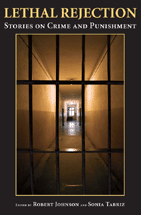
Jun 22, 2009
ARBITRARINESS: A Death Penalty Prosecution Instead Settles with a Short Sentence After Misconduct is Revealed
A prosecutor’s misconduct related to a Kentucky capital murder case led the state to accept a plea bargain with the defendant in which he now faces a sentence of 10 years with the possibility of immediate parole. Officials say Assistant Commonweath Attorney Ruth Lerner compromised the death penalty prosecution against Cory Gibson by cutting a deal with a witness against Gibson. Lerner had not disclosed a deal made with the witness in a separate robbery case in exchange for his testimony against…
Read MoreJun 19, 2009
Supreme Court Rejects Due Process Right to DNA Testing After Trial
In a 5 – 4 ruling on June 18, the U.S. Supreme Court reversed a lower federal court ruling holding that the due process clause of the Fourteenth Amendment guarantees a convicted inmate the right to a DNA test on evidence that might prove his innocence. The defendant, William Osborne, had been convicted in 1994 of sexual assault in Alaska and sentenced to 26 years in prison. Alaska is one of only 4 states in the country that does not have a law providing for access to DNA evidence (the other 3 are…
Read MoreJun 18, 2009
Indiana Prosecutors Say “We’re running out of death row inmates,” Citing High Costs of Death Penalty
Indiana is sentencing fewer people to death and executing at its slowest pace in 15 years. It has gone two years without an execution for the first time since the mid-1990’s. “We’re running out of death row inmates,” said Clark County Prosecutor Steven Stewart, who maintains a pro-death penalty Web site. Prosecutors attribute the decline to time and money issues, part of a national trend that has prompted several states to move towards abolishing the death penalty. Vanderburgh County Prosecutor…
Read MoreJun 17, 2009
Prominent Death Penalty Attorney Bryan Stevenson Wins Gruber Justice Award
Renowned Alabama attorney Bryan Stevenson was awarded the 2009 Gruber Justice Prize for his dedicated work representing death row inmates, indigent defendants and juveniles. Stevenson said the $250,000 prize would be directed to the Equal Justice Initiative, an organization Stevenson founded that is best known for representing death row inmates. The Gruber Foundation noted that Stevenson and his staff had been responsible for “for reversals and reduced sentences in more than 75 death penalty…
Read More
Jun 16, 2009
STUDIES: Majority of Leading Criminologists Find Death Penalty Does Not Deter Murder
Eighty-eight percent of the country’s top criminologists do not believe the death penalty acts as a deterrent to homicide, according to a new study published on June 16 in the Northwestern University School of Law’s Journal of Criminal Law and Criminology. The study was authored by Professor Michael Radelet, Chair of the Department of Sociology at the University of Colorado-Boulder, and graduate student Traci Lacock. Their article, “Do Executions Lower Homicide Rates? The Views of Leading…
Read More