Publications & Testimony
Testimony and Statements on the Death Penalty
FROM DPIC
For testimony by former Executive Director Robert Dunham and former Executive Director Richard C. Dieter, please visit our page DPIC Testimony.
FROM RELIGIOUS LEADERS AND ORGANIZATIONS
- News Brief: Pope Francis Calls for Prayer to Abolish the Death Penalty (September 1, 2022)
- Jewish Congregation Renews Request for Department of Justice to Drop Death Penalty in Tree of Life Synagogue Killings (June 24, 2021)
- Orthodox Church Patriarch Calls Death Penalty Incompatible with Christian Beliefs (October 20, 2020)
- Presbyterian Church (U.S.A.) — Statement on the Federal Death Penalty (August 5, 2019)
- Louisiana Christian Faith Leaders Call for State to Abolish Death Penalty (April 25, 2019)
- Pittsburgh Rabbi’s Wife Opposes Death Penalty for Tree of Life Synagogue Killings (March 18, 2019)
- Orthodox Jewish Organization Calls for an End to Capital Punishment in the U.S. | Death Penalty Information Center (February 17, 2016)
- Baptist Theologian Says Death Penalty Does Not Fit With Christian Theology (March 8, 2016)
- Civil and Human Rights: Death Penalty — Church & Society, The United Methodist Church
- Religious Views: Over 150 Catholic Theologians Call for Repeal of the Death Penalty (September 27, 2011)
- Power Over Life and Death — The Power to Save a Life (January 15, 2005)
- Responsibility, Rehabilitation, and Restoration: A Catholic Perspective on Crime and Criminal Justice (November 2000)
- The Challenge of Holiness: A Sermon on the Death Penalty (January 10, 2000)
- General Assembly of the Texas Conference of Churches — Resolution Opposing the Death Penalty (February 24, 1998)
- Statement by Catholic Bishops of Texas on Capital Punishment (October 20, 1997)
- Catholic Church Expresses Strong Opposition to Capital Punishment in Catechism (September 9, 1997)
- Catholic Bishops of Iowa Issue Statement on Death Penalty (February 4, 1998)
- To End the Death Penalty: A Report of the National Jewish/Catholic Consultation
- Transcript of Dr. Pat Robertson’s Speech on the Role of Religion and the Death Penalty at The College of William and Mary
- Collection of Official Catholic Statements on the Death Penalty (1980)
FROM THE INTERNATIONAL COMMUNITY
- UN experts call for universal abolition of the death penalty | OHCHR (October 9, 2023)
- Zambia Becomes 25th Sub-Saharan African Nation to Abolish Death Penalty (December 23, 2022)
- Belgium Wants a World Without the Death Penalty (October 20, 2022)
- As France Prepares to Assume Presidency of European Union, Emmanuel Macron Announces Initiative for Worldwide Abolition of Death Penalty (October 11, 2021)
- U.N. Secretary-General, European Union Ambassador Call for Abolition of “Barbaric” Death Penalty (October 11, 2017)
- European Union Calls for Abolition of Capital Punishment as World Coalition Hosts International Death Penalty Conference (June 27, 2017)
- U.N. Investigator Talks About the Future of Solitary and the Death Penalty (November 7, 2016)
- World Congress Against the Death Penalty Renews Call for Global Moratorium, Pope Sends Message of Support (June 27, 2016)
- Declaration by the Presidency on behalf of the European Union on the 400th execution in Texas from the Council of the European Union (August 21, 2007)
- Resolution Supporting Worldwide Moratorium on Executions from the United Nations Commission on Human Rights (April 1999)
- Mary Robinson, U.N. High Commissioner for Human Rights — Message to the Press Conference organized by the Death Penalty Information Center for the release of the report, “International Perspectives on the Death Penalty” (October 12, 1999)
- Status of the International Covenants on Human Rights from the United Nations Commission on Human Rights (April 1998)
FROM ADVOCACY GROUPS
- Advocacy Group Tells Supreme Court that Negative Stereotypes Distort Perception that Latinos in Death-Penalty Cases Pose Future Danger to Society (April 15, 2022)
- Disability Rights Groups, Legal Experts, and Conservative Advocates Urge Supreme Court to Strike Down Georgia’s Uniquely Harsh Proof Requirements in Death-Penalty Intellectual Disabilities Cases (January 11, 2022)
- NAACP Reaffirms Its Support of Abolishing the Death Penalty (2022)
- More Than 80 Civil Rights and Advocacy Organizations Urge President Biden to End Federal Executions | Death Penalty Information Center (February 9, 2021)
- More Than 250 Conservative Leaders Join Call to End Death Penalty (October 29, 2019)
- National Alliance on Mental Illness: The Death Penalty
- Florida League of Women Voters Calls for Halt to Executions (May 28, 2007)
- Victims Organizations Issue Joint Statement for National Victims’ Rights Week (April 19, 2007)
FROM JUDGES, LEGISLATORS, AND OTHER ORGANIZATIONS
- Republican-led Oklahoma committee considers pause on executions amid death case scrutiny (October 5, 2023)
- Former Pro-Death Penalty District Attorney Explains Why He Now Supports Abolition, and Fears Political Promises to Expand the Use of the Death Penalty (August 20, 2023)
- Pressley, Durbin Reintroduce Bill to End the Federal Death Penalty (July 13, 2023)
- The Lancet Editorial: Physician Involvement in Executions Violates Medical Ethics | Death Penalty Information Center (May 20, 2023)
- APA calls for extending ineligibility for the death penalty to adolescent offenders younger than age 21 (August 4, 2022)
- Why some Republicans are turning against the death penalty | Ron Ferguson | Ohio House of Representatives (March 8, 2022)
- Eight years on Texas’ highest criminal court turned Elsa Alcala into a death penalty skeptic. How will the court change without her? (January 26, 2019)
- AMA to Supreme Court: Doctor participation in executions unethical (August 22, 2018)
- Former Governor Bill Richardson: Death Penalty Is Bad for Business, Out of Step With World’s Views (June 16, 2017)
- Capital Punishment and Nurses’ Participation in Capital Punishment (2016)
- Former Ohio Attorney General Jim Petro Says Death Penalty Unfixable, “Not Worth It Any More” (September 12, 2016)
- Resolution Supporting Repeal of the Death Penalty, National Hispanic Caucus of State Legislators (August 11, 2016)
- Retired Police Captain Says Repealing Death Penalty Is “Smart on Crime” (November 24, 2014)
- Resolution Supporting Abolition of the Death Penalty, Natl. Assoc. of Black Psychologists (2012)
- The Road to Justice and Peace by New Jersey State Senator Raymond Lesniak (February 1, 2009)
- Statement On The Federal Death Penalty System by Senator Feingold (June 7, 2001)
- Statement on the Need for a Federal Moratorium on the Death Penalty Senator Feingold (October 29, 2000)
- Death Penalty: The Torah and Today (August 23, 2000)
- Press Release for Senator Russ Feingold’s Introduction of Senate’s First Death Penalty Moratorium Bill (April 20, 2000)
- Amnesty International Southern Regional Conference: Orlando, Florida Remarks by Former Florida Chief Justice Gerald Kogan (October 23, 1999)
- American Bar Association Resolution on the Death Penalty (February 3, 1997)
FROM MURDER VICTIMS’ FAMILY MEMBERS
Items: 4711 — 4720
Dec 31, 2008
Baze v. Rees: Stays Granted
At least 40 death row inmates, some on the day of their execution, were granted stays lasting beyond their scheduled dates in 2006-08 based in whole or in part on challenges to the lethal injection process. Some stays were lifted and the inmates eventually executed. In many states, all executions were effectively on hold until the lethal injection controversy is resolved. At the same time, other executions were allowed to go forward with no stays. Almost all of the executions have been by…
Read MoreDec 31, 2008
State Media Coverage of Baze v. Rees
Below are examples of state media coverage of Baze v. Rees regarding the constitutionality of lethal injection. In many instances, the articles discuss the possible impact of the decision on specific states: Alabama — From the Gadsen Times Arkansas — From the Arkansas Democrat Gazette California — From the San Jose Mercury News Florida — From the Gainesville Sun Georgia — From the Atlanta Journal-Constitution Kentucky — From the Courier-Journal Maryland — From the Baltimore Sun…
Read MoreDec 30, 2008
EDITORIALS: Death Penalty Moratorium Needed in Texas
The Dallas Morning News renewed its call for a moratorium on executions in Texas because of the numerous errors in the state’s death penalty system. The paper highlighted the cases of Michael Blair and Charles Hood as examples of how the system has broken down. Blair was exonerated in 2008 after 14 years on death row. DNA evidence revealed that he had not been the murderer of 7‑year-old Ashley Estel in 1993, despite the fact that the jury had taken only 27 minutes to convict him, and that he…
Read MoreDec 26, 2008
Top Medical Officer Resigns Over Participation in Executions
The top medical officer for the Department of Corrections in the state of Washington has resigned in order to avoid any participation in the state’s execution process. As the doctor responsible for preparing others to carry out lethal injections, Dr. Marc Stern concluded that his ethical obligations as a physician required that he recuse himself from such actions and that resigning was the only way to fully remove himself from this process. Dr. Stern, who supervised 700 employees around the…
Read MoreDec 23, 2008
NEW VOICES: One Year Later, New Jersey Prosecutors Find No Problem with Abolition of Death Penalty
In December 2007, New Jersey became the first state to legislatively abolish the death penalty in 40 years. In commenting on the absence of capital punishment for one year, a number of state prosecutors found no problems with the new system. “We have not viewed it as an impediment in the disposition of murder cases,” said Hudson County Prosecutor Edward DeFazio, who served on a state study commission that reviewed the death penalty. “As a practical matter, we have really seen no difference in…
Read More
Dec 23, 2008
Louisiana Must Pay $14 Million to Man Exonerated From Death Row
The U.S. Court of Appeals for the Fifth Circuit upheld a $14 million award to John Thompson, a former death row inmate in Louisiana who was exonerated after withheld evidence was revealed. Thompson spent 18 years in prison, including 14 years in the solitary confinement of death row in Angola Prison. He came within one month of being executed in 1999 when his attorneys discovered blood evidence that should have been turned over to the defense years ago. The new evidence cleared Thompson of an…
Read MoreDec 22, 2008
NEW VOICES: Police Chief Says Death Penalty Hurting Public Safety
Ray Samuels, a police officer for 33 years and Chief of Police in Newark, California, for 5 years, recently expressed concern that state budget cuts will prevent important crime-fighting measures from being passed, while an expensive death penalty continues to drain the state’s finances. In an op-ed in the Contra Costa Times, Samuels wrote: Local jurisdictions are likely to lose a significant amount of state funding this year because of the severe financial crisis. This funding helps cities…
Read MoreDec 19, 2008
Death Penalty Sentences Have Dropped Considerably in the 2000s
Compared to the 1990s, there has been a marked decline in death sentences in the U.S. since 2000. Every region of the country and every state that averaged one or more death sentences per year have seen a decline in the annual number of death sentences. The chart below compares the annual number of death sentences in each state in the 1990s with the 2000s. North Carolina, California, Florida, and Texas experienced the greatest declines in sentencing. This issue and others are addressed in the…
Read More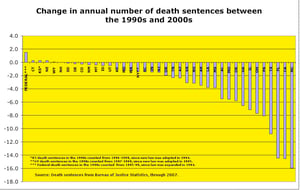
Dec 18, 2008
California Lawmakers Oppose Funding $395 Million for New Death Row
Two California legislators from opposing political parties and with different points of view on the death penalty have proposed cutting funding for a new $395 million death row at San Quentin Prison. “The Death Row expansion is a bottomless money pit,” said Republican state Senator Jeff Denham. Democratic Assemblyman Jared Huffman added, “We should use this opportunity, with the state running out of cash, to step back and rethink this project.” Calling the renovation project, “Cadillac Death…
Read More
Dec 17, 2008
NEW VOICES: Mississippi Supreme Court Justice Says Death Penalty Unconstitutional
The Presiding Justice of the Mississippi Supreme Court, Oliver Diaz, dissented in a recent capital case, Doss v. Mississippi, stating he had come to the conclusion that the death penalty is unconstitutional: [A]ll that remains to justify our system of capital punishment is the quest for revenge, and I cannot find, as a matter of law, that the thirst for vengeance is a legitimate state interest. Even if it is, capital punishment’s benefit over life imprisonment in society’s quest for revenge is…
Read More