Publications & Testimony
Testimony and Statements on the Death Penalty
FROM DPIC
For testimony by former Executive Director Robert Dunham and former Executive Director Richard C. Dieter, please visit our page DPIC Testimony.
FROM RELIGIOUS LEADERS AND ORGANIZATIONS
- News Brief: Pope Francis Calls for Prayer to Abolish the Death Penalty (September 1, 2022)
- Jewish Congregation Renews Request for Department of Justice to Drop Death Penalty in Tree of Life Synagogue Killings (June 24, 2021)
- Orthodox Church Patriarch Calls Death Penalty Incompatible with Christian Beliefs (October 20, 2020)
- Presbyterian Church (U.S.A.) — Statement on the Federal Death Penalty (August 5, 2019)
- Louisiana Christian Faith Leaders Call for State to Abolish Death Penalty (April 25, 2019)
- Pittsburgh Rabbi’s Wife Opposes Death Penalty for Tree of Life Synagogue Killings (March 18, 2019)
- Orthodox Jewish Organization Calls for an End to Capital Punishment in the U.S. | Death Penalty Information Center (February 17, 2016)
- Baptist Theologian Says Death Penalty Does Not Fit With Christian Theology (March 8, 2016)
- Civil and Human Rights: Death Penalty — Church & Society, The United Methodist Church
- Religious Views: Over 150 Catholic Theologians Call for Repeal of the Death Penalty (September 27, 2011)
- Power Over Life and Death — The Power to Save a Life (January 15, 2005)
- Responsibility, Rehabilitation, and Restoration: A Catholic Perspective on Crime and Criminal Justice (November 2000)
- The Challenge of Holiness: A Sermon on the Death Penalty (January 10, 2000)
- General Assembly of the Texas Conference of Churches — Resolution Opposing the Death Penalty (February 24, 1998)
- Statement by Catholic Bishops of Texas on Capital Punishment (October 20, 1997)
- Catholic Church Expresses Strong Opposition to Capital Punishment in Catechism (September 9, 1997)
- Catholic Bishops of Iowa Issue Statement on Death Penalty (February 4, 1998)
- To End the Death Penalty: A Report of the National Jewish/Catholic Consultation
- Transcript of Dr. Pat Robertson’s Speech on the Role of Religion and the Death Penalty at The College of William and Mary
- Collection of Official Catholic Statements on the Death Penalty (1980)
FROM THE INTERNATIONAL COMMUNITY
- UN experts call for universal abolition of the death penalty | OHCHR (October 9, 2023)
- Zambia Becomes 25th Sub-Saharan African Nation to Abolish Death Penalty (December 23, 2022)
- Belgium Wants a World Without the Death Penalty (October 20, 2022)
- As France Prepares to Assume Presidency of European Union, Emmanuel Macron Announces Initiative for Worldwide Abolition of Death Penalty (October 11, 2021)
- U.N. Secretary-General, European Union Ambassador Call for Abolition of “Barbaric” Death Penalty (October 11, 2017)
- European Union Calls for Abolition of Capital Punishment as World Coalition Hosts International Death Penalty Conference (June 27, 2017)
- U.N. Investigator Talks About the Future of Solitary and the Death Penalty (November 7, 2016)
- World Congress Against the Death Penalty Renews Call for Global Moratorium, Pope Sends Message of Support (June 27, 2016)
- Declaration by the Presidency on behalf of the European Union on the 400th execution in Texas from the Council of the European Union (August 21, 2007)
- Resolution Supporting Worldwide Moratorium on Executions from the United Nations Commission on Human Rights (April 1999)
- Mary Robinson, U.N. High Commissioner for Human Rights — Message to the Press Conference organized by the Death Penalty Information Center for the release of the report, “International Perspectives on the Death Penalty” (October 12, 1999)
- Status of the International Covenants on Human Rights from the United Nations Commission on Human Rights (April 1998)
FROM ADVOCACY GROUPS
- Advocacy Group Tells Supreme Court that Negative Stereotypes Distort Perception that Latinos in Death-Penalty Cases Pose Future Danger to Society (April 15, 2022)
- Disability Rights Groups, Legal Experts, and Conservative Advocates Urge Supreme Court to Strike Down Georgia’s Uniquely Harsh Proof Requirements in Death-Penalty Intellectual Disabilities Cases (January 11, 2022)
- NAACP Reaffirms Its Support of Abolishing the Death Penalty (2022)
- More Than 80 Civil Rights and Advocacy Organizations Urge President Biden to End Federal Executions | Death Penalty Information Center (February 9, 2021)
- More Than 250 Conservative Leaders Join Call to End Death Penalty (October 29, 2019)
- National Alliance on Mental Illness: The Death Penalty
- Florida League of Women Voters Calls for Halt to Executions (May 28, 2007)
- Victims Organizations Issue Joint Statement for National Victims’ Rights Week (April 19, 2007)
FROM JUDGES, LEGISLATORS, AND OTHER ORGANIZATIONS
- Republican-led Oklahoma committee considers pause on executions amid death case scrutiny (October 5, 2023)
- Former Pro-Death Penalty District Attorney Explains Why He Now Supports Abolition, and Fears Political Promises to Expand the Use of the Death Penalty (August 20, 2023)
- Pressley, Durbin Reintroduce Bill to End the Federal Death Penalty (July 13, 2023)
- The Lancet Editorial: Physician Involvement in Executions Violates Medical Ethics | Death Penalty Information Center (May 20, 2023)
- APA calls for extending ineligibility for the death penalty to adolescent offenders younger than age 21 (August 4, 2022)
- Why some Republicans are turning against the death penalty | Ron Ferguson | Ohio House of Representatives (March 8, 2022)
- Eight years on Texas’ highest criminal court turned Elsa Alcala into a death penalty skeptic. How will the court change without her? (January 26, 2019)
- AMA to Supreme Court: Doctor participation in executions unethical (August 22, 2018)
- Former Governor Bill Richardson: Death Penalty Is Bad for Business, Out of Step With World’s Views (June 16, 2017)
- Capital Punishment and Nurses’ Participation in Capital Punishment (2016)
- Former Ohio Attorney General Jim Petro Says Death Penalty Unfixable, “Not Worth It Any More” (September 12, 2016)
- Resolution Supporting Repeal of the Death Penalty, National Hispanic Caucus of State Legislators (August 11, 2016)
- Retired Police Captain Says Repealing Death Penalty Is “Smart on Crime” (November 24, 2014)
- Resolution Supporting Abolition of the Death Penalty, Natl. Assoc. of Black Psychologists (2012)
- The Road to Justice and Peace by New Jersey State Senator Raymond Lesniak (February 1, 2009)
- Statement On The Federal Death Penalty System by Senator Feingold (June 7, 2001)
- Statement on the Need for a Federal Moratorium on the Death Penalty Senator Feingold (October 29, 2000)
- Death Penalty: The Torah and Today (August 23, 2000)
- Press Release for Senator Russ Feingold’s Introduction of Senate’s First Death Penalty Moratorium Bill (April 20, 2000)
- Amnesty International Southern Regional Conference: Orlando, Florida Remarks by Former Florida Chief Justice Gerald Kogan (October 23, 1999)
- American Bar Association Resolution on the Death Penalty (February 3, 1997)
FROM MURDER VICTIMS’ FAMILY MEMBERS
Items: 4721 — 4730
Dec 22, 2008
NEW VOICES: Police Chief Says Death Penalty Hurting Public Safety
Ray Samuels, a police officer for 33 years and Chief of Police in Newark, California, for 5 years, recently expressed concern that state budget cuts will prevent important crime-fighting measures from being passed, while an expensive death penalty continues to drain the state’s finances. In an op-ed in the Contra Costa Times, Samuels wrote: Local jurisdictions are likely to lose a significant amount of state funding this year because of the severe financial crisis. This funding helps cities…
Read MoreDec 19, 2008
Death Penalty Sentences Have Dropped Considerably in the 2000s
Compared to the 1990s, there has been a marked decline in death sentences in the U.S. since 2000. Every region of the country and every state that averaged one or more death sentences per year have seen a decline in the annual number of death sentences. The chart below compares the annual number of death sentences in each state in the 1990s with the 2000s. North Carolina, California, Florida, and Texas experienced the greatest declines in sentencing. This issue and others are addressed in the…
Read More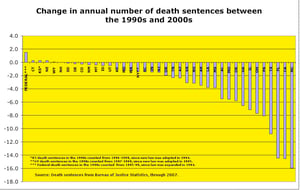
Dec 18, 2008
California Lawmakers Oppose Funding $395 Million for New Death Row
Two California legislators from opposing political parties and with different points of view on the death penalty have proposed cutting funding for a new $395 million death row at San Quentin Prison. “The Death Row expansion is a bottomless money pit,” said Republican state Senator Jeff Denham. Democratic Assemblyman Jared Huffman added, “We should use this opportunity, with the state running out of cash, to step back and rethink this project.” Calling the renovation project, “Cadillac Death…
Read More
Dec 17, 2008
NEW VOICES: Mississippi Supreme Court Justice Says Death Penalty Unconstitutional
The Presiding Justice of the Mississippi Supreme Court, Oliver Diaz, dissented in a recent capital case, Doss v. Mississippi, stating he had come to the conclusion that the death penalty is unconstitutional: [A]ll that remains to justify our system of capital punishment is the quest for revenge, and I cannot find, as a matter of law, that the thirst for vengeance is a legitimate state interest. Even if it is, capital punishment’s benefit over life imprisonment in society’s quest for revenge is…
Read MoreDec 16, 2008
NEW RESOURCES: Death Qualification and Prejudice
Research on death qualification — the selection of jurors who are qualified to serve on a capital case because they are willing to sentence someone to death — has revealed additional characteristics among such jurors. Professor Brooke Butler of the University of South Florida in Sarasota has studied such jurors and published her results in the journal of Behavioral Sciences and the Law. Her study, “Death qualification and prejudice: the effect of implicit racism, sexism, and homophobia on capital…
Read MoreDec 15, 2008
Expensive Death Penalty Prosecution of Infamous Murderer Results in Life-Without-Parole Sentence in Georgia
Brian Nichols was sentenced to life in prison without parole in Georgia on December 13 after the jury could not reach a unanimous verdict of death. Nichols had been found guilty of killing a judge, a court reporter, a police deputy, and a U.S. Customs agent during his escape from a courthouse hearing on other charges. The jury remained deadlocked in a 9 – 3 vote after four days of deliberations. A unanimous vote is required for a death sentence, just as it is for a guilty verdict. The jury did…
Read MoreDec 12, 2008
Maryland Commission Recommends Abolition of Death Penalty in Final Report
The legislative commission established to examine the death penalty in Maryland has recommended abolition of the punishment by a vote of 13 – 9. The Maryland Commission on Capital Punishment released its final report on December 12, detailing the reasons for its recommendation. “There is no good and sufficient reason to have the death penalty,” Chairman Benjamin R. Civiletti said at a news conference. Regarding the commission’s recommendation of repeal rather than reform, he said, “There are so…
Read More
Dec 11, 2008
RESOURCES: New Website and Database Launched
The Death Penalty Project launched a new Web site on December 10 that includes a legal resource database with a comprehensive list of international legal authorities and case law, some dating back to the 19th century, and detailed head notes for those seeking jurisprudence on criminal, constitutional, and international points of law. Users can search for case references by subject matter and a sophisticated case index. The site is located at www.deathpenaltyproject.org. The Death Penalty…
Read MoreDec 10, 2008
Federal Appeals Court Considers Sufficiency of Evidence in Troy Davis Case
A three-judge panel of the US Court of Appeals for the 11th Circuit in Atlanta heard arguments in the Troy Davis case on December 9. The judges weighed whether Davis’ new evidence was sufficient to merit a more extensive hearing and perhaps a new trial. One of the judges, Rosemary Barkett, said she would like to see the innocence claims fleshed out in a further hearing. Judge Barkett expressed her frustration with the fact that none of the eyewitnesses were shown another primary suspect’s…
Read More
Dec 09, 2008
Tennessee Death Penalty Committee Recommends Changes in Representation Standards
A legislative committee created to study the death penalty in Tennessee has recommended ways to ensure capital cases are handled fairly and effectively. The committee approved a resolution that asks lawmakers to create a statewide authority whose duties would include identifying lawyers experienced in capital cases, raising the standard pay for such attorneys, and monitoring their caseloads. Thomas Lee, a Tennessee attorney on the committee, said such an authority would help ensure that…
Read More