Publications & Testimony
Testimony and Statements on the Death Penalty
FROM DPIC
For testimony by former Executive Director Robert Dunham and former Executive Director Richard C. Dieter, please visit our page DPIC Testimony.
FROM RELIGIOUS LEADERS AND ORGANIZATIONS
- News Brief: Pope Francis Calls for Prayer to Abolish the Death Penalty (September 1, 2022)
- Jewish Congregation Renews Request for Department of Justice to Drop Death Penalty in Tree of Life Synagogue Killings (June 24, 2021)
- Orthodox Church Patriarch Calls Death Penalty Incompatible with Christian Beliefs (October 20, 2020)
- Presbyterian Church (U.S.A.) — Statement on the Federal Death Penalty (August 5, 2019)
- Louisiana Christian Faith Leaders Call for State to Abolish Death Penalty (April 25, 2019)
- Pittsburgh Rabbi’s Wife Opposes Death Penalty for Tree of Life Synagogue Killings (March 18, 2019)
- Orthodox Jewish Organization Calls for an End to Capital Punishment in the U.S. | Death Penalty Information Center (February 17, 2016)
- Baptist Theologian Says Death Penalty Does Not Fit With Christian Theology (March 8, 2016)
- Civil and Human Rights: Death Penalty — Church & Society, The United Methodist Church
- Religious Views: Over 150 Catholic Theologians Call for Repeal of the Death Penalty (September 27, 2011)
- Power Over Life and Death — The Power to Save a Life (January 15, 2005)
- Responsibility, Rehabilitation, and Restoration: A Catholic Perspective on Crime and Criminal Justice (November 2000)
- The Challenge of Holiness: A Sermon on the Death Penalty (January 10, 2000)
- General Assembly of the Texas Conference of Churches — Resolution Opposing the Death Penalty (February 24, 1998)
- Statement by Catholic Bishops of Texas on Capital Punishment (October 20, 1997)
- Catholic Church Expresses Strong Opposition to Capital Punishment in Catechism (September 9, 1997)
- Catholic Bishops of Iowa Issue Statement on Death Penalty (February 4, 1998)
- To End the Death Penalty: A Report of the National Jewish/Catholic Consultation
- Transcript of Dr. Pat Robertson’s Speech on the Role of Religion and the Death Penalty at The College of William and Mary
- Collection of Official Catholic Statements on the Death Penalty (1980)
FROM THE INTERNATIONAL COMMUNITY
- UN experts call for universal abolition of the death penalty | OHCHR (October 9, 2023)
- Zambia Becomes 25th Sub-Saharan African Nation to Abolish Death Penalty (December 23, 2022)
- Belgium Wants a World Without the Death Penalty (October 20, 2022)
- As France Prepares to Assume Presidency of European Union, Emmanuel Macron Announces Initiative for Worldwide Abolition of Death Penalty (October 11, 2021)
- U.N. Secretary-General, European Union Ambassador Call for Abolition of “Barbaric” Death Penalty (October 11, 2017)
- European Union Calls for Abolition of Capital Punishment as World Coalition Hosts International Death Penalty Conference (June 27, 2017)
- U.N. Investigator Talks About the Future of Solitary and the Death Penalty (November 7, 2016)
- World Congress Against the Death Penalty Renews Call for Global Moratorium, Pope Sends Message of Support (June 27, 2016)
- Declaration by the Presidency on behalf of the European Union on the 400th execution in Texas from the Council of the European Union (August 21, 2007)
- Resolution Supporting Worldwide Moratorium on Executions from the United Nations Commission on Human Rights (April 1999)
- Mary Robinson, U.N. High Commissioner for Human Rights — Message to the Press Conference organized by the Death Penalty Information Center for the release of the report, “International Perspectives on the Death Penalty” (October 12, 1999)
- Status of the International Covenants on Human Rights from the United Nations Commission on Human Rights (April 1998)
FROM ADVOCACY GROUPS
- Advocacy Group Tells Supreme Court that Negative Stereotypes Distort Perception that Latinos in Death-Penalty Cases Pose Future Danger to Society (April 15, 2022)
- Disability Rights Groups, Legal Experts, and Conservative Advocates Urge Supreme Court to Strike Down Georgia’s Uniquely Harsh Proof Requirements in Death-Penalty Intellectual Disabilities Cases (January 11, 2022)
- NAACP Reaffirms Its Support of Abolishing the Death Penalty (2022)
- More Than 80 Civil Rights and Advocacy Organizations Urge President Biden to End Federal Executions | Death Penalty Information Center (February 9, 2021)
- More Than 250 Conservative Leaders Join Call to End Death Penalty (October 29, 2019)
- National Alliance on Mental Illness: The Death Penalty
- Florida League of Women Voters Calls for Halt to Executions (May 28, 2007)
- Victims Organizations Issue Joint Statement for National Victims’ Rights Week (April 19, 2007)
FROM JUDGES, LEGISLATORS, AND OTHER ORGANIZATIONS
- Republican-led Oklahoma committee considers pause on executions amid death case scrutiny (October 5, 2023)
- Former Pro-Death Penalty District Attorney Explains Why He Now Supports Abolition, and Fears Political Promises to Expand the Use of the Death Penalty (August 20, 2023)
- Pressley, Durbin Reintroduce Bill to End the Federal Death Penalty (July 13, 2023)
- The Lancet Editorial: Physician Involvement in Executions Violates Medical Ethics | Death Penalty Information Center (May 20, 2023)
- APA calls for extending ineligibility for the death penalty to adolescent offenders younger than age 21 (August 4, 2022)
- Why some Republicans are turning against the death penalty | Ron Ferguson | Ohio House of Representatives (March 8, 2022)
- Eight years on Texas’ highest criminal court turned Elsa Alcala into a death penalty skeptic. How will the court change without her? (January 26, 2019)
- AMA to Supreme Court: Doctor participation in executions unethical (August 22, 2018)
- Former Governor Bill Richardson: Death Penalty Is Bad for Business, Out of Step With World’s Views (June 16, 2017)
- Capital Punishment and Nurses’ Participation in Capital Punishment (2016)
- Former Ohio Attorney General Jim Petro Says Death Penalty Unfixable, “Not Worth It Any More” (September 12, 2016)
- Resolution Supporting Repeal of the Death Penalty, National Hispanic Caucus of State Legislators (August 11, 2016)
- Retired Police Captain Says Repealing Death Penalty Is “Smart on Crime” (November 24, 2014)
- Resolution Supporting Abolition of the Death Penalty, Natl. Assoc. of Black Psychologists (2012)
- The Road to Justice and Peace by New Jersey State Senator Raymond Lesniak (February 1, 2009)
- Statement On The Federal Death Penalty System by Senator Feingold (June 7, 2001)
- Statement on the Need for a Federal Moratorium on the Death Penalty Senator Feingold (October 29, 2000)
- Death Penalty: The Torah and Today (August 23, 2000)
- Press Release for Senator Russ Feingold’s Introduction of Senate’s First Death Penalty Moratorium Bill (April 20, 2000)
- Amnesty International Southern Regional Conference: Orlando, Florida Remarks by Former Florida Chief Justice Gerald Kogan (October 23, 1999)
- American Bar Association Resolution on the Death Penalty (February 3, 1997)
FROM MURDER VICTIMS’ FAMILY MEMBERS
Items: 5791 — 5800
Apr 19, 2005
Attorneys Seek DNA Testing In Case of Executed Texas Man
Attorney Barry Scheck plans to ask Texas Governor Rick Perry to order DNA testing in the case of Claude Jones, who maintained his innocence until his execution in December 2000. Scheck, co-founder of the Innocence Project, says Jones’ conviction was largely based on dubious evidence. The state’s case against him included testimony from an accomplice linking Jones to the crime and the report of a state forensic scientist who examined a one-inch length of hair found at the crime scene. The…
Read MoreApr 15, 2005
Lethal Injection To Be Examined In Kentucky
A Franklin County, Kentucky, court will hear arguments beginning April 18 to determine whether the state’s lethal injection procedures rise to the level of cruelty that is forbidden by the U.S. and state constitutions. In November 2004, the same court cited questions about the lethal injection process when it issued a stay of execution for Thomas Clyde Bowling, Jr. just days before his scheduled execution. Attorneys for Bowling and death row inmate Ralph Baze, who is also a plaintiff in the…
Read MoreApr 15, 2005
Eric Rudolph Pleads Guilty to Terrorist Bombings in Exchange for Life Without Parole Sentences
In separate plea agreements with the federal government and Georgia prosecutors, Eric Rudolph admitted killing two people and injuring 150 others by carrying out a series bombings at a gay nightclub, abortion clinics, and the 1996 Olympics, and will serve four consecutive life sentences without the possibility of parole. Prosecutors spared Rudolph from execution in exchange for his guilty pleas and his revealing the location of about 250 pounds of dynamite he had hidden in the North Carolina…
Read MoreApr 14, 2005
MEDICAL JOURNAL, THE LANCET: Inmates Probably Conscious During Lethal Injections
A team of medical doctors reported in the British medical journal The Lancet that in 43 of 49 executed inmates (88%) studied, the anaesthetic administered during lethal injections was lower than that required for surgery. Toxicology reports from Arizona, Georgia, North Carolina, and South Carolina revealed that post-mortem concentrations of thiopental in the blood were below typical surgery levels, and in 21 inmates (43%) the concentrations of thiopental in the blood were consistent with…
Read More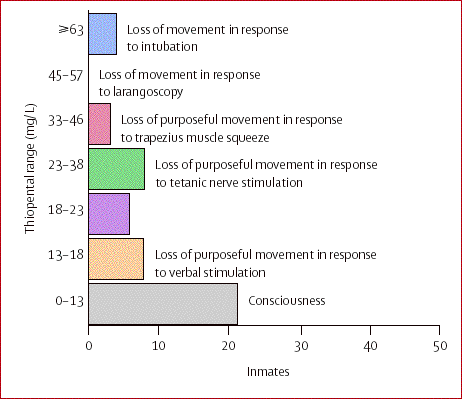
Apr 12, 2005
New York Takes Historic Step Towards Ending the Death Penalty
The Codes Committee of the New York Assembly has voted 11 – 7 against considering legislation to re-instate the death penalty in New York, a decision that likely ends such efforts during this legislative term. Assembly Speaker Sheldon Silver has recently voiced concerns about the death penalty and has shifted his stance away from supporting capital punishment. New York’s current death penalty law was passed in 1995 but declared invalid by a ruling from the state’s highest court last year. While…
Read MoreApr 11, 2005
NEW VOICES: Veteran New York Legislator Now Opposes Death Penalty
Veteran New York legislator John R. Dunne voted for the death penalty 12 times during his tenure in the New York Senate. He then went on to serve as an assistant attorney general at the U.S. Department of Justice. But his concerns about the fairness and accuracy of capital punishment have now resulted in his opposition to the death penalty. In an op-ed appearing in the New York Daily News, Dunne wrote: As a member of the New York Senate from 1966 to 1989, I voted 12 times to establish the…
Read MoreApr 11, 2005
NEW VOICES: New Iraqi President Says Death Penalty is a Problem
The new president of Iraq, Kurdish leader Jalal Talabani (pictured), recently voiced his concerns about the death penalty, even for those accused of war crimes like Saddam Hussein. “I am among the lawyers who signed an international petition against the death penalty in the world and it would be [a] problem for me if Iraqi courts issued death sentences,” Talabini said when asked about the fate of Hussein, who is in U.S. custody in Iraq awaiting trial for war crimes and crimes against humanity.
Read MoreApr 08, 2005
New Resources For Educators Teaching About the Death Penalty
The Death Penalty Information Center has expanded the resources related to its award-winning Educational Curriculum on the Death Penalty. We now offer a listserv for educators who teach about capital punishment, free teacher training workshops, and free brochures for distribution to schools and teachers. Launched in 2000, DPIC’s Educational Curriculum is a balanced Internet-based classroom tool that offers flexible lesson plans, teacher overviews, separate teacher and student curriculum Web…
Read MoreApr 07, 2005
Time Running Out for Access to DNA Testing in Florida
For Florida prisoners, including death row inmates, who were convicted before DNA evidence was routinely tested, the state-imposed October 1 deadline to submit new claims is fast approaching. After that date, evidence may be destroyed and the chance for an exoneration extinguished. Yet the system is seriously backlogged and under-resourced. Noting that Governor Jeb Bush recently stated that any court in Florida or elsewhere would “immediately” review a prisoner’s claim of DNA evidence…
Read MoreApr 06, 2005
Texas Senate Refuses to Give Jurors the Sentencing Option of Life Without Parole
Legislation that would allow those convicted of capital murder to be sentenced to life in prison without parole recently failed to win a key procedural vote in the Texas Senate, largely because of opposition from prosecutors and pro-death penalty organizations who said it would result in fewer death sentences. Although supported by a strong majority of the senators and the people of Texas, the bill needed a 2/3 majority in order to be debated. The Senate’s failure to pass the bill means that…
Read More