The Death Penalty in 2025
Legislation
In 2025, lawmakers across 36 states and in Congress introduced at least 150 death penalty-related bills, marking a threefold increase from 2024. Even excluding Texas, there was a nearly 180% year-over-year increase in the number of death penalty-related bills introduced nationwide. This year, just 17 bills were enacted across 8 states.

In 2025, lawmakers across 36 states and in Congress introduced at least 150 death penalty-related bills, marking a threefold increase from 2024. Even excluding Texas, whose legislature has odd-numbered year sessions, there was still a nearly 180% year-over-year increase in the number of death penalty-related bills introduced nationwide. Despite the increase in legislation, however, very few bills became law. This year, just 17 bills were enacted across eight states.1 Still, this number is nearly double the number of bills enacted in 2024. Death penalty abolition efforts also continued in a dozen death penalty states, and 2025 saw failed efforts to reinstate the death penalty in ten states where it is currently illegal.
Florida enacted the highest number of death penalty-related legislation, with five bills becoming law; four of the five provisions were passed during the state’s regular legislative session. Republican legislators sponsored the majority of enacted legislation, which included the following: five provisions modifying execution protocols; four expanding death eligibility; three modifying the appeals process; two expanding aggravating circumstances; one making death sentences mandatory; one modifying the process and lowering the legal standard for intellectual disability claims; and one modifying the process for determining mental competency for execution.
Enacted Death Penalty Related Legislation
| State | Bill Name | Description | Type | Date Effective |
|---|---|---|---|---|
| Arkansas | HB 1489 | Adds execution by nitrogen gas as an execution method. The bill also extends the secrecy provisions and immunity protection provisions previously applicable to lethal injection executions to include nitrogen gas executions. | Modifies Execution Protocol | August 5, 2025 |
| Arkansas | SB 375 | Creates the offense of capital rape, which includes having sex with a person 13 years or younger. | Expands Death Eligibility | August 5, 2025 |
| California | AB 1071 | Modifies and adds to procedures for relief under the 2020 Racial Justice Act for individuals who have actions pending before the trial or appellate court, who are incarcerated, or post-incarceration. If racial bias is found in an individual’s case, the person is ineligible for the death penalty. | Modifies Appeals Process | January 1, 2026 |
| California | SB 734 | Any individual accused of racial bias or animus under the 2020 Racial Justice Act shall receive notice of the accusation and be given the right to representation during the hearing to question the sufficiency of the evidence against the individual. | Modifies Appeals Process | January 1, 2026 |
| Florida | HB 693 | Expands death-eligible aggravating circumstances to include circumstances where the victim was “gathered with one or more persons for a school activity, religious activity, or public government meeting.” | Expands Aggravating Circumstances | October 1, 2025 |
| Florida | HB 903 | Expands the state’s available method of executions to include any method “not deemed unconstitutional.” | Modifies Execution Protocol | July 1, 2025 |
| Florida | SB 4C | Requires a death sentence for a defendant who is an “unauthorized alien” convicted of a capital felony. | Other | February 13, 2025 |
| Florida | HB 653 | Expands aggravating factors to include whether a capital felony was “committed against head of state,” such as President, Vice President, or Governor, or if in the process of such a crime a capital felony was committed against a separate individual. | Expands Aggravating Circumstances | July 1, 2025 |
| Florida | SB 1804 | Creates the offense of capital sex trafficking. | Expands Death Eligibility | October 1, 2025 |
| Georgia | HB 123 | Provides for pretrial hearings for capital defendants to raise intellectual disability claims; lowers the standard of proof from “beyond a reasonable doubt” to a “preponderance of evidence,” in line with other states. | Limits Death Eligibility | May 13, 2025 |
| Idaho | HB 380 | Expands death-eligible crimes to include lewd conduct with a minor child age 12 or under. | Expands Death Eligiblity | July 1, 2025 |
| Idaho | HB 37 | Makes firing squad the primary method of execution. | Modifies Execution Protocol | July 1, 2026 |
| Louisiana | HB 675 | Modifies procedures related to post-conviction relief, including the timeline for sentence review and requirements for petitions submitted. | Modifies Appeals Process | August 1, 2025 |
| Louisiana | HB 394 | Modifies procedures related to executions, including timeline for the court to reset an execution date following a gubernatorial reprieve or court-granted stay of execution. Removes minimum and maximum number of “other” execution witnesses, instead allowing “other” execution witnesses to be determined by the secretary of the Department of Public Safety and Corrections. | Modifies Execution Protocol | June 8, 2025 |
| North Carolina | HB 307 | Removes the prohibition against electrocution and lethal gas and retains lethal injection as the state’s method of choice; in case lethal injection is deemed unconsititional, adds provisions that allow use of an execution method approved by another state, so long as the U.S Supreme Court has not declared that method to be unconstitutional. Also modifies provisions relating to post-conviction relief and adds the crime occurring while the victim is on public transportation as an aggravating factor | Modifies Execution Protocol (Secondarily Modifies Appeals Processes and Expands Aggravating Factors) | December 1, 2025 |
| Oklahoma | SB 599 | Makes defendants “convicted of forcible anal or oral sodomy, rape, rape by instrumentation, or lewd molestation of a child under fourteen (14) years of age” eligible for a death sentence. | Expands Death Eligiblity | November 1, 2025 |
| Oklahoma | HB 1693 | Modifies the process to determine mental competency for execution, including requiring the trial court to render a decision before the scheduled execution date unless the Court of Criminal Appeals issues a stay of execution. | Other | November 1, 2025 |
Legislation to Modify Execution Protocols, Including Increased Secrecy Provisions
States are increasingly proposing changes to execution protocols. Five states (Arkansas, Florida, Idaho, Louisiana, and North Carolina) enacted legislation to modify their execution protocols, including bills to add new, largely untested execution methods and reintroduce previously abandoned methods. Nineteen bills to modify or augment execution methods were introduced in 14 states, which either failed to be enacted or remain pending.

Nitrogen Gas
Arkansas Representatives Jeff Wardlaw (R) and Blake Johnson (R) introduced HB 1489, which adds suffocation by nitrogen gas as an execution method, on March 18, 2025. The bill passed both chambers of the state legislature by wide margins. Arkansas now joins Alabama, Louisiana, and Mississippi as the fourth state to adopt this execution method. Arkansas Act 302, which became law on August 5, 2025, was promptly met with a lawsuit from a group of 10 death-sentenced prisoners, who argue the new law violates the state constitution’s separation of powers. Both Alabama and Louisiana have used nitrogen gas in executions over the past year, with witnesses reporting serious anomalies during the executions, including signs of pain and distress from the prisoners.
Lawmakers in both Nebraska (LB 432) and Ohio (HB 36) also introduced bills to authorize using nitrogen gas as an execution method, but both bills remain pending.
Firing Squad
Idaho Representative Bruce Skaug (R) sponsored HB 37, which was signed into law on March 12, 2025, making firing squad the state’s primary execution method. The new law, which doesn’t take effect until July 1, 2026, passed by wide margins in both chambers: 58 to 11 in the House and 28 to 7 in the Senate. Although five states now allow executions by firing squad (Idaho, Mississippi, Oklahoma, South Carolina, and Utah), this law makes Idaho the only state to authorize it as its primary, default execution method.
On March 7, 2025, the U.S. had its first firing squad execution in fifteen years with South Carolina’s execution of Brad Sigmon. His lawyer, who witnessed the execution, reported serious concerns about how the new procedure was used. South Carolina subsequently used a firing squad on April 11 to execute Mikal Mahdi. Mr. Mahdi’s lawyers later made public the autopsy report that noted two bullet wounds instead of three, both of which missed Mr. Mahdi’s heart, suggesting his execution was botched. In total, South Carolina carried out the nation’s three firing squad executions this year — the most in a single year since 1976.
Unusually, Indiana started their 2026 legislative session a month early due to calls to consider new congressional maps and tax codes. Introduced by Senator Michael Young (R) on December 8, 2025, SB 11 would allow firing squad to be used if lethal injection drugs are unavailable or if the prisoner specifically requests it.
New Drugs and Pharmaceutical Companies
Tennessee lawmakers introduced bills (SB 0491 / HB 1022) seeking to add pharmaceutical fentanyl as an execution drug. The legislation remains pending.
In Montana, Representative Shannon Maness (R) introduced HB 205 to modify the state’s lethal injection protocol to allow for an “intravenous injection of a substance or substances in a lethal quantity” that is “sufficient to cause death.” The state’s current protocol is more specific and requires the “administration of a continuous intravenous injection of a lethal quantity of an ultra-fast-acting barbiturate in combination with a chemical paralytic agent.” HB 205 failed to pass in the House by a small margin.
Unique bills in Connecticut and Delaware — both states without the death penalty — sought to place restrictions on pharmaceutical companies incorporated in their states whose drugs or equipment may be used in executions. First introduced as SB 430, and later rolled into SB 1355, the Connecticut bill sought to prohibit persons who are licensed, registered or doing business in this state from manufacturing, compounding, selling, testing, distributing, dispensing, or supplying any drug or medical device for the purpose of executing the death penalty. On May 20, 2025, SB 1355 passed the Senate with a vote of 24 to 11, but it failed to receive a vote in the House before the session closed.
Delaware’s HB 61 has similar prohibitions but goes further to create criminal, in addition to civil, liabilities for corporations or other businesses in the state that violate the provisions. For example, HB 61 proposes that if the highest-ranking officer of an entity that “knew or should have known” that the firm’s products would be used “in any capacity” in an execution, then the firm’s charter will be revoked and that officer will be guilty of a class A felony and subject to a civil penalty of up to $50,000. HB 61 was last assigned to the House Judiciary Committee on March 6, 2025. It may be taken up again in January 2026, when Delaware’s two-year legislative session resumes.
“A Method Not Deemed Unconstitutional”
Florida’s HB 903 authorizes the state to use “a method not deemed unconstitutional” if lethal injection and electrocution are unavailable for a variety of reasons. It was signed by Governor Ron DeSantis on May 22, 2025, and went into effect July 1, 2025. In explaining his reasoning for sponsoring the bill, Representative Berny Jacques (R) complained, despite the record high number of executions in Florida this year, that “weak sentencing guidelines and bureaucratic inefficiencies have allowed violent offenders to escape real consequences.” Advocates have expressed concerns that this new provision “greenlights experimental executions.”
Lawmakers in North Carolina approved sweeping changes to their criminal laws, including changes to the state’s execution protocol that echo HB 903 in Florida. Sponsored by Representative Sarah Stevens (R), HB 307, also known as “Iryna’s Law,” retains lethal injection as the state’s primary method of choice but removes the current prohibition against electrocution and lethal gas as execution methods. If lethal injection is deemed unconstitutional, the state may now use an execution method approved by another state, so long as the U.S. Supreme Court has not declared that method to be unconstitutional. The U.S. Supreme Court has never found a method of execution to be unconstitutional. On October 3, 2025, Governor Josh Stein signed HB 307, which went into effect on December 1, 2025.
Secrecy and Transparency
Arkansas HB 1489 expands existing secrecy provisions to prevent public disclosure of information about the individuals involved in nitrogen gas executions or the suppliers of the gas, chemicals, and equipment used in the execution. It became effective August 5, 2025. Ohio’s bill HB 36 also now prohibits the public disclosure of “execution identifying information.”
Louisiana Representative Nicholas Muscarello, Jr. (R) sponsored HB 394, which removes the minimum and maximum number of “other” execution witnesses allowed, instead leaving that determination to the secretary of the Department of Public Safety and Corrections. Governor Jeff Landry signed the bill on June 8, 2025, and it became effective immediately.
Texas bill SB 1690, which would require the state to maintain records and report annually on the drugs stocked by the state to use in executions, including expiration dates, remains pending.
Other states proposed changing the identity of the witnesses who may be present at executions to include, for example, members of the legislature (HB 198 / SB 1214 in Tennessee), the state attorney general (S 0267, S 0308, H 3852 in South Carolina), or a legal representative of the person sentenced to death (HB 207 in Louisiana). None of these provisions have been enacted.
Legislation to Reinstate or Expand Use of the Death Penalty, Including for Non-Homicide Crimes
Bills to reinstate the death penalty were introduced in ten states in 2025, and bills seeking to expand use of the death penalty were introduced in 11 states and in Congress. Three states (Arkansas, Idaho, and Oklahoma) enacted legislation to expand death penalty eligibility to include persons convicted of non-lethal sex-related crimes, despite being directly contrary to controlling Supreme Court precedent. These three states join Florida, which was the first to enact such legislation in 2023, and Tennessee, which enacted similar legislation in 2024. This year, lawmakers in Florida also enacted legislation to create the offense of capital sex trafficking.

Sex Crimes Against Children as Capital Offenses
In Arkansas, Senator Jeremiah Moore (R) introduced SB 375, which creates the offense of capital rape. Capital rape is defined as “sexual intercourse or deviate sexual activity” with a child age 13 or younger. The bill passed with wide margins in both chambers. Governor Sarah Huckabee Sanders signed the bill on April 16, 2025, and it became law on August 5, 2025.
In Idaho, Representative Bruce Skaug (R) introduced HB 380, which specifically makes aggravated lewd conduct with a minor child age 12 or under a death-eligible offense. The bill passed unanimously in the House and nearly unanimously in the Senate. Governor Brad Little signed the bill on March 26, 2025, and it became law on July 1, 2025.
In Oklahoma, Representative Warren Hamilton (R) introduced SB 599, which specifically makes “any person convicted of forcible anal or oral sodomy, rape, rape by instrumentation, or lewd molestation of a child under fourteen (14) years of age” eligible for a death sentence. The bill passed by wide margins in both chambers. Governor Kevin Stitt signed the bill on May 22, 2025, and it became law on November 1, 2025.
In Florida, Representative Jonathan Martin (R) introduced SB 1804, which creates the offense of capital sex trafficking. Governor Ron DeSantis signed the bill on June 19, 2025, and it became law on October 1, 2025.
All of these bills making non-lethal sex crimes or human trafficking death-eligible offenses are contrary to the Supreme Court’s 2008 decision in Kennedy v. Louisiana. Similar bills have been introduced in Alabama, Kentucky, Mississippi, Missouri, Oklahoma, South Carolina, and in Congress.
“Unborn Child” as Victim
Bills in several states have introduced legislation to add an “unborn child” as a victim whose death could result in capital prosecution (e.g., HB 518 in Alabama, HB 1334 in Indiana, and H 3537 in South Carolina). None have been enacted.
Legislation Mandating Death Sentences for Undocumented Persons Convicted of Capital Felonies
The U.S. Supreme Court held in Woodson v. North Carolina (1976) that mandatory death sentences are unconstitutional. Despite this nearly 50-year precedent, Florida lawmakers passed SB 4C during their special legislative session, requiring the courts to impose a death sentence for a defendant who is an “unauthorized alien” and who is convicted of a capital felony. Governor Ron DeSantis signed the bill on February 13, 2025, and it became effective immediately.
Although Florida was the only state to enact legislation requiring mandatory death sentences, other bills targeting undocumented persons were introduced in Pennsylvania (HB 896) and Oklahoma (HB 1307). In Congress, S 1675 and HR 4697 add “illegal aliens” who have “been convicted of killing, attempting to kill, or conspiring to kill a United States citizen” to the list of death-eligible aggravating factors for federal death sentences.

Legislation Expanding Aggravating Factors
North Carolina’s HB 307, which became law on December 1, 2025, added crimes that occur on public transportation as an aggravating factor, following the August 2025 highly publicized killing of Iryna Zarutska, a 23-year-old Ukrainian refugee, on a light rail train in Charlotte.
Lawmakers in Florida also enacted legislation to expand the number of aggravating factors that allow prosecutors to seek a death sentence. In Florida, two bills were enacted. HB 653, effective July 1, 2025, adds a crime “committed against head of state,” such as a President, Vice President, or Governor, or if in the process of such a crime a capital felony was committed against a separate individual, to the state’s list of death-eligible aggravating factors. HB 693, effective October 1, 2025, expands aggravating circumstances to include when a victim was “gathered with one or more persons for a school activity, religious activity, or public government meeting” at the time of the crime.
Legislators in two states (Ohio and North Carolina) and in U.S. Congress introduced legislation to expand aggravating factors to include politically motivated killings. In North Carolina, the entire contents of SB 13, which was originally introduced by Senator Todd Johnson (R) regarding an unrelated matter, was substituted in the House Rules, Calendar, and Operations Committee on September 22, 2025 to include “politically motivated acts of violence.” In Ohio, Representatives Jack Daniels (R) and Josh Williams (R) introduced HB 457 to expand aggravating factors to include a crime motivated by “political affiliation, association, belief, or ideology” and whether the victim was an elected official. In Congress, Senator John Kennedy (R — Louisiana) introduced S 3104 to expand aggravators to include targeting a victim based on “actual or perceived political or religious beliefs, affiliation, expression, or activity” or if the defendant commits a crime with the intent to “promote, retaliate against, influence, protest, or otherwise make a public statement concerning any political or religious belief, practice, institution, group, ideology, event, or public figure.”
Legislation to Abolish or Limit Use of the Death Penalty for Certain Groups
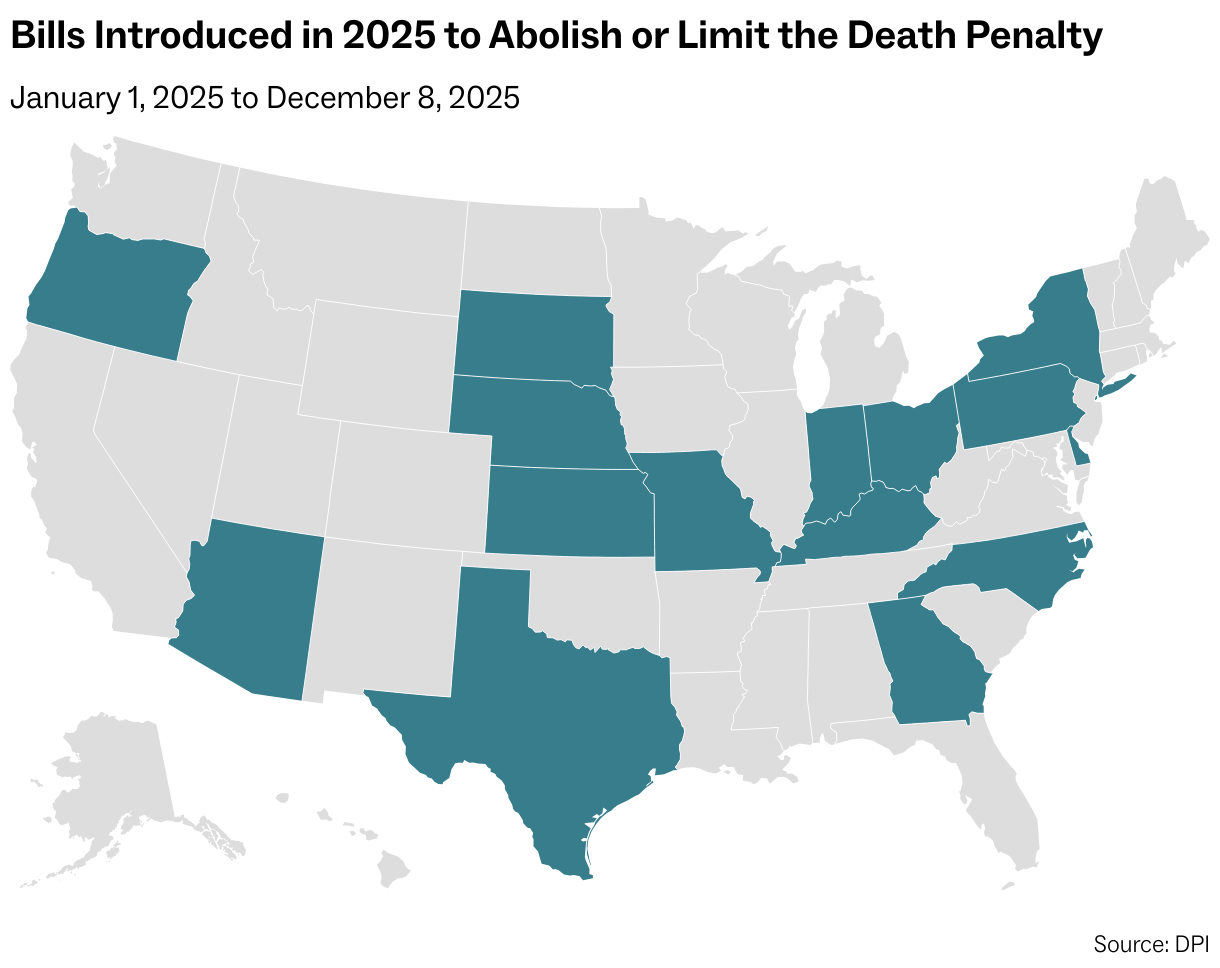
Abolition
Bills seeking to abolish the death penalty were introduced in 12 states with the death penalty (Arizona, Indiana, Kansas, Kentucky, Missouri, Nebraska, North Carolina, Ohio, Oregon, Pennsylvania, South Dakota, and Texas), but none were enacted into law.
Moratoriums on Executions
Legislators in Texas and Oklahoma — the two states with the highest execution totals in the modern death penalty era — introduced bills to pause executions. In Texas, Representative Lauren Ashley Simmons (D) introduced HB 2792 to establish a four-year moratorium from September 1, 2025 to September 1, 2029. HB 2792 would have also required the state to evaluate the cost difference between those sentenced to death and those sentenced to life without parole, as well as the impact of the death penalty on different demographic groups and the families of victims and defendants.
In Oklahoma, Senator Dave Rader (R) introduced SB 601 to create the Death Penalty Moratorium Act and create the Death Penalty Reform Task Force to review the progress of implementing recommendations from the 2017 Report of the Oklahoma Death Penalty Review Commission. In the Oklahoma House, Representative Justin Humphrey (R) similarly introduced HB 1309 to prevent the imposition of new death sentences, vacate all scheduled execution dates, and prevent the setting of new execution dates. Neither bill in Texas nor Oklahoma received a floor vote.
Youth
Legislative efforts were made in Texas and Nebraska to extend the Supreme Court’s 2005 decision in Roper v. Simmons, which held the imposition of the death penalty on juveniles under the age of 18 as unconstitutional, to include young people under the age of 21 (HB 2055) or age 22 (LB 700) at the time of the crime. While HB 2055 in Texas failed to pass, LB 700 in Nebraska remains pending.
Intellectual Disability
Texas legislators introduced bills to codify the U.S. Supreme Court’s 2002 decision in Atkins v. Virginia, where the Court held that executing individuals with intellectual disabilities violated the 8th Amendment’s prohibition on cruel and unusual punishments (HB 688 / SB 432). The legislation failed to move out of committee before the session closed.
A new law sponsored by five Republicans and one Democrat, HB 123 in Georgia, now provides pretrial hearings for capital defendants to raise intellectual disability claims and lowers the standard of proof for those claims from “beyond a reasonable doubt” (the highest standard in the country) to a “preponderance of evidence.” The new law brings Georgia’s legal standard in line with the 26 other states that retain use of the death penalty. Although similar bills have been introduced in the past, none had ever received a committee vote before the legislative session ended.2 This year, HB 123 unanimously passed in the House and nearly unanimously in the Senate on March 31, 2024. Republican Governor Brian Kemp signed the bill on May 13, 2025, effective immediately. Prior to the bill’s passage, no person charged with an intentional homicide in Georgia had been able to meet the state’s burden of proof to demonstrate intellectual disability and therefore be exempted from death penalty eligibility and execution.
Legislation to Modify Death Penalty Appeals Procedures
Lawmakers in eight states (California, Kansas, Louisiana, Missouri, Nebraska, North Carolina, Ohio, and Texas) introduced legislation to modify capital appeals procedures.In addition to HB 307 in North Carolina, three bills — two in California and one in Louisiana — were enacted this year.

Racial Justice
California Governor Gavin Newsom signed two amendments, AB 1071 and SB 734, to the groundbreaking Racial Justice Act (CRJA) that prohibits criminal convictions and sentences based on race, ethnicity, or national origin. Under this law, death-sentenced prisoners are provided meaningful avenues of relief, beyond the reversal of a death sentence, if the state is found to be in violation of these protections. AB 1071 now enables defendants to request disclosure of all evidence relating to the state’s potential violation of CRJA and authorizes the court to order a remedy so long as it is not prohibited by another law. SB 734 allows a public agency from making personnel actions against a public safety officer based on the “underlying acts or omissions” of a CRJA court claim so long as administrative protocol is followed; however, it prohibits the admission of the court finding in the CRJA proceeding during administrative personnel processes.
Shortening Post-Conviction Appeals
North Carolina’s bill HB 307 now establishes strict timelines for pending appeals and motions in capital cases, requiring any filing more than 24 months old to be scheduled for a hearing by December 2026, and no later than December 2027.
Louisiana Representative Brian Glorioso (R) sponsored HB 675, which significantly revises state post-conviction proceedings, including shortening the time for prisoners to submit petitions for relief and for courts to review them. Under HB 675, death-sentenced prisoners must file complete state post-conviction relief applications to the state supreme court within two years of their direct appeal decision or forfeit their right to ever do so. The changes have raised concerns that the new provisions will result in wrongful convictions. The law provides no exceptions for new evidence, including potentially exonerating DNA evidence, and grants the Louisiana Attorney General the authority to file procedural objections to prisoners’ claims and to move to dismiss their petitions. The dramatic shift to delegate authority to the Attorney General is also unusual, as the responsibility was traditionally assigned to the local district attorney. Governor Jeff Landry signed HB 675 on June 20, 2025, and it went into effect on August 1, 2025.
Legislation to Modify the Procedure for Determining Mental Competency
Oklahoma enacted HB 1693, which alters the legal procedures to determine mental competency for execution. Under this new law, prisoners who have been found mentally incompetent to be executed will receive continued treatment and evaluations every six months until competency is restored. “It’s certainly inefficient and a waste of resources,” Professor of Law and Director of the Cornell Death Penalty Project John Blume told The Oklahoman. “Even if this person just barely squeaks over the line in competency, you’re still executing someone who has a long-standing, persistent, severe mental illness, and that is something that’s inhumane.” Governor Kevin Stitt signed HB 1693 on May 9, 2025, and it went into effect November 1, 2025.

