
No Stays Among Rising Number of Executions (47)
The United States Supreme Court denied every request to stay an execution in 2025. Prisoners asked the Court to stay their executions for a variety of reasons, including to review the legality of methods of execution, consider constitutional errors in their cases, and enforce the Court’s own precedent. None were successful. The last time the Court went an entire year without granting a stay of execution was in 2022, and before that, in 2013.
The lack of stays is a departure from previous years when there were a comparable number of executions (2011 and 2012). In 2011, when there were 43 executions, the Court granted six stays to four individuals; in 2012, also with 43 executions, the Court granted two stays of execution.

During the 2010 through 2017 Supreme Court terms, 9% of death-sentenced prisoners received stays of execution. Justice Brett Kavanaugh joined the Court at the beginning of the 2018 term, cementing a 5 – 4 conservative majority, which grew to 6 – 3 with the addition of Justice Amy Coney Barrett in 2020. From the 2018 term through the 2024 term, which ended in early October this year, the Court granted stays of execution to just 4% of applicants. The conservative Court majority has been clear that it disfavors end-stage capital appeals and places great value on achieving “finality” in capital cases — a stance seemingly confirmed by the absence of any execution stays this year.
New research conducted by DPI also shows that a significant percentage of people facing execution do not utilize their final appeal opportunity at the Supreme Court. No final request for a stay of execution was filed for 13 prisoners, out of 47 executed in 2025; only four of these 13 were “volunteers” who waived all final appeals. Since October 2010, at least 85 non-volunteers have been executed without asking the Supreme Court to intervene before their execution — or 21% of all non-volunteers executed during that time.
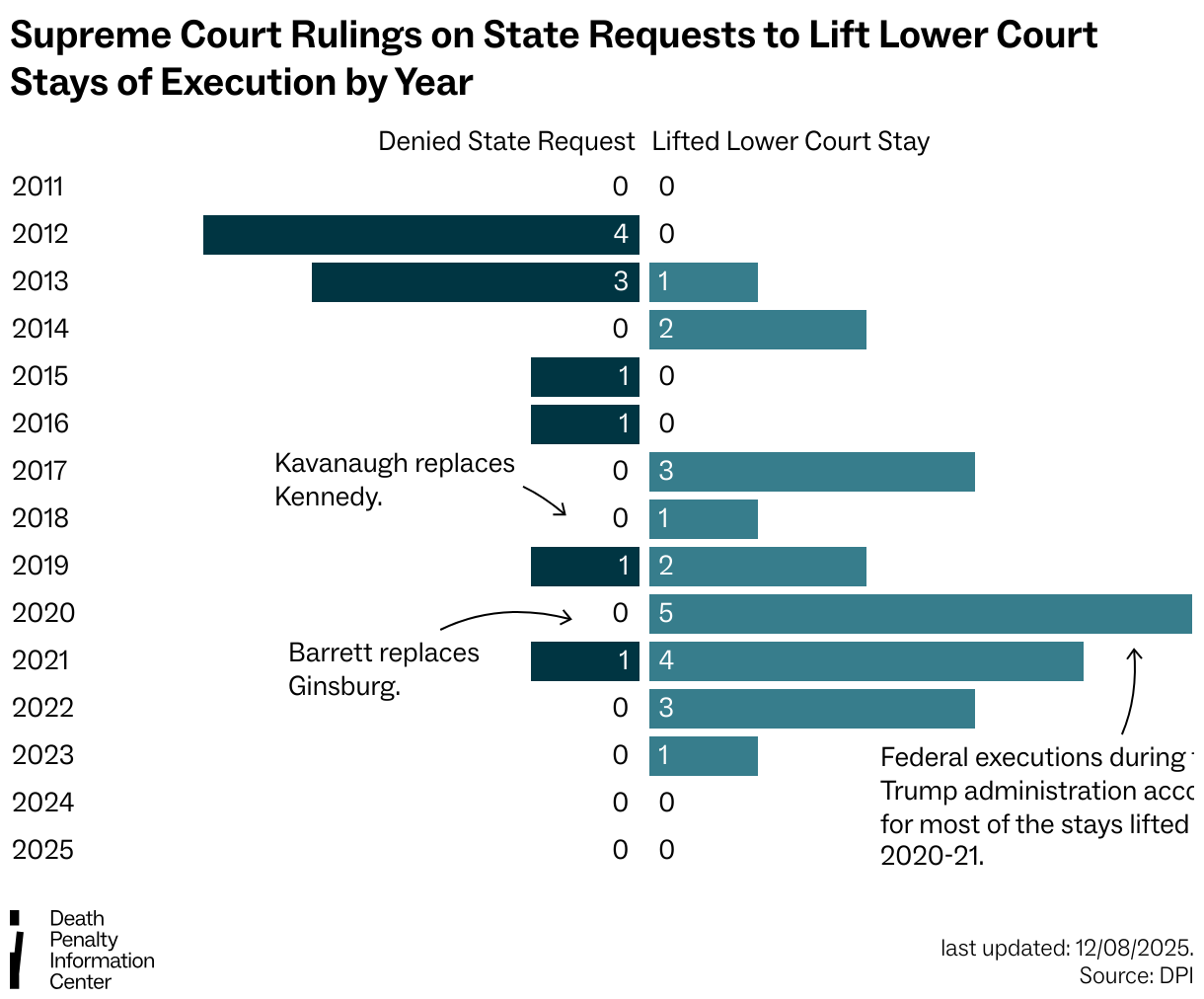
The conservative majority Court has been much more likely to lift lower court stays at the behest of states seeking to proceed with executions. From 2011 to 2017, the Court granted 40% of state requests to vacate a lower court stay. Since Justice Kavanaugh joined the Court in October 2018, however, the Court has lifted 89% of lower court stays on state request — often without explanation. No state made a request to the Court to vacate a stay in 2025.
Capital prisoners have always faced daunting odds whenever they request intervention by the Supreme Court. In 2025, death-sentenced prisoners asked the Court to review constitutional claims in their cases or grant a stay of execution 196 times; the Court agreed just three times (2%). State officials, with many fewer requests, have better chances: the Court granted one of four state requests in capital cases (25%) this past year.
Four Death Penalty Decisions in Favor of Prisoners
The Court decided four capital cases this year, all in favor of prisoners. Last year, the Court ruled against prisoners in all three capital cases it reviewed.1 For the most part, however, this year’s rulings did not rely on, strengthen, or establish new precedent in capital cases regarding eligibility for the death penalty or essential constitutional protections. Instead, the capital prisoners prevailed almost entirely on narrow procedural grounds.
Brenda Andrew: Rare Prisoner Win Highlights Use of Prejudicial, Gender-Specific Evidence

Brenda Andrew
On January 21, the Supreme Court summarily vacated and remanded the appeal of Oklahoma prisoner Brenda Andrew, holding that she properly relied on Payne v. Tennessee (1991) when she argued that the highly sexualized evidence presented by the state in her capital trial was so prejudicial that it violated her Fourteenth Amendment right to due process. At her 2004 trial for the murder of her husband, the prosecution referred to Ms. Andrew as a “slut puppy” in closing arguments, displayed Ms. Andrew’s “thong underwear” to the jury, and offered testimony about how Ms. Andrew often had sex in her car. The prosecution asked witnesses “whether a good mother would dress or behave in the way Andrew had.”
Importantly, the Court did not hold that the government’s behavior violated her due process rights — only that Ms. Andrew was entitled to argue that it did, because prior Court precedent “established a general rule that the erroneous admission of prejudicial evidence could violate due process.” The Tenth Circuit had refused to even consider Ms. Andrew’s argument because it wrongly failed to recognize that principle. Making clear the limits of its holding, the Court’s per curiam decision noted that the “Court today says nothing about the strength of the evidence against Andrew because the issue of prejudice in both the guilt and sentencing phases of the trial is one for the Tenth Circuit to consider.” The Tenth Circuit is now weighing that question on the merits; at oral arguments on remand in June, one judge suggested that the evidence was relevant because “sex is sometimes a very strong motive that causes people to do very bad things.” A decision remains pending.
Ruben Gutierrez and David Wood: Texas Again Rebuked for Refusing to Test DNA
On June 26, the Court ruled in favor of Ruben Gutierrez on a complex procedural question regarding his efforts to secure post-conviction DNA testing of crime scene evidence. Mr. Gutierrez was sentenced to death based on his alleged participation in a robbery-murder but has long maintained that he was outside the trailer where the crime took place and did not know that the victim would be killed. If true, Mr. Gutierrez could still be convicted of first-degree murder but would not be eligible for a death sentence, which can only be imposed in Texas if the defendant “actually caused” the death, “intended to kill” the victim, or “anticipated that a human life would be taken.” Mr. Gutierrez argues that DNA testing of items from the crime scene will show that he was not present in the trailer and bolster his argument that he is ineligible for death.
For nearly fifteen years, prosecutors refused requests to test the evidence because a Texas law known as Article 64 only allows for post-conviction DNA testing when it would undermine a conviction, not just a sentence as in Mr. Gutierrez’s case. He brought a federal civil rights lawsuit arguing that the state had violated due process. A federal district court agreed with Mr. Gutierrez and held the strictness of Article 64 rendered his habeas rights merely “illusory.”

Ruben Gutierrez
But in an unusual decision, the Fifth Circuit Court of Appeals reversed, holding that Mr. Gutierrez did not have standing to bring the lawsuit. Standing requires a “likely remedy,” and the Fifth Circuit concluded that the incalcitrant state prosecutor would refuse to follow the court order, making a remedy both “unlikely” and unavailable.
In reversing the Fifth Circuit, the Supreme Court did not decide the substantive question of whether Mr. Gutierrez is entitled to test the DNA evidence that could remove him from death row. Its ruling was limited to the conclusion that Mr. Gutierrez now has standing to bring a federal civil rights lawsuit to support his quest for post-conviction DNA testing. “That a prosecutor might eventually find another reason, grounded in Article 64 or elsewhere, to deny a prisoner’s request for DNA testing does not vitiate his standing to argue that the cited reasons violated his rights under the Due Process Clause,” Justice Sotomayor wrote for the majority. Mr. Gutierrez’s lawsuit clears the basic procedural threshold and will now be considered on the merits by a Texas court.
Justice Thomas, along with Justice Alito, dissented from the decision. “The Constitution,” Justice Thomas wrote, “does not require any State to establish procedures for state prisoners to challenge the validity of their convictions after trial.” The Supreme Court’s decision, he concluded, “serves no purpose other than to exacerbate the already egregious delays endemic to capital litigation.”
This is not the first time that the Supreme Court has heard appeals based on Texas officials’ refusal to authorize post-conviction DNA testing under Article 64. Texas blocked death-sentenced prisoner Rodney Reed’s federal lawsuit aimed at securing DNA testing, arguing it should be dismissed as untimely. The Supreme Court ruled in 2023 that Mr. Reed’s lawsuit was indeed timely. However, on remand, Texas officials again refused to test the murder weapon, arguing that Mr. Reed doesn’t qualify for Article 64 relief because the statute requires the DNA evidence to be non-contaminated, and — in a twist — the state itself may have contaminated the evidence by handling it in court. Mr. Reed appealed, and his latest petition is now pending at the Supreme Court.
In June, the Supreme Court summarily granted certiorari and remanded David Wood’s case in light of its decision in Gutierrez, but the Fifth Circuit again rejected Mr. Wood’s lawsuit just a month later. DNA testing excluded Mr. Wood from a bloodstain on the clothes of the victim, and he sought Article 64 relief to test other crime scene evidence as well as a sample taken from an alternate suspect. Like for Mr. Reed and Mr. Gutierrez, Texas officials refused to permit testing, and the state’s highest criminal court upheld their refusal in what Mr. Wood characterizes as its “fifteen-year, twenty-three case unbroken string of denying DNA testing appeals.” Mr. Wood’s attorneys filed a new petition at the Supreme Court on November 4.
Richard Glossip: Prosecutorial Misconduct Results in New Trial

Richard Glossip
On February 25, the Supreme Court ruled 6 to 2 in favor of a new trial for Richard Glossip in an unmistakably substantive win. Mr. Glossip’s second time at the Supreme Court focused on his argument that the prosecution withheld material exculpatory evidence at trial, including the star prosecution witness’s diagnosis of bipolar disorder, and knowingly elicited false testimony to support the state’s theory that Mr. Glossip had committed a murder-for-hire. Oklahoma’s Attorney General, in a rare concession, had confessed error in the case, yet Oklahoma’s highest court still denied relief. In an opinion authored by Justice Sotomayor, the Court held that Mr. Glossip was entitled to a new trial based on the prosecutors’ misconduct.
The decision in Glossip is the Court’s first major ruling in favor of a death-sentenced prisoner based on a substantive constitutional trial violation since 2019, when the Court overturned the conviction and death sentence of Curtis Flowers based on racial discrimination in jury selection. All subsequent capital decisions have largely turned on narrow and fact-specific procedural issues or problems regarding the prisoner’s execution procedure. Two summary “shadow docket” decisions dealt with substantive constitutional questions, but neither had the effect of overturning the prisoner’s conviction or sentence.2
Pending Capital Case: Hamm v. Smith
On December 10, the Supreme Court heard oral arguments in Hamm v. Smith regarding Alabama death-sentenced prisoner Joseph Clifton Smith’s claim that he has intellectual disability and cannot be executed. The Eleventh Circuit Court of Appeals affirmed a lower court finding that Mr. Smith was ineligible to be executed, but Alabama state officials appealed the decision. The Supreme Court vacated the decision in November 2024 and asked the Eleventh Circuit to clarify whether it used a “holistic analysis” to evaluate Mr. Smith’s multiple IQ scores alongside other evidence of his cognitive and adaptive functioning, or whether the lower end of the IQ score range was “dispositive.” When the Eleventh Circuit confirmed on remand that it used a holistic approach and again ruled in favor of Mr. Smith, Alabama again appealed.
The Supreme Court granted certiorari on June 6 to determine “whether and how courts may consider the cumulative effect of multiple IQ scores in assessing an Atkins claim.” Alabama argues that the Eleventh Circuit “trampled on the discretion that Atkins left to the States” to set intellectual disability standards, such as Alabama’s rule requiring prisoners to demonstrate by a preponderance of the evidence that they have a “true IQ of 70 or less.” An amicus brief submitted by a group of state attorneys general argued for more latitude, with the Criminal Justice Legal Foundation’s brief arguing that states should be permitted to use “any reasonable definition” for determining intellectual disability.

Multistate Amicus Briefs Criticize Federal Authority to Regulate Death Penalty
On August 11, a group of 19 state elected officials filed an amicus brief in Hamm v. Smith urging the Court to abandon the longstanding “evolving standards of decency” approach to questions of cruel and unusual punishment, and instead embrace an “originalist” approach that forbids only the punishments considered excessive by society at the time of the Constitution’s ratification in 1789. The Court ultimately declined to consider that specific question, but it will likely appear again; the brief was one of many in a yearslong effort arguing for limits to the ability of federal courts to regulate states’ use of the death penalty. Of the 18 capital cases decided by the Court since 2022, 10 have attracted an amicus brief by state attorneys general arguing for increased state sovereignty in capital punishment, including both Glossip and Gutierrez this year. The briefs repeatedly characterize federal court rulings in favor of death-sentenced prisoners as ideological decisions that inappropriately disturb the “finality” of state judgments.

Dissenting Justices Raise Constitutional Concerns
This year, the Court’s denials of review in capital cases once again prompted a number of dissents from the Court’s liberal members.
Refusal to Clarify or Enforce Precedent
The Court rejected the case of Charles Crawford, whose trial attorneys told the jury he was guilty against his express wishes — a seemingly straightforward violation of the Court’s holding in McCoy v. Louisiana (2018). A McCoy violation is a structural error that requires a new trial.3 However, because Mr. Crawford’s conviction became “final” before McCoy, Louisiana courts had refused to give him the benefit of that decision. His attorneys asked the Supreme Court to clarify whether McCoy should be applied retroactively. “Charles Ray Crawford has identified an important constitutional issue that this Court has not addressed and has divided courts around the country,” Justice Sotomayor wrote in dissent from the denial of certiorari, joined by Justices Kagan and Jackson. “The Court refuses to resolve that question, even though a man’s life is in the balance.” Mr. Crawford died by lethal injection in Mississippi on October 15.

Areli Escobar
As in Crawford, the Court refused another opportunity this year to clarify or enforce its own precedent. Areli Escobar won summary relief from the Court in 2023 because the district attorney in his case conceded error. The DA admitted that the prosecution had wrongly relied on compromised forensic evidence analyzed by the scandal-plagued and now-defunct Austin Police Department Crime Lab; later DNA testing was inconclusive. Yet after the Texas Court of Criminal Appeals again ruled against Mr. Escobar on remand, the Supreme Court denied relief on March 23 this year without comment. The case had attracted numerous amicus briefs, including one from a group of former prosecutors and state attorneys general who argued that the “prosecution’s responsibility for confessing error is a solemn one — not undertaken lightly,” and criticized the lower court for its failure to give the concession appropriate weight. They urged the Court to grant certiorari a second time and “again stop this runaway train.” The denial means the question Mr. Escobar asked of the Court remains unanswered: “Whether due process of law requires reversal, where a capital conviction is so infected with errors that the State no longer seeks to defend it.”
“Procedural Thicket” Obstructs Review of Critical Constitutional Issues
During Lance Shockley’s capital trial in Missouri, the jury foreman brought his self-published book to deliberations and showed it to other jurors — a book where the fictional protagonist sought vigilante justice against the perpetrator of a crime that mirrored the crime Mr. Shockley was accused of committing. The jury convicted Mr. Shockley. When the misconduct became known, the trial judge removed the foreman from the jury, but according to Justice Sotomayor, Mr. Shockley’s attorney “inexplicably” declined to call witnesses to support his motion for a mistrial. The same jury then sentenced Mr. Shockley to death.
The question the Supreme Court refused to hear was about Mr. Shockley’s ability to merely appeal his claim that his attorney had been unconstitutionally ineffective. Four federal circuits have held that a death-sentenced prisoner may appeal the decision of the district court so long as one of the three judges on the circuit court’s panel votes to issue a “certificate of appealability” (COA), while five federal circuit courts — including the Eighth Circuit, which heard Mr. Shockley’s case — have interpreted federal law to mean that a majority of the panel must agree to issue a COA. For Mr. Shockley, whose request for a COA was denied 2 to 1, which approach is followed would mean the difference between the end of his appeals and the opportunity for further proceedings. But the Court declined to resolve this clear circuit split.

Lance Shockley
Justice Sotomayor authored the dissent from denial of certiorari on March 31, joined by Justice Jackson. She maintained that adopting a single-judge standard would not only unify lower court practice but would also promote efficiency by encouraging courts to reach the merits of constitutional claims instead of getting mired in procedural disputes. Justice Sotomayor wrote that the court of appeals in Mr. Shockley’s case “plainly erred” when it “treated as not even debatable the District Court’s denial of relief” for ineffective assistance of counsel. Mr. Shockley was executed by Missouri state officials on October 14, 2025.
Stacey Humphreys’ trial in Georgia also involved what Justice Sotomayor termed “extreme juror misconduct.” One juror in Mr. Humphreys’ trial lied to attorneys during voir dire about her own experience as a victim of attempted rape and robbery, “then bullied the other jurors into voting for death based on that prior experience.” After an initial vote of 11 – 1 for life without parole, the juror “yelled, cursed, and screamed that she would ‘stay [t]here till forever if’ that is what it took ‘for [Mr. Humphreys] to get death.’” Her “misconduct appears to have singlehandedly changed the verdict from life without parole to death,” Justice Sotomayor wrote in dissent from the denial of certiorari on October 14, joined by Justices Kagan and Jackson.
Yet like in Mr. Shockley’s case, that underlying claim was “buried in a procedural thicket,” according to Justice Sotomayor. That “thicket” involved Mr. Humphreys’ attorneys’ failure to raise the issue on direct appeal; Georgia’s “no-impeachment rule,” which bars the use of juror testimony to impeach a verdict; and the Eleventh Circuit’s “unclear” application of federal habeas standards to the state court opinions. “In a capital case with a potentially meritorious juror-misconduct claim, mere confusion about a lower court’s reasoning does not justify closing the door to relief altogether,” Justice Sotomayor wrote. “Tragically, the Court denies review instead, allowing a death sentence tainted by a single juror’s extraordinary misconduct to stand.”
Court Grants Review in Case Alleging Jury Race Discrimination
On December 15, the Court granted certiorari in Pitchford v. Cain. The Court will hear oral arguments in 2026 and weigh, under AEDPA, whether the Mississippi Supreme Court unreasonably determined that Terry Pitchford “waived his right to rebut the prosecutor’s asserted race-neutral reasons for exercising peremptory strikes against four [B]lack jurors.” The prosecutor, Doug Evans, is the same prosecutor who unconstitutionally struck dozens of Black jurors across the six capital trials of Curtis Flowers, who won relief from the Supreme Court in 2019 and was later exonerated. The Mississippi Legislative Black Caucus; a group of former prosecutors, attorneys general, and judges; and three of the Black jurors struck in the case had all filed amicus briefs urging the Court to take the case on Mr. Pitchford’s behalf.

Alarm Over Use of Nitrogen Gas
The Court repeatedly refused to consider serious concerns — and growing evidence — about the dangers of using nitrogen gas as an execution method, despite increasingly alarmed dissents.
Jessie Hoffman was the first person scheduled for nitrogen gas execution in Louisiana, and the first to face the method anywhere outside of Alabama. He was also a Buddhist, and “in Buddhist tradition, meditative breathing at the time of death carries profound spiritual significance, founded in the core belief that meditation and unfettered breath at the time of transition from life to death determines the quality of rebirth,” his attorneys wrote. Mr. Hoffman’s defense team argued that executing him by nitrogen gas would violate his religious rights by interfering with that spiritual process. The Supreme Court denied his application on March 18, 2025, and Mr. Hoffman was executed by the state of Louisiana later that day. In a rare dissent from denial of the stay, his first in a capital case since joining the Court in 2017, Justice Gorsuch wrote that the lower court had “no license to declare…whether an adherent has ‘correctly perceived’ the commands of his religion”; he would have remanded the case for the court to properly address Mr. Hoffman’s religious exercise claim.
Historically, tradition dictated that when four justices voted to grant certiorari, a fifth justice would cast a “courtesy vote” to stay the execution. This practice recognized the procedural asymmetry that four votes are required to grant certiorari, but five votes are required to stay an execution. It prevented the dilemma of having a case secure enough legal interest for formal consideration by the Court but not enough to stop the execution. But in Mr. Hoffman’s case, that worst-case scenario is exactly what happened. Four Supreme Court Justices — Sotomayor, Kagan, Jackson, and Gorsuch — voted to grant certiorari and review his religious freedom claim. No courtesy vote, however, was cast to stay his execution.
On October 23, Justice Sotomayor issued a searing dissent from the Court’s denial in Anthony Boyd’s case, joined by Justices Kagan and Jackson. Justice Sotomayor opened by asking the reader to set a timer for four minutes.
Now imagine for that entire time, you are suffocating. You want to breathe; you have to breathe. But you are strapped to a gurney with a mask on your face pumping your lungs with nitrogen gas. Your mind knows that the gas will kill you. But your body keeps telling you to breathe. That is what awaits Anthony Boyd tonight. […] When the gas starts flowing, he will immediately convulse. He will gasp for air. And he will thrash violently against the restraints holding him in place as he experiences this intense psychological torment until he finally loses consciousness.

The dissent acknowledged the signs of distress observed during Alabama’s four previous nitrogen gas executions, including “apparent consciousness for minutes, not seconds; and violent convulsing, eyes bulging, consistent thrashing against the restraints, and clear gasping for the air that will not come.” The justices argued that “when a State introduces an experimental method of execution that superadds psychological terror as a necessary feature of its successful completion, courts should enforce the Eighth Amendment’s mandate against cruel and unusual punishment.”
The dissenting justices could not have anticipated just how long Mr. Boyd’s execution would last that night. Mr. Boyd convulsed against the restraints for over 15 minutes, drawing over 225 “agonized” breaths by the count of a media witness. He was declared dead after 40 minutes, the longest nitrogen gas execution yet.
“Allowing the nitrogen hypoxia experiment to continue despite mounting and unbroken evidence that it violates the Constitution by inflicting unnecessary suffering fails to protect the dignity of the Nation we have been, the Nation we are, and the Nation we aspire to be,” the dissenters concluded.


-
The capital decisions issued by the Supreme Court in 2024 were Thornell v. Jones, Alabama v. Williams, and Hamm v. Smith.
-
In Escobar v. Texas (2023), the Court summarily vacated a lower court ruling and remanded for further consideration in light of the prosecutor’s confession of error. In Andrus v. Texas (2020), the Court summarily vacated a lower court ruling and held that Terrence Andrus had demonstrated his attorney performed deficiently; the Court remanded for consideration of whether that deficient performance prejudiced Mr. Andrus. The lower court ruled against him, and a few months after the Supreme Court denied review of that decision, Mr. Andrus took his own life on death row in 2023.
-
McCoy was the last time before this year’s decision in Glossip that the Court ordered a new trial for a capital prisoner. Typically, even when identifying a major constitutional violation in a capital trial, the Court will reverse the lower court’s decision and remand for further consideration, as in Flowers v. Mississippi (2019). In dissent from the decision in Glossip, Justice Thomas argued that the Court had exceeded its authority by granting a new trial and noted that the remedy was “unusual” and “remarkable.”