Studies
State Studies
The following list is a sample of recent state studies focusing on issues of the death penalty.
Alabama
- The Death Penalty in Alabama: Judge Override (2011) — Study by the Equal Justice Initiative in Alabama exposing the practice of state judges imposing death sentences by overriding a jury’s recommendation for life.
- Alabama Death Penalty Assessment (2006) — Study by the American Bar Association’s Death Penalty Moratorium Implementation Project found that Alabama’s death penalty failed to meet fundamental ABA standards of fairness and accuracy.
- Broken Justice: The Death Penalty in Alabama (2005) — Study by the American Civil Liberties Union (ACLU), showing how structural and procedural flaws in Alabama’s criminal justice system stack the deck against fair trials and appropriate sentencing for those facing the death penalty.
Arkansas
- Racial Sentencing Patterns in Arkansas (2008) — A study by University of Iowa law professor David Baldus of the death penalty in Arkansas showing racial patterns in sentencing.
Arizona
- Arizona Death Penalty Assessment (2006) — Study by the American Bar Association’s (ABA) Death Penalty Moratorium Implementation Project determining that Arizona’s capital punishment laws are plagued with serious problems.
California
- California Cost Study 2011 — DPIC summary of “A roadmap to mend or end the California legislature’s multi-billion dollar death penalty debacle” from Loyola of Los Angeles Law Review by Judge Arthur L. Alarcon & Paula M. Mitchell.
- California’s Death Penalty is Dead (2011) — Study by the ACLU of Northern California catalogs numerous intractable problems and waning public support which may lead to the end of capital punishment in the state.
- Death in Decline ’09 (2009) — A study by the ACLU of Northern California revealing that only three counties (Los Angeles, Orange, and Riverside) accounted for 83% of the state’s death sentences in 2009.
- The Hidden Death Tax (2009) — A study by the ACLU of Northern California on the costs of the death penalty found additional expenses due to a net increase in the size of death row.
- Death by Geography (2008) — A study by the ACLU of Northern California examining the variation among California counties in seeking the death penalty.
- The Impact of Legally Inappropriate Factors on Death Sentencing for California Homicides, 1990 – 1999 (2005) — A study by G. Pierce & M. Radelet published in the Santa Clara Law Review finding that the race of the victim in the underlying murder greatly affected whether a defendant would be sentenced to death.
Colorado
- Colorado Capital Punishment: An Empirical Study (2013) — Conducted by law professors Justin Marceau and Sam Kamin of the University of Denver and Wanda Foglia of Rowan University found that the death penalty in Colorado is applied so rarely as to render the system unconstitutional. The authors concluded that Colorado’s death penalty law is applicable to almost all first-degree murders, but is imposed so infrequently that it fails to provide the kind of careful narrowing of cases required by the Supreme Court in Furman v. Georgia (1972). In this groundbreaking study, the researchers reviewed all first-degree murder cases in the state between 1999 and 2010. They found that 92 percent of the 544 first-degree murder cases in that time span contained at least one aggravating factor that made the defendant eligible for the death penalty. However, prosecutors filed notices of intent to seek the death penalty in only 15 murder cases and pursued the death penalty at trial in only five of those cases — a 1% rate among death-eligible cases. The authors wrote, “Under the Colorado capital sentencing system, many defendants are eligible but almost none are actually sentenced to death. Because Colorado’s aggravating factors so rarely result in actual death sentences, their use in any given case is a violation of the Eighth Amendment.”
Connecticut
- Arbitrariness in Death Cases (2011) — Study by Professor John Donohue of Yale University’s School of Law of death sentences in Connecticut finding that seeking the death penalty often correlated with the race of the victim and the defendant, and not necessarily with the severity of the crimes.
Delaware
- The Delaware Death Penalty: An Empirical Study (2012) — A five-year study of the operation of Delaware’s death penalty by Cornell law school.
Florida
- The Death Penalty in Florida (2009) — An evaluation of Florida’s death penalty by Christopher Slobogin, Professor of Law and Psychiatry at Vanderbilt University.
- Florida Death Penalty Assessment (2006) — Study by the American Bar Association of Florida’s death penalty system.
Georgia
- A Matter of Life and Death (2007) — Study by the Atlanta Journal-Constitution of Georgia’s use of the death penalty finding that “getting the death penalty in Georgia is as predictable as a lightning strike.”
- Georgia Eyewitness Identification Procedures (2007) — Study by the Georgia Innocence Project revealing that 83% of Georgia police agencies have no written rules on handling eyewitness identifications.
- Georgia Death Penalty Assessment Report (2006) — Study by the American Bar Association Death Penalty Moratorium Implementation Project found that Georgia’s death penalty fails to meet 43 ABA standards for improving the fairness and accuracy of the death penalty.
- Thirty Years Analysis of Death Penalty Cases in Georgia (2005) — Study by the Georgia Public Defender Standards Council analyzing death penalty cases in the state from 1973 — 2003.
Illinois
- Illinois Capital Reform Study Committee Final Report (2010) — Sixth and final report of the committee created by the state legislature in 2003 and headed by Thomas P. Sullivan, a former U.S. Attorney.
- Illinois Commission on Capital Punishment (2005) — Study by the Commission, aiming to address problems Illinois Governor George Ryan identified two years prior, including potential safeguards to prevent the possible conviction and execution of innocent inmates.
Indiana
- Indiana Death Penalty Cost Study (2010) — A state analysis of the costs of the death penalty in Indiana finding the average cost to a county for a trial and direct appeal in a capital case to be over ten times more than a life-without-parole case.
- Indiana Death Penalty Assessment (2007) — Study by the American Bar Association calling for a halt to executions in the state because of concerns about the arbitrariness of the state’s death penalty.
Kansas
- Kansas Judicial Council Death Penalty Advisory Committee Report (2014) — Study by the committee examining the state’s application of capital punishment and the hefty price tag of seeking the death penalty.
- Kansas Cost Study (2003) — Study by the Kansas government detailing the disparity in cost between death penalty cases and non-death penalty cases in Kansas.
Kentucky
- Kentucky Assessment on the Death Penalty (2011) — ABA study analyzing various laws, rules, procedures, standards, and guidelines relating to the administration of capital punishment in Kentucky.
Louisiana
- Diminishing All of Us: The Death Penalty in Louisiana (2012) — A recent study published by the Jesuit Social Research Institute of Loyola University pointed to numerous problems with Louisiana’s death penalty.
- Death Sentencing in East Baton Rouge Parish, 1990 – 2008 (2011) — A study conducted by Professors Glenn Pierce and Michael Radelet published in the Lousiana Law Review showing that the odds of a death sentence in parts of Louisiana were 2.6 times higher for those charged with killing a white victim than for those charged with killing a black victim.
Maryland
- Maryland Commission on Capital Punishment Report (2008) — Study by the legislative commission established to examine the death penalty in Maryland recommending abolition of the punishment.
- Maryland Cost Study (2008) — Study by the Urban Institute detailing the disparity in cost between death penalty cases and non-death penalty cases in Maryland.
Missouri
- Missouri Death Penalty Assessment (2012) — Study by the American Bar Association’s (ABA) Death Penalty Moratorium Implementation Project determining that Missouri’s capital punishment laws are plagued with serious problems.
- Missouri Death Penalty and Geography (2008) — Study by Prof. David Sloss of the St. Louis University School of Law showing that the chance of a death sentence appears to rest on what part of the state the crime was committed in.
- Life and Death Decisions: Prosecutorial Discretion and Capital Punishment in Missouri (2008) — A study by Katherine Barnes of Arizona University Law School, and David Sloss and Stephen Thaman of St. Louis Univeristy Law School, studying 1046 cases of intentional homicide in Missouri to determine geographical and racial effects in the rates at which prosecutors seek the death penalty.
Nevada
- Nevada Cost Study 2012 — A study by Dr. Terance Miethe of the Department of Criminal Justice at the University of Nevada on the costs of the death penalty in Nevada.
New Hampshire
- Majority Report of the Commission to Study the Death Penalty in New Hampshire (2010) — A study by a New Hampshire commission evaluating the use of the death penalty within the state.
New Mexico
- The Application of the Death Penalty in New Mexico, July 1979 through December 2007: An Empirical Analysis (2008) — A study by attorney Marcia Wilson revealing information on how the death penalty was applied in New Mexico after its reinstatement.
North Carolina
- Race Discrimination in Jury Selection and Non-Enforcement of Batson in North Carolina (2016) — A study by appellate lawyers Daniel R. Pollitt and Brittany P. Warren found that, despite pervasive evidence that North Carolina prosecutors disproportionately employed peremptory strikes to exclude black jurors, the state’s courts have persistently refused to enforce the constitutional prohibition against race-based jury strikes. In 114 cases in which Batson issues were decided on the merits, North Carolina appeals courts never found any substantive Batson violation where a prosecutor had articulated a reason for the peremptory challenge of a minority juror. In the 74 cases in which it had decided Batson claims on the merits, the Supreme Court of North Carolina had never once found a substantive Batson violation.
- The Death Penalty in North Carolina: A Summary of the Data and Scientific Studies (2011) — A comprehensive review of studies on the death penalty by Matthew Robinson, Professor of Government and Justice Studies at Appalachian State University.
- Excessive Sentencing in North Carolina (2010) — A study by Professor Frank Baumgartner showed that most of those originally condemned to death in North Carolina eventually received lesser sentences when their cases were concluded.
- Racial Bias Study (2010) — A study by Professors Michael Radelet and Glenn Pierce found that the odds of a defendant receiving a death sentence in North Carolina were three times higher if the person was convicted of killing a white person than if he had killed a black person.
- Potential Savings from Abolition of the Death Penalty in North Carolina (2009) — A study published by a Duke University economist revealing that North Carolina could save $11 million annually if it dropped the death penalty.
- The High Cost of the Death Penalty (2009) — A study by the Independent Weekly showing that North Carolina conservatively spent at least $36 million dollars by seeking the death penalty instead of life in prison without parole over a seven year span.
- Mental Illness and the Death Penalty in North Carolina: A Diagnostic Approach (2007) — Study by the Charlotte School of Law revealing that obstacles entrenched within the criminal justice system impede efforts to identify those with severe mental illness and treat them fairly.
- Death Row Injustices (2006) — Study by the Common Sense Foundation of North Carolina finding that at least 37 people on death row had trial lawyers who would not have met minimum standards of qualification at the time of the study.
- Race and the Death Penalty in North Carolina An Empirical Analysis: 1993 – 1997 (2001) — A study by Professor Jack Boger and presented by The Common Sense Foundation North Carolina Council of Churches.
Ohio
- Report of Task Force Appointed by the Chief Justice of the Ohio Supreme Court (2014) The Task Force announced 56 recommendations for changing the death penalty, including:
- Require higher standards for proving guilt if a death sentence is sought (such as DNA evidence)
- Bar the death penalty for those who suffer from “serious mental illness”
- Lessen the number of crimes eligible for the death penalty
- Create a Death Penalty Charging Committee at the Attorney General’s Office to approve capital prosecutions
- Adopt a Racial Justice Act to facilitate inequality claims in Ohio courts.
- Ohio Death Penalty Assessment Report (2007) — Study by the American Bar Association stating that Ohio’s capital punishment system is so flawed that it should be suspended while the state conducts a thorough review of its fairness and accuracy.
- AP Ohio Study (2005) — Study by the Associated Press of 1,936 indictments reported to the Ohio Supreme Court by Ohio counties with capital cases from October 1981 through 2002 finding that capital punishment has been applied in an uneven and often arbitrary fashion.
Oregon
- Fair Punishment Project (2016) — Analysis of case records, media reports, and opinions of Oregon legal experts by Harvard University’s Fair Punishment Project ofinding that two-thirds of the 35 people on Oregon’s death row have serious mental illness or intellectual impairment, experienced severe childhood trauma, or were under age 21 at the time of the offense.
- Oregon’s Death Penalty: A Cost Analysis (2016) — Study by Lewis & Clark Law School Prof. Aliza B. Kaplan, Seattle University criminal justice Prof. Peter Collins, and Lewis & Clark law candidate Venetia L. Mayhew examined the costs of hundreds of aggravated murder and murder cases in Oregon finding that the average trial and incarceration costs of an Oregon murder case that results in a death penalty are almost double those of a murder case that results in a sentence of life imprisonment or a term of years, and that, excluding state prison costs, cases that result in death sentences may be three to four times more expensive.
Pennsylvania
- In Life and Death, Costly Mistakes (2011) — Study by the Philadelphia Inquirer of death penalty appeals in Pennsylvania spanning three decades, finding a pattern of ineffective assistance by defense attorneys.
- Report of the Advisory Committee on Wrongful Convictions (2011) — A study by the Pennsylvania Advisory Committee on Wrongful Convictions identifying the most common causes of wrongful convictions and any current laws and procedures implicated in each type of causation.
- Facts about Pennsylvania’s Death Penalty (2009) — Study by the Associated Press showing the state goes through the expensive and time-consuming process of trying many death penalty cases and fighting appeals, but almost all cases end with a life sentence.
- Pennsylvania Death Penalty Assessment Report (2007) — Study by the American Bar Association (ABA) showing that flaws in Pennsylvania’s death penalty system are so pervasive that the state risks executing an innocent person.
- Pennsylvania Supreme Court Committee on Racial and Gender Bias in the Justice System (1999) — Study by the Committee, making a series of 23 recommendations to the Pennsylvania Supreme Court, to the Legislature, to the state’s Attorney General and District Attorneys, and to Governor Ed Rendell.
South Carolina
- Removal of African Americans and Women in Jury Selection in South Carolina Capital Cases, 1977 – 2012 (2016) — Study by Professor Ann M. Eisenberg of the University of South Carolina of jury selection in 35 South Carolina homicide cases between 1997 and 2012 that resulted in death sentences, reviewing the strikes or acceptance of more than 3,000 venire members for gender and more than 1,000 veniremenbers for race. The study found that prosecutors exercised their peremptory strikes at nearly triple the rate against African-American prospective jurors than against white prospective jurors and that the death-qualification process further impeded a substantial number of African-American jurors from serving, contributing to an overrepresentation of whites on death penalty juries. The gender study showed that, while men and women were excused for cause at comparable rates, both were struck more for views against the death the death penalty than for pro-death penalty views and women were 3.8 times more likely to be excluded for opposing the death penalty than for pro-death penalty views. Women were 1.4 times more likely to be struck for cause for opposing the death penalty than men and men were 2.3 times more likely to be struck than women for being unable to consider a life sentence. Prosecutors were 1.4 times more likely to peremptorily strike a woman than a man, and defense lawyers were 1.4 times more likely to peremptorily strike a man than a woman.
- The Effect of Race, Gender, and Location on Prosecutorial Decision to Seek the Death Penalty in South Carolina (2006) — Study of homicide cases in South Carolina by Professor Isaac Unah of the University of North Carolina-Chapel Hill and attorney Michael Songer finding that prosecutors were more likely to seek the death penalty when the victim in the underlying murder was white, if the victim was female, and when the crime occurred in a rural area of the state.
Tennessee
- Tennessee’s Death Penalty Lottery (2018) — An examination of every first-degree murder case in Tennessee from 1977 – 2017 found that the facts of the crime did not predict whether a death sentence would be imposed. Rather, the best indicators were arbitrary factors such as where the murder occurred, the race of the defendant, the quality of the defense, and the views of the prosecutors and judges assigned to the case.
- Tennessee Legislative Study Committee Recommendations (2009) — A 16-month analysis of the state’s capital punishment process by the committee with recommendations for achieving a more fair and accurate system
- Tennessee Death Penalty Assessment (2007) — Study by the ABA detailing racial and geographic disparities in capital cases, poorly trained defense attorneys, heavy caseloads for those representing defedants, and inadequate procedures to address innocence claims.
Texas
- Texas Death Penalty Assessment Report (2013) — Study by the ABA focusing on the fairness and accuracy of the death penalty system in Texas.
- Regulating Death in the Lone Star State (2011) — A study by the ACLU of Texas and Northwestern University’s Center for International Human Rights revealing that procedures for euthanizing animals in the state are more carefully regulated than the protocol for executing death row inmates.
- What’s Messing with Texas Death Sentences? (2011) — A study analyzing the decline of death sentencing in Texas by David McCord.
- Convicting the Innocent: Texas Justice Derailed (2009) — A study by The Justice Project analyzing the cases of 39 innocent Texans who collectively spent more than 500 years in prison for crimes they did not commit.
- Too Much Cruelty, Too Little Clemency (2009) — A study by Amnesty International examining many of the nearly 200 executions that have occurred during Governor Rick Perry’s term in office.
- Legal Disparities in the Capital of Capital Punishment (2009) — A study that reveals disparities in who receives the death penalty in Texas by Scott Phillips, a professor at the Department of Sociology and Criminology at the University of Denver.
- Status Disparities in the Capital of Capital Punishment (2009) — A study by Scott Phillips, a sociology and criminology professor at the University of Denver, published in the Law & Society Review focusing on the imposition of death sentences in relation to the victim’s social status.
- Racial Disparities in the Capital of Capital Punishment (2008) — A study by Prof. Scott Phillips of the University of Denver exploring the relationship of race to death sentencing in Harris County (Houston), Texas.
- A New Look at Race When Death Is Sought (2008) — A study by Professor Scott Phillips of the University of Denver found that black defendants in Houston, Texas, are more likely to be sentenced to death than white defendants, even when other variables are accounted for.
- Eyewitness Identification Procedure in Texas (2008) — A study by the Justice Project concerning criminal justice procedures in Texas.
- Mental Illness and Executions in Texas (2007) — Study conducted by the National Alliance on Mental Illness (NAMI) has revealing that Texas is almost last among states in spending on mental health services and performs poorly in other mental health areas, while executing many inmates with serious mental illness.
- Minimizing Risk, A Blueprint for Death Penalty Reform in Texas (2005) — Study by the Texas Defender Service calling for substantial changes in the way Texas handles capital murder cases.
- A State of Denial: Texas Justice and the Death Penalty (2000) — A study by the Texas Defender Service.
Virginia
- Virginia Death Penalty Assessment Report (2013) — Study by the ABA focusing on the fairness and accuracy of Virginia’s death penalty system.
- A Vision for Justice (2005) — Study by the Innocence Commission for Virginia of 11 wrongful conviction cases in Virginia finding that mistaken eyewitness identification is the major reason innocent people have been convicted in the state.
- Virginia Crime Lab Audit (2005) — Study by the American Society of Crime Laboratory Directors finding that the Virginia lab’s internal review process was flawed and that labs had botched DNA tests.
Washington
- Washington State Bar Report (2006) — Study by the Death Penalty Subcommittee of the Committee on Public Defense of the Washington State Bar on the state’s death penalty.
Latest
Jul 24, 2024
New Study Finds Evidence of Racial Bias in California Death Sentences As Resentencings Begin in Cases Tainted by Discriminatory Jury Selection
As Alameda County District Attorney Pamela Price seeks to remedy her office’s history of discriminatory jury selection, an study published in the 2024 Journal of Empirical Legal Studies by Catherine M. Grosso, Jeffrey Fagan, and Michael Laurence finds empirical evidence that the race of the defendant and the race of the victim affect the likelihood of a death sentence being imposed in California. “The Influence of the race of defendant and the race of victim on capital charging and sentencing…
Read More
Feb 16, 2024
Black History Month Profile Series: Jennifer Eberhardt
This month, DPIC celebrates Black History Month with weekly profiles of notable Black Americans whose work affected the modern death penalty era. The second in the series is Professor Jennifer Eberhardt. Jennifer Eberhardt, a professor of Psychology at Stanford University and a recipient of a MacArthur “genius grant,” studies the relationship between race and sentencing. Her book, Biased: Uncovering the Hidden Prejudice That Shapes What We See, Think, and Do, uncovers implicit biases in all…
Read More
Feb 28, 2023
NEW RESOURCES: Interactive Display Illustrates Conditions on Death Row
A joint research project begun by two Texas universities illustrates the confinement conditions of death-row prisoners, including areas such as visitation, health care, attorney visits, recreation, food, and opportunities for work. The Capital Punishment & Social Rights Research Initiative has created an initial infographic describing the conditions in Texas. The project includes qualitative research on death row conditions, as well as firsthand accounts from prisoners. Anthony Medina, a Texas…
Read More
Sep 30, 2022
Report: Black People 7.5 Times More Likely to Be Wrongfully Convicted of Murder than Whites, Risk Even Greater if Victim was White
Black people are about 7½ times more likely to be wrongfully convicted of murder in the U.S. than are whites, and about 80% more likely to be innocent than others convicted of murder, according to a new report by the National Registry of Exonerations. The already disproportionate risk of wrongful conviction, the Registry found, was even worse if the murder victim in a case was white. The report, Race and Wrongful Convictions in the United States 2022, reviewed the cases of 3,200 innocent…
Read More
Sep 23, 2022
North Carolina ACLU Challenges Death Qualification of Jurors as Racially and Sexually Discriminatory
Lawyers for a North Carolina capital defendant have filed a sweeping challenge to the method by which death-penalty jurors are empaneled, arguing that the combination of a process known as “death qualification” and discretionary jury strikes produces a jury so racially and sexually unrepresentative that it violates a defendant’s right to a fair trial. Death qualification refers to the process of removing potential jurors from service in a capital case because of their expressed opposition to…
Read More
Sep 12, 2022
As the Lone Star State Conducts 400th White-Victim Execution, Study Shows Black Lives Matter Less in Texas Capital Cases
A new study of the Texas death penalty, released as the state was conducting its 400th modern-era execution in a case involving a white victim, has documented overwhelming racial disparities in the Lone Star state’s capital punishment system. Reviewing more than 15,000 capital murder convictions in Texas from 1973 to 2018, University of Detroit Mercy School of Law Dean Jelani Jefferson Exum (pictured left) and University of Cincinnati School of Public and International Affairs Associate…
Read More
Aug 29, 2022
Report: Racial Disparities in Death Sentences Imposed on Late Adolescent Offenders Have Grown Since Supreme Court Ruling Banning Juvenile Death Penalty
Racial disparities in U.S. death sentences imposed on late adolescent offenders have grown substantially since the U.S. Supreme Court struck down the use of capital punishment against juvenile offenders in 2005, according to a new report by University of North Carolina political scientist Frank R. Baumgartner (pictured). Baumgartner’s report, Race and Age Characteristics of those Sentenced to Death before and after Roper, released on June 21, 2022 reviewed death sentences imposed on more than…
Read More
Jul 20, 2022
New DPIC Podcast: The Death Penalty Census
Data from fifty years of the modern U.S. death penalty reveal “a system that is rife with error, filled with discrimination, [and] very, very difficult to fairly administer,” Death Penalty Information Center Executive Director Robert Dunham says in the July episode the Discussions with DPIC podcast. The episode, a discussion between Dunham and 2021 – 2022 DPIC Data Fellow Aimee Breaux about the launch of DPIC’s groundbreaking Death Penalty Census database, was released July 20, 2022. The Death…
Read More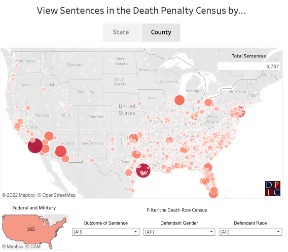
Apr 04, 2022
New DPIC Podcast: Prof. Meredith Rountree on What Influences Death Penalty Jurors’ Moral Decision Making
In the March 2022 episode of Discussions With DPIC, Northwestern Pritzker School of Law Senior Lecturer Meredith Rountree speaks with Death Penalty Information Center Executive Director Robert Dunham about her study of the types of evidence that influence juror decision-making at the sentencing stage of capital cases. Rountree and her co-author Dr. Mary Rose of the University of Texas, reviewed and analyzed 176 verdict forms completed by juries in federal death penalty cases, focusing on three…
Read More
Jan 13, 2022
New Study: Kentucky Death Penalty Racially Biased, Arbitrary, Error Prone
Kentucky’s death penalty is racially discriminatory, geographically arbitrary, and riddled with systemic flaws, a new study of the commonwealth’s use of capital punishment has found. The study, A Statistical Overview of the Kentucky Death Penalty, by University of North Carolina political scientist Frank R. Baumgartner, examined Kentucky’s use of the death penalty from 1975, when its current system was implemented, to the present. Prof. Baumgartner released his analysis of the results on…
Read More