
[W]hile [a prosecutor] may strike hard blows, he is not at liberty to strike foul ones. It is as much his duty to refrain from improper methods calculated to produce a wrongful conviction as it is to use every legitimate means to bring about a just one.
Overview
Prosecutors wield enormous power in the death penalty system. That power is susceptible to abuse, as evidenced by the numerous death penalty cases that have been reversed as a result of misconduct by prosecutors and police. Official misconduct is a leading cause of the wrongful murder convictions associated with death-row exonerations.
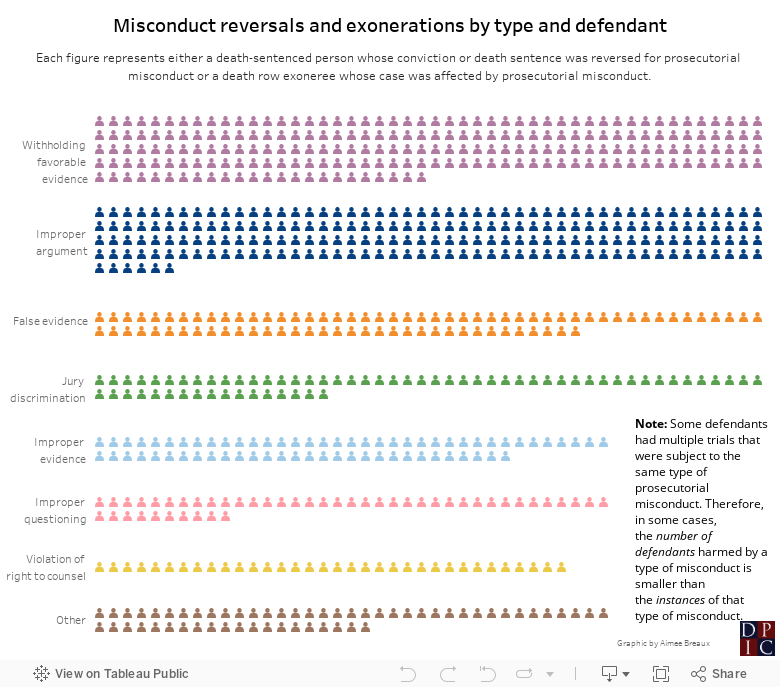
Prosecutorial misconduct can take many forms. The most well-publicized type of misconduct involves the withholding of potentially exculpatory evidence, in violation of the U.S. Supreme Court case, Brady v. Maryland. It can also encompass the exclusion of people of color from juries, in violation of Batson v. Kentucky. All-white and nearly all-white juries have been found to be more conviction-prone and more likely to impose death sentences.
Misconduct can also taint the evidence presented in a case, especially when witnesses are coerced or threatened into testifying, or when prosecutors knowingly present false witness testimony or false or inflammatory argument to the jury. Prosecutors are required to disclose any benefits offered to witnesses, including promises of reduced charges or sentences or other favorable treatment. They can violate the defendant’s rights and deprive the jury of needed information by withholding this information.
At Issue
While a growing number of prosecutors’ offices have begun to address misconduct through reform measures and conviction integrity units, misconduct continues to affect a significant number of cases. Many defendants who were convicted or sentenced to death as a result of undisclosed or unredressed misconduct have already been executed, and others face the difficult task of convincing a court not only that misconduct took place, but that it was harmful to their case. By its nature, much prosecutorial misconduct — especially Brady violations — involves concealment, and ongoing attempts to keep the misconduct hidden mean that defendants lack the evidence to prove that their convictions were unconstitutionally obtained through improper means.
What DPIC Offers
DPIC has compiled resources and studies from academic researchers and organizations like the Columbia Law School Broken System study, the Habeas Assistance Project, the Fair Punishment Project, and the National Registry of Exonerations. DPIC’s groundbreaking 2013 report, The 2% Death Penalty, highlights some of the ways in which overuse of capital punishment is linked to prosecutorial overreach and misconduct.
DPIC has identified more than 600 prosecutorial misconduct reversals and exonerations in capital cases. This means that more than 6.3% of all death sentences imposed since 1972 have been reversed for prosecutorial misconduct or resulted in a misconduct exoneration. This group of cases provides only a glimpse of the prosecutorial misconduct that occurs in the death penalty context. The list does not include cases in which prosecutors committed misconduct but courts denied relief on grounds of supposed immateriality or harmless error. It also does not include misconduct reversals of capitally charged crimes that resulted in life sentences.
For more information on the cases included in this dataset, see DPIC’s background document here. See a list of the cases here. We welcome any additions or corrections. To correct an error or provide missing information, please notify us by email and send documentation of the correct information to prosecutorial-accountability@deathpenaltyinfo.org.
News & Developments
News
Oct 06, 2026
Justin Wolfe, Former Virginia Death Row Prisoner, Released on Plea Deal After Federal Court Found Significant Prosecutorial Misconduct

Justin Wolfe (pictured, center, with his mother and uncle) was released from prison on September 28, 2026 after pleading guilty to marijuana distribution and entering an Alford plea on charges of solicitation of robbery. He had been sentenced to death nearly 25 years ago for the murder-for-hire of Daniel Petrole, Jr., his marijuana supplier. Owen Barber IV, who admitted to shooting Mr. Petrole, had implicated Mr. Wolfe in order to avoid a death sentence himself. Mr. Barber later recanted his…
Read MoreNews
Sep 28, 2026
Texas Court of Criminal Appeals Refuses to Grant Relief to Melissa Lucio, Despite Trial Court’s Finding of Actual Innocence
Nearly two years after District Judge Arturo Nelson declared Texas death-sentenced prisoner Melissa Lucio “actually innocent,” the Texas Court of Criminal Appeals (TCCA) refused to accept the recommendation of the lower court to overturn her conviction. A closely divided TCCA declined “to adopt any of the habeas court’s findings and conclusions,” which the majority of the court wrote “exclusively reflect [Ms. Lucio’s] interpretation of the evidence and are often unsupported.” In its 5 – 4…
Read More
News
Sep 11, 2026
Set for Execution in Georgia September 16, Stacey Humphreys’ New Appeals Highlight Clemency Conflict of Interest, Juror Misconduct
For the second time in less than a year, Stacey Humphreys faces execution in Georgia. His initial execution date last December was postponed when a state court agreed that a member of the clemency board had a conflict of interest. Now the state has set his execution for September 16, arguing the problem has been resolved because the board member recused herself — even though no one has been appointed in her place. In new court filings, Mr. Humphreys argues that the U.S. Constitution requires his…
Read MoreNews
Sep 09, 2026
In New Filing, DNA Expert’s Recanted Testimony Further Undermines the Conviction and Death Sentence of Texas Prisoner Jeffery Prible
A forensic DNA analyst whose trial testimony helped secure the 2002 conviction and death sentence of Ronald “Jeffery” Prible has now disavowed that testimony, adding new weight to Mr. Prible’s long-standing innocence claim in a case marked by serious allegations of prosecutorial misconduct. In an August 28 declaration filed as part of continued efforts to overturn Mr. Prible’s conviction, DNA expert William Watson wrote that developments in forensic science and his own professional opinion…
Read More
News
Aug 26, 2026
Ohio Parole Board Recommends Commutation of Death Sentence for Tyrone Noling Following Rare Opportunity for Hearing
On August 25, 2026, the Ohio Parole Board recommended, following a full clemency hearing a week earlier, that Governor Mike DeWine grant death-sentenced prisoner Tyrone Noling a commutation and parole eligibility beginning January 1, 2029. Mr. Noling had asked the parole board for a full pardon, but the board, in a split vote, instead recommended a sentence commutation and parole eligibility. Mr. Noling has spent 30 years on Ohio’s death row for the murders of an elderly couple but has always…
Read More