
[W]hile [a prosecutor] may strike hard blows, he is not at liberty to strike foul ones. It is as much his duty to refrain from improper methods calculated to produce a wrongful conviction as it is to use every legitimate means to bring about a just one.
Overview
Prosecutors wield enormous power in the death penalty system. That power is susceptible to abuse, as evidenced by the numerous death penalty cases that have been reversed as a result of misconduct by prosecutors and police. Official misconduct is a leading cause of the wrongful murder convictions associated with death-row exonerations.
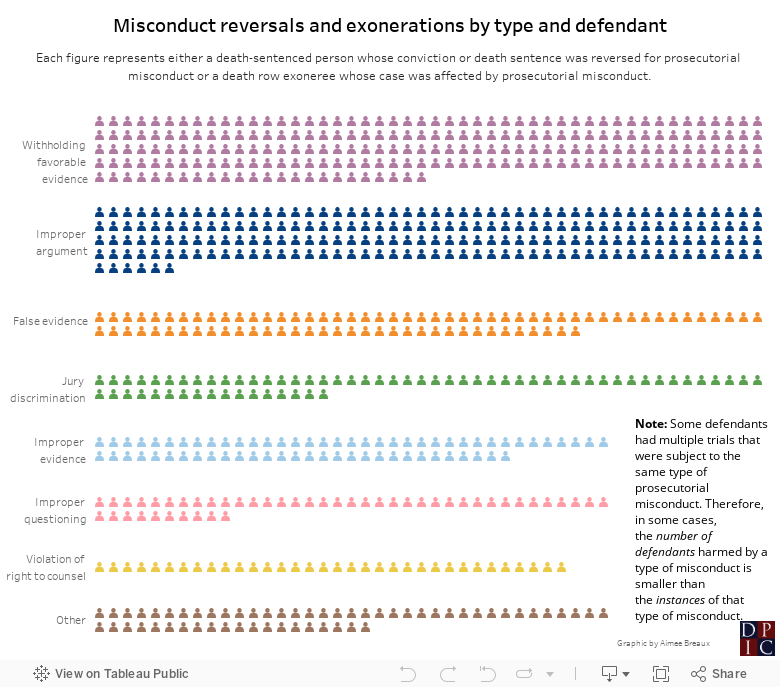
Prosecutorial misconduct can take many forms. The most well-publicized type of misconduct involves the withholding of potentially exculpatory evidence, in violation of the U.S. Supreme Court case, Brady v. Maryland. It can also encompass the exclusion of people of color from juries, in violation of Batson v. Kentucky. All-white and nearly all-white juries have been found to be more conviction-prone and more likely to impose death sentences.
Misconduct can also taint the evidence presented in a case, especially when witnesses are coerced or threatened into testifying, or when prosecutors knowingly present false witness testimony or false or inflammatory argument to the jury. Prosecutors are required to disclose any benefits offered to witnesses, including promises of reduced charges or sentences or other favorable treatment. They can violate the defendant’s rights and deprive the jury of needed information by withholding this information.
At Issue
While a growing number of prosecutors’ offices have begun to address misconduct through reform measures and conviction integrity units, misconduct continues to affect a significant number of cases. Many defendants who were convicted or sentenced to death as a result of undisclosed or unredressed misconduct have already been executed, and others face the difficult task of convincing a court not only that misconduct took place, but that it was harmful to their case. By its nature, much prosecutorial misconduct — especially Brady violations — involves concealment, and ongoing attempts to keep the misconduct hidden mean that defendants lack the evidence to prove that their convictions were unconstitutionally obtained through improper means.
What DPIC Offers
DPIC has compiled resources and studies from academic researchers and organizations like the Columbia Law School Broken System study, the Habeas Assistance Project, the Fair Punishment Project, and the National Registry of Exonerations. DPIC’s groundbreaking 2013 report, The 2% Death Penalty, highlights some of the ways in which overuse of capital punishment is linked to prosecutorial overreach and misconduct.
DPIC has identified more than 600 prosecutorial misconduct reversals and exonerations in capital cases. This means that more than 6.3% of all death sentences imposed since 1972 have been reversed for prosecutorial misconduct or resulted in a misconduct exoneration. This group of cases provides only a glimpse of the prosecutorial misconduct that occurs in the death penalty context. The list does not include cases in which prosecutors committed misconduct but courts denied relief on grounds of supposed immateriality or harmless error. It also does not include misconduct reversals of capitally charged crimes that resulted in life sentences.
For more information on the cases included in this dataset, see DPIC’s background document here. See a list of the cases here. We welcome any additions or corrections. To correct an error or provide missing information, please notify us by email and send documentation of the correct information to prosecutorial-accountability@deathpenaltyinfo.org.
News & Developments
News
Jan 30, 2026
DPI Podcast 12:01 The Death Penalty in Context: Fair and Just Prosecution’s Aramis Ayala on the Death Penalty, Prosecutorial Discretion, and Conviction Integrity

In the January 2026 episode of 12:01: The Death Penalty in Context, DPI Managing Director Anne Holsinger speaks with Aramis Ayala, Executive Director of Fair and Just Prosecution. Ms. Ayala made history in 2016 as Florida’s first Black state attorney and later became the first Black woman in Florida to be nominated for state attorney general by a major party. In the podcast, she discusses her decision to not seek the death penalty, the reaction to her decision, and the…
Read MoreNews
Jan 22, 2026
“I Have Been Tricked Out of My Life”: Dallas Man Exonerated 70 Years After Execution
September 30, 1953 was an eventful night for 19-year-old Tommy Lee Walker. After catching a ride home from work at 6 p.m. — he didn’t have a car — he spent a few hours with friends in Exall Park near his home in Dallas. He then visited his girlfriend Mary Louise Smith, who was nine months pregnant. It seemed like the baby would come any minute, and sure enough, Mary Louise went into labor that night. Their son Ted was born in the early hours of October 1. Yet despite the many…
Read More
News
Jan 08, 2026
Georgia Court Halts Stacey Humphreys’ Execution to Weigh Clemency Board Member Conflict of Interest
On December 29, 2025, Fulton County Superior Court Judge Robert McBurney issued an order blocking the Georgia Board of Pardons and Parole (GBPP) from rescheduling a clemency hearing and setting a new execution date for Stacey Humphreys. Two weeks earlier, on December 15th the GBPP put Mr. Humphreys’ December 16th clemency hearing on hold“indefinitely,” leaving in limbo the status of his execution, scheduled for the following day. Judge McBurney issued the stay,…
Read MoreNews
Dec 19, 2025
U.S. Supreme Court Agrees to Hear Mississippi Death Penalty Case Alleging Race Based Jury Discrimination
The U.S Supreme Court announced on December 15, 2025, that it will hear the appeal of Mississippi death-sentenced prisoner Terry Pitchford, who has argued his constitutional rights were violated because of race discrimination during jury selection. Mr. Pitchford was sentenced to death nearly two decades ago for his role in the shooting death of Reuben Britt. At the center of Mr. Pitchford’s case is Doug Evans, a Mississippi district attorney whose conduct has drawn…
Read MoreNews
Dec 17, 2025
Ohio Prosecutors Dismiss Case Against Elwood Jones Nearly 30 Year After Wrongful Conviction
Hamilton County Prosecutor Connie Pillich formally dismissed the case against Elwood Jones on December 12, 2025, ending a nearly 30-year saga that saw Mr. Jones spend 27 years on Ohio’s death row for a murder he did not commit.“I did not take this extraordinary step lightly,” said Prosecutor Pillich.“But after reviewing the evidence, I am not convinced that Mr. Jones killed Rhoda Nathan.” Mr. Jones, now 57, was convicted and sentenced to death in 1996 for the 1994 murder…
Read More