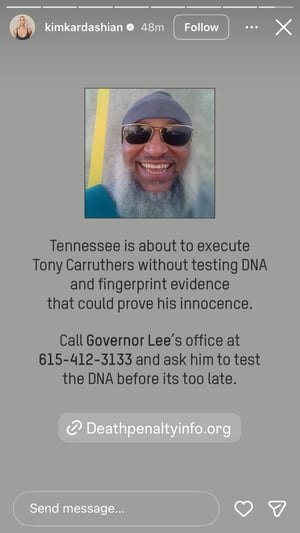
Tennessee’s attempt to execute Tony Carruthers on May 21, 2026, failed after execution team members could not establish an intravenous line after more than an hour of attempts, prompting Governor Bill Lee to grant a one-year reprieve. In a written statement, the Tennessee Department of Corrections said medical personnel had quickly established a primary IV line but were unable to establish a backup line as required by the state’s execution protocol. Efforts to insert a central line also failed, and officials called off the execution.
According to counsel for Mr. Carruthers, execution team members punctured him more than a dozen times while repeatedly attempting to establish an IV line before the execution was stopped. Maria DeLiberato, one of Mr. Carruthers’ attorneys who was in the execution chamber, said she saw Mr. Carruthers “wincing and groaning” while officials attempted to find a vein, calling it “horrible” to watch, and telling the media they “should have been in that room with” her to witness it.
“If the state of Tennessee is going to execute its own, there has to be full and complete transparency. There was no transparency here and this botched execution showed why there must be.”
Within hours of the botched execution, attorneys from the Federal Public Defender’s Office filed a new federal lawsuit naming Dr. Mark Walton Fowler as the physician tasked with establishing IV access and alleged he had not placed a central IV line in a patient in over a decade. In a deposition, Dr. Fowler stated he last placed a central line around 2013, when he worked in an emergency room, and that he had placed a dozen or more central lines during his career — one that ended with a guide wire in the patient’s carotid vein. Dr. Fowler confirmed in a deposition that he has no current hospital privileges, meaning no hospital has authorized him to practice or perform procedures at its facility.
The lawsuit seeks to prevent Tennessee from attempting to execute Mr. Carruthers a second time using IV methods unless the process is carried out by an individual qualified, licensed, and presently authorized by a medical facility to establish a central IV line. Assistant Federal Defender Amy Harwell, who represents Mr. Carruthers, told media of the broader problems underlying the state’s use of medical professionals in executions. “Most medical professionals do not participate in lethal injections because it violates their ethical obligation ‘to do no harm.’” Ms. Harwell also called on Gov. Lee to “launch yet another investigation into TDOC’s execution practices to determine how the Department came to rely on such incompetent, unethical, and unqualified medical professionals.”
Convicted and sentenced to death for his alleged involvement in the kidnapping and murder of Marcellos Anderson, Delois Anderson, and Frederick Tucker in 1994, Mr. Carruthers has consistently maintained his innocence, and no forensic evidence has ever connected him to the crime. Prosecutors relied almost entirely on the testimony of a jailhouse informant, who Mr. Carruthers’ counsel now knows was paid for his testimony. There is unidentified physical evidence from the crime scene, including fingerprints and an unknown male DNA profile which have never been analyzed despite many requests by Mr. Carruthers’ counsel. In addition to DNA testing, there are five fingerprints that were recovered from the crime scene that do not match Mr. Carruthers and remain unmatched at this time.
At trial, Mr. Carruthers was forced to represent himself because his trial judge became frustrated with his repeated dismissal of court-appointed counsel — which his counsel argued was “due to his longstanding and well-documented mental illness.” Mr. Carruthers did not ask to represent himself at trial and repeatedly requested legal representation. Post-conviction attorneys for Mr. Carruthers wrote in a 2019 filing that his performance at trial was “one of the most singularly inept, ineffective, and disastrous cross-examinations possible, one that seemed designed to secure not only a guilty verdict, but a death sentence.” Counsel for Mr. Carruthers have unsuccessfully argued that their client cannot legally be executed because of his severe mental illness. According to a filing from February 2026, Mr. Carruthers has a “pervasive and all-consuming obsession that a cabal of corrupt judges, prosecutors, and defense attorneys have conspired to secure his conviction and death sentence.” The filing also noted that Mr. Carruthers has called the Tennessee Federal Public Defender’s office as often as 300 times in one day.
With Gov. Lee’s one-year reprieve in effect, the ACLU has called Mr. Carruthers’ attempted execution “botched and torturous,” and continues to call for DNA testing of the remaining evidence. “Permitting Tony Carruthers’ execution to move forward without ordering DNA testing was already a profound injustice,” said Ms. DeLiberato. She added, “[t]oday, that injustice became outright barbaric after Mr. Carruthers was subject to a botched execution attempt.” Ms. Harwell told the press, “We ask the Governor once again to pause executions to ensure that the state is following its own rules and to implement appropriate oversight.”
Three more individuals are scheduled for execution in Tennessee in 2026: Anthony Hines (August 13), Christa Pike (September 30), and Gary Wayne Sutton (December 3).
- Bedard, H. (2026, May 26). Tennessee’s Botched Execution of Tony Carruthers Raises Questions About Medical Qualifications Among Concerns with Innocence and Due Process. Death Penalty Information Center. Retrieved October 15, 2026, from https://deathpenaltyinfo.org/tennessees-botched-execution-of-tony-carruthers-raises-questions-about-medical-qualifications-among-concerns-with-innocence-and-due-process
- Bedard, Hayley. “Tennessee’s Botched Execution of Tony Carruthers Raises Questions About Medical Qualifications Among Concerns with Innocence and Due Process.” Death Penalty Information Center. May 26, 2026. Accessed October 15, 2026. https://deathpenaltyinfo.org/tennessees-botched-execution-of-tony-carruthers-raises-questions-about-medical-qualifications-among-concerns-with-innocence-and-due-process.
- Bedard, Hayley. “Tennessee’s Botched Execution of Tony Carruthers Raises Questions About Medical Qualifications Among Concerns with Innocence and Due Process.” Death Penalty Information Center, 26 May 2026, https://deathpenaltyinfo.org/tennessees-botched-execution-of-tony-carruthers-raises-questions-about-medical-qualifications-among-concerns-with-innocence-and-due-process. Accessed 15 Oct. 2026.
Caleb Wethington, Attorneys pushing for Gov. Lee to pause executions in TN after botched lethal injection, WSMV, May 25, 2026; Steven Hale, Questions Raised About the Doctor Who Was Overseeing Tony Carruthers’ Execution, Nashville Banner, May 22, 2026; Steve Mehling, Doctor in botched Tennessee execution had not placed central line in 13 years, court filing alleges, WSMV, May 22, 2026; Mikeie Honda Reiland, Steven Hale, and Steve Cavendish, Tony Carruthers’ Execution Delayed After Doctor Unable to Administer IV, Nashville Banner, May 21, 2026; Holly Lehren, Jason Lamb, Nikki Hauser, Gov. Bill Lee grants one-year reprieve after halted execution of Tony Carruthers, NewsChannel5, May 21, 2026.


