Introduction
False statements by government officials. Media witnesses banned from viewing executions. New laws passed to evade judicial review. During the first six months of 2026, the Death Penalty Information Center documented new efforts to conceal critical details about the death penalty — even as some government officials sought to increase and expand its use.
These efforts are best understood when the truth about the death penalty and executions is viewed as a threat to its acceptance — an observation first made fifty years ago this month, by U.S. Supreme Court Justice Thurgood Marshall:
“[T]he American people know little about the death penalty, and [] the opinions of an informed public would differ significantly from those of a public unaware of the consequences and effects of the death penalty.”

The Supreme Court’s landmark ruling in Gregg v. Georgia (1976) marked the beginning of the modern death penalty era. It authorized the resumption of executions after a four-year pause and established new legal protections and procedures to guide sentencing determinations. These changes, the Court said, would ensure consistency and fairness in death penalty cases. But fifty years later, the data show that neither assurance was accurate.
DPI’s data show that when the death penalty is used, there is racial bias, error, and arbitrariness in the outcomes. The first six months of 2026 show a continuation of these persistent themes, even as secrecy and legislative efforts to expand the death penalty have increased. But as Justice Marshall predicted, the facts about the death penalty are making an impact that can clearly be seen in the rejection of new death sentences by juries and declining public support.
Here are the headlines for the first six months of 2026.
12 new death sentences were imposed in seven states; fewer death sentences were imposed by unanimous juries.
In the first half of 2026, 12 people were sentenced to death, in line with last year’s sentencing rates. Only seven of them were imposed by unanimous juries, continuing a trend DPI has been closely tracking. In the first six months of the year, Florida juries once again imposed the highest number of new death sentences (4), none of which were unanimous; Florida imposed five new death sentences in all of 2025. Juries in Arizona and Texas each imposed two new death sentences. California, Missouri, Nebraska (judge imposed), and North Carolina each had one new death sentence.
Capital juries chose life sentences more often than death—at least 19 times this year.
Sixteen of the life sentences imposed by capital juries in the first half of 2026 came from Alabama and Florida — the only two states that allow non-unanimous juries to make capital sentencing determinations. In Florida, death can be imposed with the agreement of just eight out of 12 jurors. In Alabama, 10 are required. Yet even with those lowered thresholds — and decisions made by death-qualified jurors who have indicated their willingness to impose death sentences — juries chose life sentences more often than they chose death. Though prosecutors in Alabama sought the death penalty more often than prosecutors in any other state, no one was sentenced to death in Alabama in the first half of 2026.
New secrecy laws hide critical details about the death penalty from the public.
Two states expanded their secrecy policies in 2026, joining other states with secrecy provisions that prevent the public from understanding critical details about how their elected officials are using the death penalty. Kentucky legislators overrode a veto by Governor Andy Beshear to enact a law that allows execution protocols to bypass the state’s usual administrative regulations. The state has not performed any executions since 2008.
Idaho, which attempted to resume executions in 2024 but ultimately failed to set an IV line to execute Thomas Creech, passed new legislation to further shield its execution procedures from public scrutiny. The new law states that execution procedures are not subject to judicial review under Idaho’s Administrative Procedure Act (APA), which lays out the standards government agencies must follow when adopting new rules to ensure public participation, transparency of decision-making, and accountability for decision-makers.
A divided 7th Circuit Court of Appeals upheld Indiana’s law and department of corrections policy that generally prohibits journalists from witnessing executions. In her dissent, Judge Candace Jackson-Akiwumi argued that executions occupy a unique place in constitutional law because they involve the state’s ultimate exercise of power. “A government exercises its greatest power when it ends a person’s life,” she wrote. “As I see it, such severe and irreversible punishment on behalf of ‘the people’ must be observable to comply with the Constitution.” An appeal is pending.
The U.S. death row population is the lowest since the 1980s.
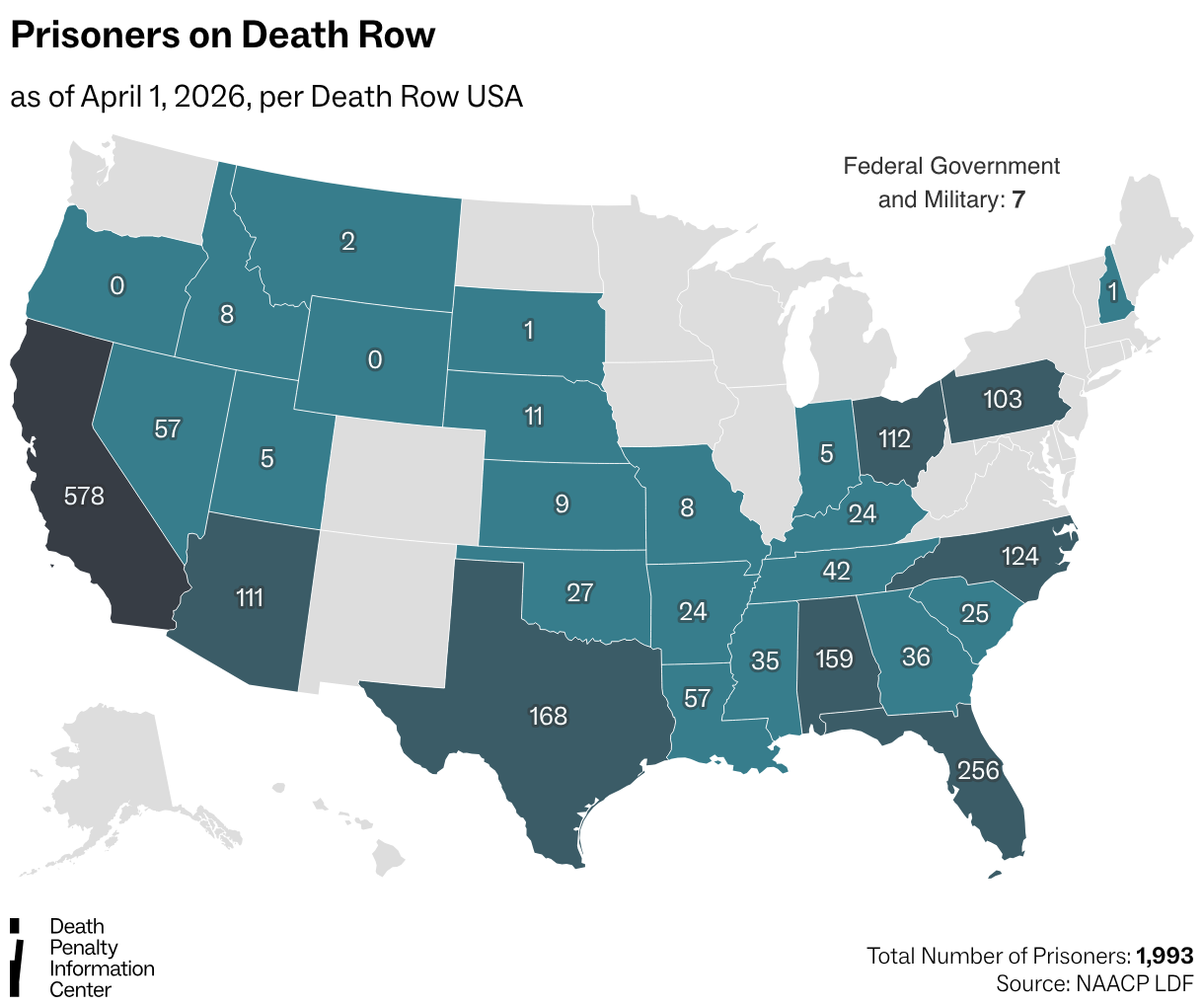
In June, the Legal Defense Fund (LDF) reported that the U.S. death row population has dropped below 2,000 people for the first time since the 1980s. The 1,993 people currently sentenced to death represent a 47% decline from the peak of 3,726 in 2001. In a press release, LDF explained, “Despite government efforts to expand death-eligible offenses, introduce new methods of execution, and accelerate executions, the Spring 2026 report shows the removal of individuals through resentencing, judicial reversals, and declining imposition of new death sentences is helping to shrink the death row population.” Research by University of North Carolina-Chapel Hill Professor Frank Baumgartner and DPI has found that the most likely outcome for a death sentence is that it will be overturned and the prisoner will be given a sentence less than death.
Early trends suggests fewer executions than 2025; largely in the South and occurring in just 4 states.
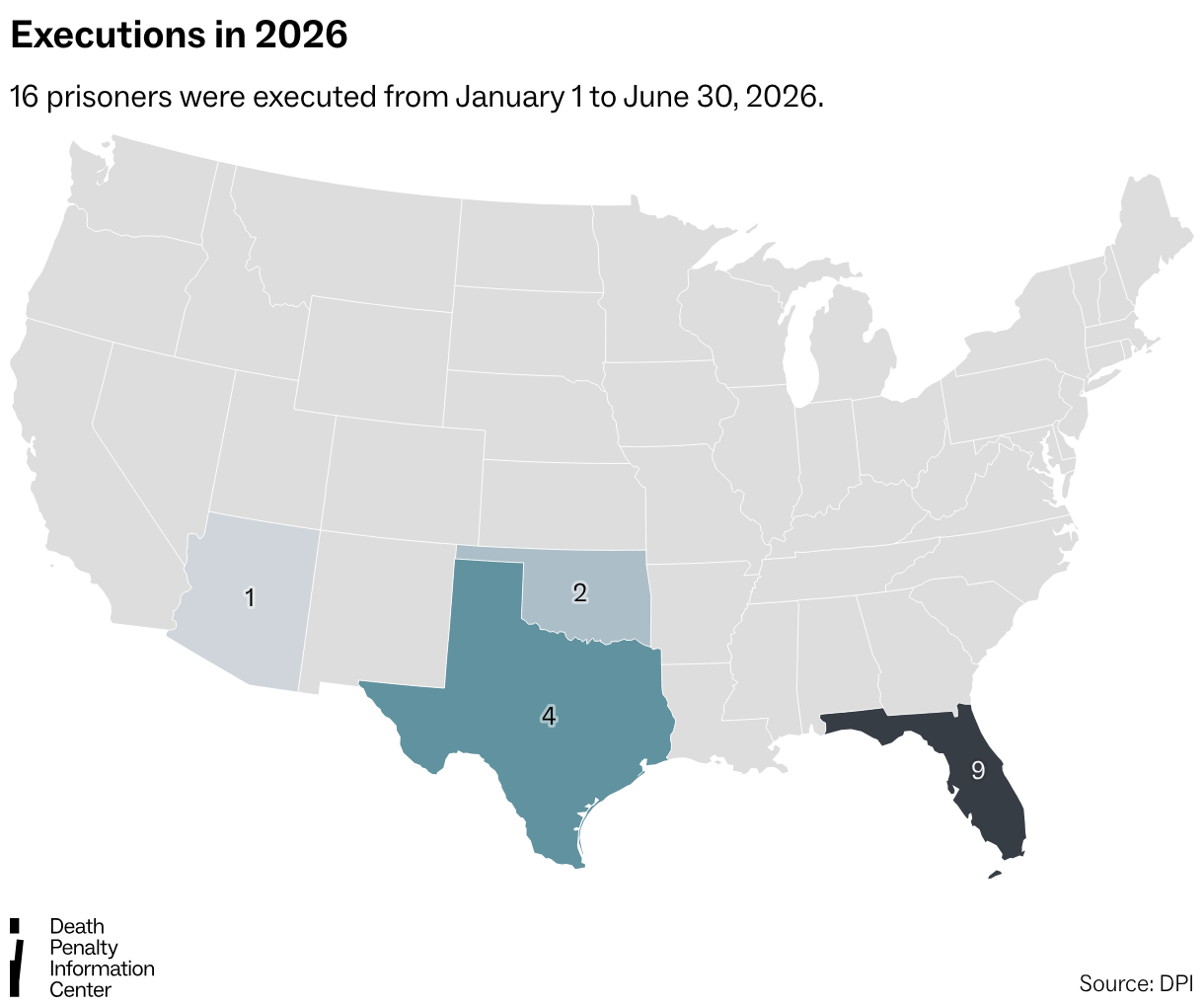
The 16 executions so far in 2026, compared to 25 at this same time last year, took place in just four states: Arizona (1), Florida (9), Oklahoma (2), and Texas (4). Florida has now executed more people this year than all other states combined, similar to last year’s pace. While 27 states legally permit the death penalty, 10 of them have not executed anyone in the last decade or more.
All but one of this year’s executions (94%) took place in southern states. In the last 50 years, 82% of executions have taken place in the South.
The same four states that carried out executions so far this year were also responsible for eight of the twelve new death sentences (67%). Oklahoma was the only state to execute someone but not impose any new death sentences.
Racial bias remains evident in executions, both in the race of defendants and victims.
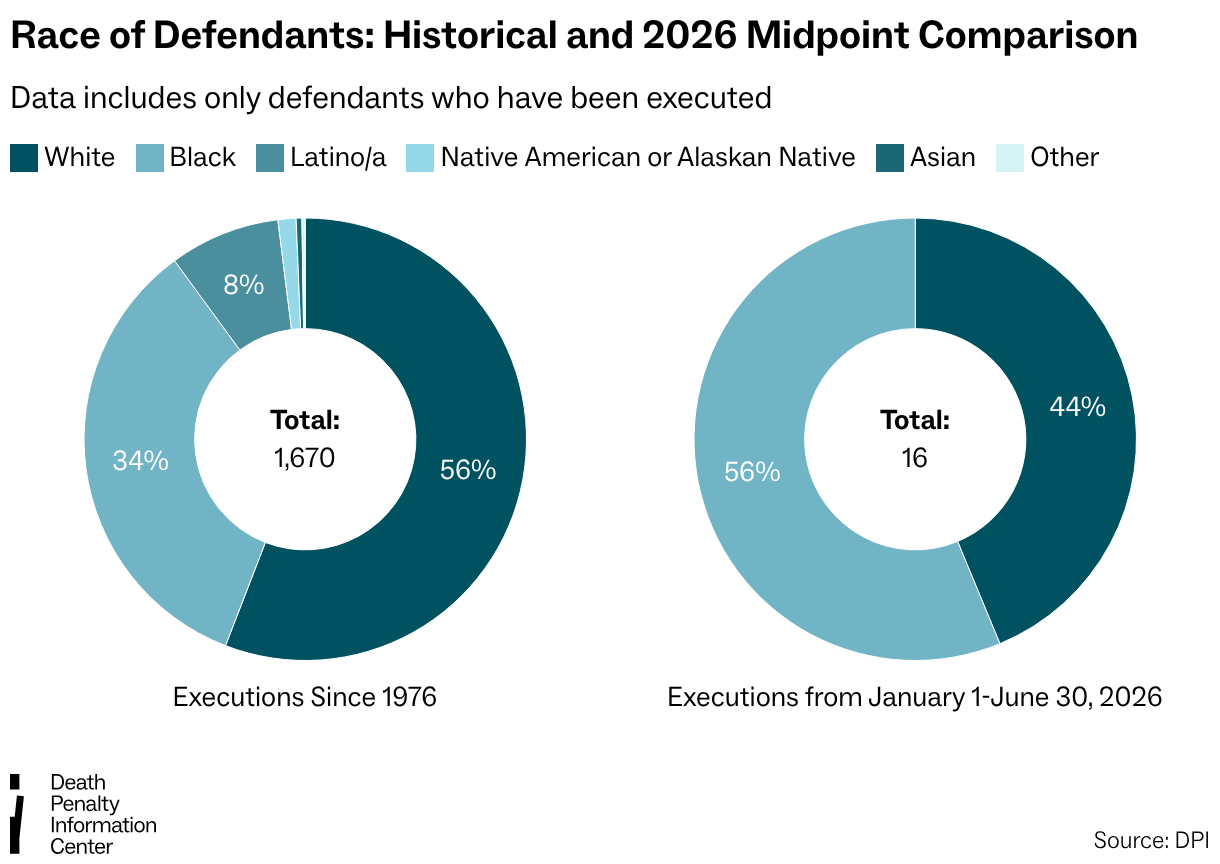
Nine of the 16 (56%) people executed in the first six months of 2026 were Black. This percentage is higher than the overall percentage of Black defendants executed (34%) or those currently on death row (40%).
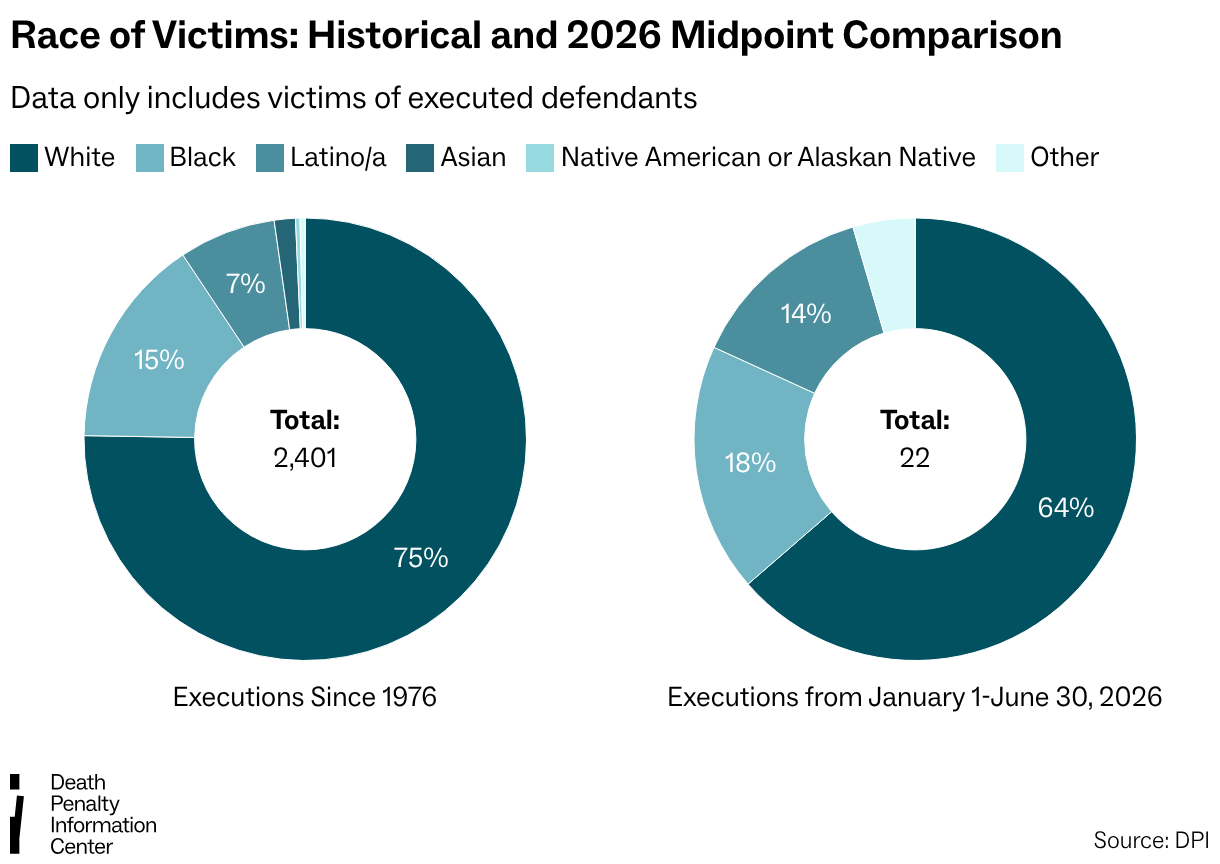
The 16 people executed were convicted of killing a total of 22 victims. Of those victims, 64% (14) were white, though white people make up only about 50% of murder victims nationwide. While five Black prisoners were executed for killing only white victims, no white prisoner was executed for killing any Black victims. One white prisoner (Leroy McGill in Arizona) was executed for killing a Latino victim. This white victim preference has been persistent throughout the history of the death penalty in the U.S. Since 1976, 75% of victims in cases that resulted in an execution have been white.
Alabama’s nitrogen gas protocol was found unconstitutional, and Idaho’s primary execution method is now a firing squad.
Alabama was the first state to use nitrogen gas to execute prisoners, and in every execution using this protocol, witnesses observed signs indicating that prisoners were experiencing pain and distress. Jeffery Lee, a death-sentenced Alabama man whose judge overrode the jury’s recommendation for a life sentence, challenged the state’s nitrogen gas protocol in May. In June, after a remand from the 11th Circuit Court of Appeals, a federal district court judge held that the protocol violated the 8th Amendment’s prohibition against cruel and unusual punishment and “permanently enjoined” the state from using it to execute Mr. Lee. The state has appealed the injunction but has now indicated it will execute Mr. Lee using lethal injection. This is the first time a federal court has found a method of execution to be unconstitutional under the current Baze-Glossip legal standard.
Idaho’s new law adopting the firing squad as its primary execution method went into effect on July 1st, following the completion of a new execution chamber that cost almost 1 million dollars. Executions will be carried out by volunteer law enforcement personnel.
A Tennessee prisoner with a strong claim of innocence and untested DNA evidence survived a botched execution.
Tony Carruthers has consistently maintained his innocence throughout his more than 30 years on Tennessee’s death row. At his trial, prosecutors relied almost entirely on the testimony of a paid jailhouse informant. DNA collected from the crime scene has never been compared to another suspect in the case. Ahead of his scheduled May 21 execution date, more than 130,000 people signed petitions calling for clemency.
Tennessee proceeded with Mr. Carruthers’ execution, but after an hour of attempting and failing to set an IV line, the execution was called off and Governor Bill Lee issued a one-year reprieve. Maria DeLiberato, an attorney for Mr. Carruthers who witnessed the state’s failed attempt to execute him, said, “Permitting Tony Carruthers’ execution to move forward without ordering DNA testing was already a profound injustice. Today, that injustice became outright barbaric after Mr. Carruthers was subject to a botched execution attempt.” It was the 64th botched execution in the modern death penalty era.
U.S. Supreme Court ignores death penalty cases with serious innocence claims.
Texas prisoner Charles Flores sought to challenge the use of hypnotized witness testimony in his case. The U.S. Supreme Court on June 15 declined to review his appeal, which argued that his conviction should be overturned under Texas’ junk science statute, Article 11.073, which allows prisoners to challenge convictions that rely on outdated and/or disproven science. Mr. Flores was convicted and sentenced to death for the 1998 robbery and murder of Elizabeth “Betty” Black in her Texas home. He was convicted based on the testimony of Jill Barganier, one of Mrs. Black’s neighbors, who did not identify Mr. Flores until she was hypnotized by police — 13 months after the crime occurred. Texas courts have refused to grant relief to Mr. Flores, despite the fact that no DNA or physical evidence has ever tied him to the crime.
On March 23 the Court denied review to Rodney Reed, another Texas prisoner with a longstanding innocence claim. Mr. Reed, who is Black, was convicted and sentenced to death for the 1996 strangulation of Stacey Stites, a young white woman. Mr. Reed has argued that Ms. Stites’ fiancé Jimmy Fennell killed her because she and Mr. Reed had a consensual relationship. Yet the state has long fought Mr. Reed’s request for DNA testing, even after the Court ruled in Mr. Reed’s favor in 2023. The Court declined review of his latest appeal over a dissent from the three liberal justices, who wrote that “[i]t is inexplicable why the [DA’s office] refuses to allow DNA testing of the belt that was used to kill Stites, despite the very substantial possibility that such testing could exculpate Reed and identify the real killer…the State will likely execute Reed without the world ever knowing whether Reed’s or Fennell’s DNA is on the murder weapon, even though a simple DNA test could reveal that information.”
Political rhetoric and misinformation drive current use of the death penalty.
On both the federal and state level, decisions about whether and how to use the death penalty are determined by elected officials. In Florida, Governor Ron DeSantis has been given complete discretion to set execution dates and select the prisoners who will be executed without providing any rationale. The state has dramatically increased executions, setting a record of 19 executions in 2025. In the first six months of 2026, Florida has executed more people (9) than in any previous full year except 2025.
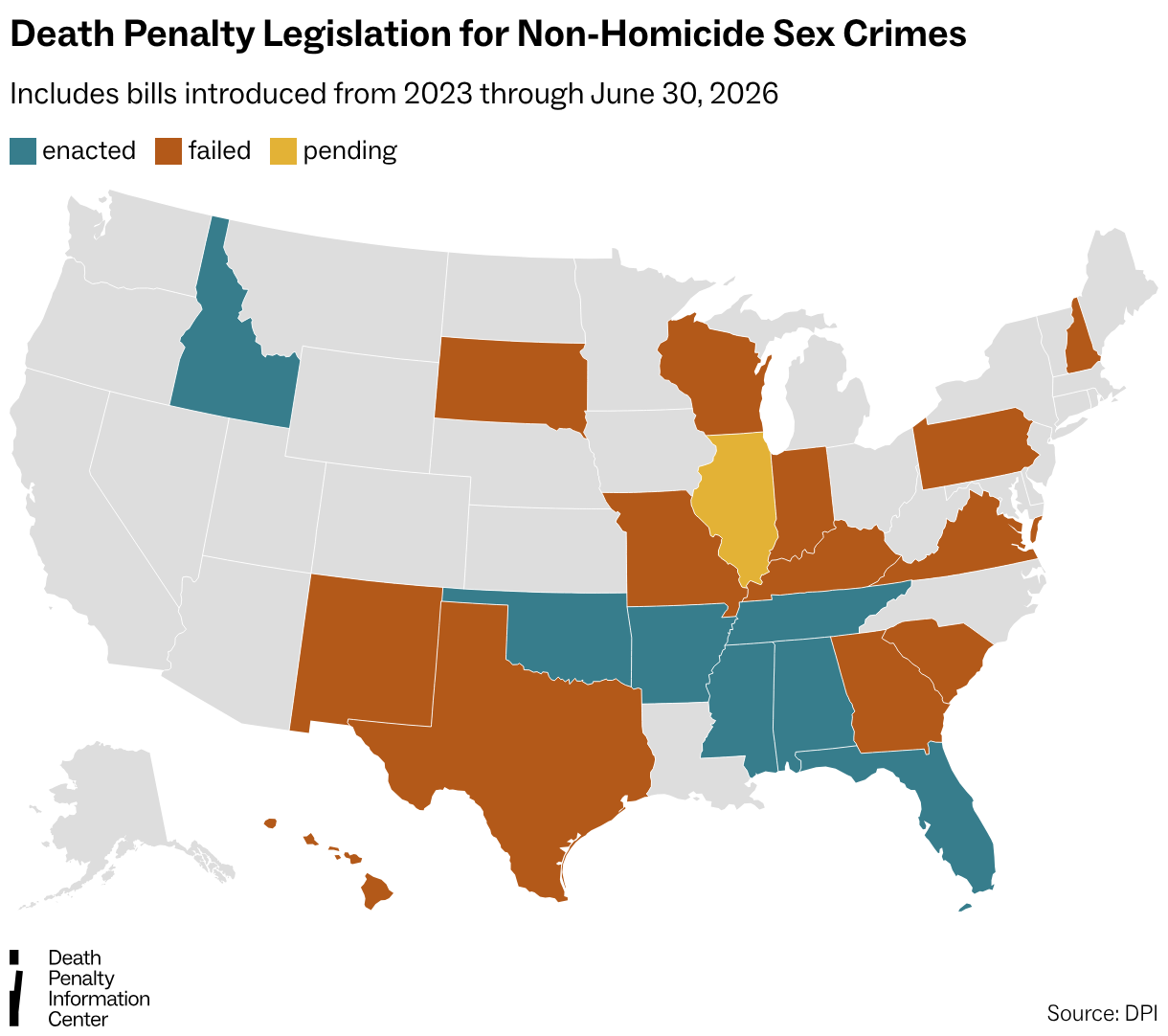
State legislators in Alabama and Mississippi passed bills in February and April this year making child rape a death-eligible crime. The U.S. Supreme Court’s 2008 decision in Kennedy v. Louisiana confirmed that crimes can only be death-eligible if the victim is killed. These new laws, which were passed in five other states over the last three years, are intended to directly challenge that legal precedent. In twelve other states, similar legislation has been proposed and defeated. Mississippi State Representative Jansen Owen (R – Lamar, Pearl River) told a local news outlet that this legislation was introduced at the suggestion of the White House as part of a coordinated national effort to create circumstances for the Supreme Court to revisit Kennedy. Mississippi’s law also introduces non-unanimity, allowing a death sentence for child rape with the agreement of only eight jurors. Death sentences for homicide in Mississippi must be unanimous.
The Trump Administration announced new plans to expand and speed up the federal death penalty, touting debunked deterrence theories and claiming, despite contrary evidence, that there is broad public support for its efforts. In April, the Department of Justice (DOJ) issued a report calling on the Federal Bureau of Prisons (BOP) to reinstate use of a single-drug (pentobarbital) execution protocol, and urged Congress to enact a sweeping legislative agenda. Among the report’s proposals are the use of the firing squad, electrocution, and lethal gas — methods it uncritically presents as constitutional, misrepresenting the history and judicial decisions surrounding those methods.
In March, the DOJ also proposed a new set of regulations intended to fast-track death penalty appeals by shortening filing deadlines and curtailing federal court review. The rule as currently proposed allows the Attorney General to certify states that can use these fast-track proceedings based only on the assertions of state officials that they provide competent attorneys to prisoners for their state post-conviction appeals — and by refusing to consider evidence that suggests otherwise. At least six states have submitted applications for certification, arguing that their post-conviction counsel systems qualified as of the included dates: Alabama (2016), Florida (2015), Mississippi (2000), Ohio (1996), Tennessee (1995), and Texas (1995). These states represent some of the most active death penalty states in the country, all of which have troubling evidence of inadequate or nonexistent counsel on appeal.
The federal government has also faced serious setbacks in its efforts to seek new federal death sentences. On January 30, a federal judge ruled that Luigi Mangione cannot face the death penalty in his upcoming trial for the murder of UnitedHealthcare CEO Brian Thompson. Two counts from his federal indictment were dismissed, one of which carried the death penalty as a potential sentence. Federal prosecutors had sought the death penalty under a federal firearms statute that allows a death sentence when a firearm is used in a homicide while a federal “crime of violence” is also committed. The underlying “crime of violence” that was alleged was stalking, but a U.S. District Judge found that it did not meet the definition.
The Department of Justice also attempted but failed to revive federal death prosecutions for a number of cases decided under the Biden Administration. In each of the cases, federal courts denied the DOJ’s request to seek a federal death sentence, indicating that the previous decisions made by the Biden Administration would stand. The DOJ has already indicated it will seek more federal death sentences in the first 18 months than it sought in the Trump Administration’s entire first term, including in several states that have abolished the death penalty.
Conclusion
In the 50 years since Gregg v. Georgia was decided, the death penalty has been shaped by political, cultural, and social forces. Throughout the 1980s and 90s, heated political rhetoric drove the passage of new “tough on crime” laws, and overzealous prosecution policies sent thousands to death row. Since the turn of the millennium, however, all indicators measuring the death penalty have trended down, shaped by the public’s awareness of continuing racism, errors, and arbitrariness, and new concerns about growing secrecy and cost. As a result, public support for the death penalty is now at its lowest point in 50 years.
It is too early to know whether the unusual uptick in executions in 2025 will repeat in 2026; at the six-month mark, there have been fewer executions (16) than there were in the first half of 2025. But one thing appears clear: the answer will largely depend on whether the decisions of elected politicians are guided by the values and wishes of their constituents — or made in furtherance of a political agenda.
DPI needs your support to continue its work! Please donate here.
- Death Penalty Information Center (2026, July 8). DPI’s 2026 Mid-Year Update: Jurors Continue to Reject Death Sentences Amidst Increased Secrecy and Disinformation. Retrieved October 19, 2026, from https://deathpenaltyinfo.org/dpis-2026-mid-year-update-jurors-continue-to-reject-death-sentences-amidst-increased-secrecy-and-disinformation
- Death Penalty Information Center. “DPI’s 2026 Mid-Year Update: Jurors Continue to Reject Death Sentences Amidst Increased Secrecy and Disinformation.” July 8, 2026. Accessed October 19, 2026. https://deathpenaltyinfo.org/dpis-2026-mid-year-update-jurors-continue-to-reject-death-sentences-amidst-increased-secrecy-and-disinformation.
- Death Penalty Information Center. “DPI’s 2026 Mid-Year Update: Jurors Continue to Reject Death Sentences Amidst Increased Secrecy and Disinformation.” Death Penalty Information Center, 8 July 2026, https://deathpenaltyinfo.org/dpis-2026-mid-year-update-jurors-continue-to-reject-death-sentences-amidst-increased-secrecy-and-disinformation. Accessed 19 Oct. 2026.


